
US grocery inflation eased again in November, but the latest data shows why food bills still feel stubbornly high in key supermarket aisles.
Figures released this month show US food-at-home inflation running at 1.9% year on year, well below recent peaks and far slower than price growth in restaurants. On the surface, that suggests relief is finally reaching grocery shoppers.
In practice, the pressure inside stores remains uneven — and highly visible where people spend most.
A slower headline hides uneven grocery pricing
The latest US Consumer Price Index confirms that grocery inflation is cooling overall. But beneath the average, price movements vary sharply by category.
Meat, poultry, fish and eggs remain one of the biggest pressure points, with prices still rising at more than double the overall grocery rate. Non-alcoholic beverages are also climbing steadily, driven by packaging costs, transport, and brand-led pricing strategies.
By contrast, dairy prices have fallen year on year, while fruit and vegetables are broadly flat, giving supermarkets limited but meaningful room to signal value in fresh categories.
This uneven pattern explains why many shoppers feel little relief at checkout — even as the headline number improves.
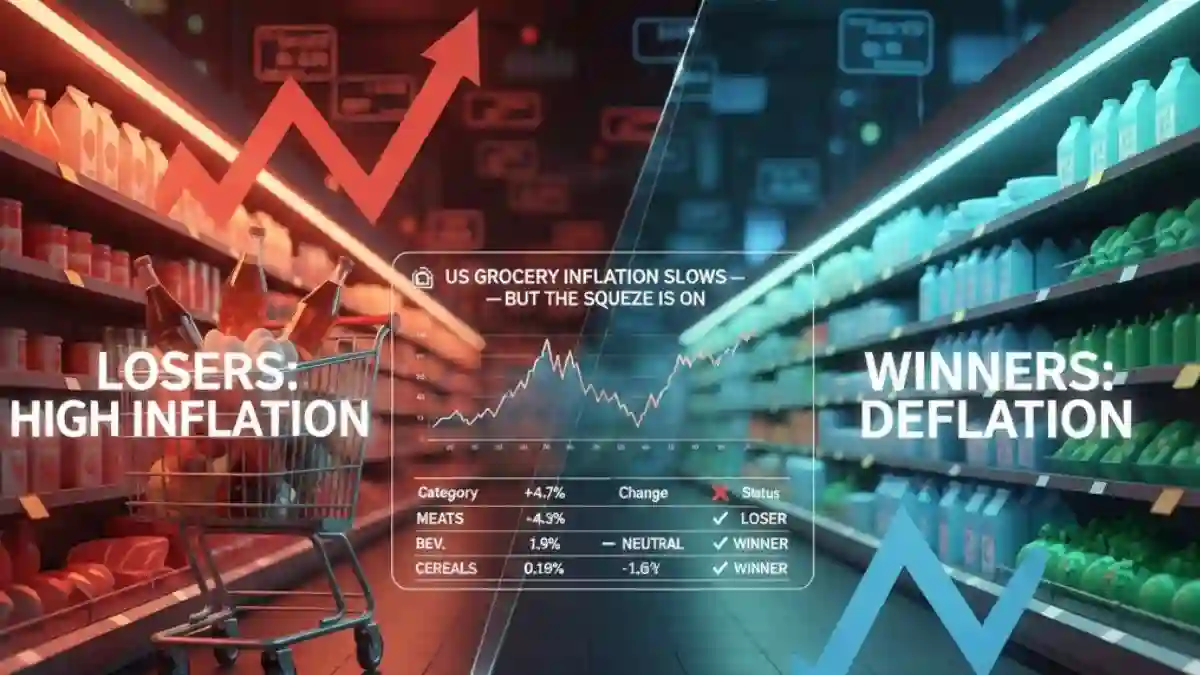
Grocery inflation winners and losers
While overall grocery inflation has slowed, the data shows a clear split between categories that continue to push bills higher and those finally easing.
| Grocery Category | 12-Month Change (Nov 2025) | Inflation Status |
| Meats, Poultry, Fish & Eggs | +4.7% | Loser – high inflation |
| Non-alcoholic Beverages | +4.3% | Loser – high inflation |
| Cereals & Bakery | +1.9% | Neutral |
| Fruits & Vegetables | +0.1% | Winner – stabilising |
| Dairy Products | -1.6% | Winner – deflation |
This split matters because shoppers experience inflation most strongly in high-frequency categories like meat and drinks. Relief in dairy and produce is real, but less noticeable — and therefore less emotionally convincing — at the checkout.
What this means inside grocery stores
For supermarkets, the slowdown is not about broad price cuts. It is about rebalancing the shop floor, supported by US retail technologyin supermarkets.
Retailers are increasingly relying on:
- Targeted promotions in inflation-heavy categories such as protein and beverages
- Private label expansion, especially where branded pricing has outpaced shopper tolerance
- Value signalling through categories where costs have stabilised, notably dairy
Margin pressure remains acute. Suppliers in high-inflation categories continue to push through increases, while retailers face rising resistance from shoppers who believe prices should now be falling.
Why grocery bills still feel high
The disconnect between official inflation data and shopper perception comes down to where and how often money is spent.
Consumers buy meat, drinks and staple groceries weekly — sometimes daily. When those items rise faster than the average, it creates the impression that “everything is more expensive,” even if some categories are quietly easing.
In short: inflation is felt most where spending is frequent, not where prices are falling.
Eating out keeps grocery value in focus
One reason supermarkets continue to win the value conversation is the widening gap between grocery and foodservice inflation.
While grocery prices are rising at under 2%, restaurant prices continue to increase at close to twice that pace. That keeps cooking at home financially attractive — reinforcing supermarkets’ role as the primary inflation buffer for US households.
For retailers, demand remains solid. Expectations, however, are higher. Shoppers want visible value, not just stable prices.
The tariff tax and the 2026 outlook
While domestic grocery inflation is cooling, shoppers are beginning to feel the pass-through costs of 2025 trade policies.
Tariffs introduced this year on a range of imported goods — including coffee, certain fruits, seafood, and packaging materials — have quietly reintroduced cost pressure into the food system. Recent estimates suggest tariff-related costs added around 0.7 percentage points to CPI earlier in 2025, offsetting some of the relief from easing supply chains.
For grocery retailers, this has created a two-track inflation environment:
- Domestic categories such as dairy and produce are easing
- Imported pantry staples remain structurally expensive
As the industry looks ahead, attention is turning to the Supreme Court’s upcoming decision on the International Emergency Economic Powers Act (IEEPA). If the current tariff regime remains in place, imported grocery staples are likely to stay inflation outliers into 2026 — even as headline food inflation cools further.
What happens next
Looking ahead, grocery inflation is expected to remain moderate but uneven.
Energy, labour, packaging and logistics costs are still structurally higher than pre-pandemic levels, limiting the scope for outright deflation. Any relief is likely to arrive slowly and unevenly — aisle by aisle rather than across the store.
- The 2026 forecast: USDA projections and major bank outlooks suggest US food-at-home inflation could ease further to around 1.2% in 2026. However, volatile categories such as beef and eggs may remain unstable due to herd size constraints and lingering avian flu impacts.
- The October data gap: October inflation data was never collected due to the 43-day federal government shutdown. November’s 2.7% headline CPI rate, down from 3.0% in September, is therefore the first clear signal in months that the slow return toward a 2% inflation environment is taking hold.
The next US inflation update, due in January, will be closely watched for signs that pressure in meat, beverages and imported staples is finally easing — or becoming a permanent feature of the grocery
FAQ
Are grocery prices going down in the US?
Overall grocery inflation has slowed to around 2% year on year, but prices are not falling across all categories.
Why does my grocery bill still feel high?
Because frequently bought items like meat and drinks are still rising faster than average, even as other categories stabilise.
Which grocery items are still increasing the most?
Meat, poultry, fish, eggs and non-alcoholic beverages remain the strongest sources of grocery inflation.
Is eating at home cheaper than eating out?
Yes. Grocery prices are rising much more slowly than restaurant prices, keeping home cooking the better-value option.
Editor’s note: October 2025 CPI data was unavailable due to the US federal government shutdown. November figures represent the first uninterrupted inflation reading since September and provide the clearest signal yet on the direction of grocery prices.