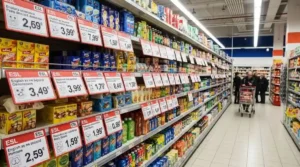

Armenia’s grocery retail market is moving through a structural shift that would have looked unlikely a decade ago. Large supermarket operators are expanding their store footprints, independent kiosks are losing share in major urban zones, and centralized retail management is becoming critical for profitability.
That pressure is changing how retailers invest in technology.
For supermarket groups operating across Yerevan and other growing commercial centers, spreadsheets and fragmented manual inventory systems are no longer enough. Multi-store retail networks now require synchronized warehouse management, localized ERP systems, supplier tracking, loyalty ecosystems, and store-level automation capable of handling rising SKU complexity and tighter margins.
The result is a rapidly evolving retail technology market built less around global software giants and more around localized operational systems designed specifically for Armenia’s retail environment.
What Drives Armenia’s Retail Technology Market?
The biggest driver is retail consolidation.
As large operators including Carrefour, Yerevan City, and SAS Group continue modernizing store networks, operational pressure increases across procurement, logistics, inventory control, and customer retention.
Retailers now need:
- centralized stock visibility,
- localized accounting compliance,
- automated supplier purchasing,
- integrated checkout systems,
- warehouse synchronization,
- and real-time loyalty management.
This has created strong demand for regional retail technology specialists that understand Armenia’s fiscal rules, supplier structures, and retail workflows better than many international enterprise software providers.
Top Retail Technology Providers in Armenia
| Rank | Company | Strategic Role | Market Focus |
|---|---|---|---|
| 1 | Armenian Software (AS / ՀԾ) | ERP and accounting backbone | Retail & enterprise |
| 2 | Como Code (Como Trade) | Supermarket operations and WMS | Grocery retail |
| 3 | TechRetail Armenia | Store automation and security | Hypermarkets & retail chains |
| 4 | Synergy International Systems | Enterprise analytics infrastructure | Multi-store retail groups |
| 5 | Emerging AI Retail Providers | Smart inventory and computer vision | Advanced retail automation |
1. Armenian Software (AS / ՀԾ)
Founded in the 1990s and headquartered in Yerevan, Armenian Software has become one of the country’s most influential enterprise software developers.
Its AS-Enterprise ecosystem operates as the financial and accounting backbone for a significant share of Armenia’s organized retail market.
While international ERP systems such as SAP or Microsoft Dynamics exist inside parts of the region, localized adaptation remains a major challenge. Armenian retailers operate under highly specific accounting rules, state reporting requirements, tax structures, and supplier documentation systems.
That is where AS maintains its dominance.
The company’s retail-focused modules, including AS-Trade and AS-Shop, are deeply integrated into local business operations. Grocery retailers use the platform for:
- accounting management,
- procurement tracking,
- supplier invoicing,
- warehouse coordination,
- payroll administration,
- and fiscal compliance.
For supermarket chains expanding across multiple locations, localized accounting precision matters just as much as inventory speed. A retailer can lose operational efficiency quickly if financial reporting systems fail to align with regional compliance frameworks.
This operational reality gives Armenian Software a major competitive advantage over larger global software vendors attempting to localize from outside the market.
2. Como Code (Como Trade)
If Armenian Software represents the financial backbone of Armenia’s retail market, Como Trade represents the operational engine running inside stores and warehouses.
Developed by Como Code, the platform has become one of the country’s most recognized retail management systems for grocery and supermarket operations.
Unlike broad enterprise software platforms, Como Trade was built specifically around real retail friction points.
Retailers do not simply need inventory records. They need systems capable of managing checkout lane traffic, fresh produce weighing integration, barcode scanning synchronization, expiry tracking, and supplier replenishment in real time.
Como Trade addresses these operational requirements directly.
The platform supports:
- POS integration,
- automated price updates,
- inventory monitoring,
- warehouse synchronization,
- customer loyalty management,
- and supplier purchasing automation.
Its warehouse management component, Como WMS, has become especially important as supermarket chains expand distribution complexity.
For grocery operators, warehouse inefficiency immediately impacts shelf availability, spoilage rates, and working capital pressure. Real-time stock visibility is no longer optional once retailers move beyond single-store formats.
The system also supports expiry-date monitoring for fresh and packaged goods, which is increasingly important as modern supermarkets expand fresh produce, chilled products, and private label ranges.
3. TechRetail Armenia
Retail modernization is not only about software.
As Armenia’s supermarket sector expands into larger-format retail environments, physical store infrastructure is becoming a much bigger investment category.
TechRetail Armenia operates at the center of that transition.
The company focuses on store automation, retail hardware integration, and loss-prevention systems. It also acts as a localized systems integrator for international retail security and automation brands including Checkpoint Systems and Sensormatic.
For growing supermarket chains, shrinkage prevention is becoming increasingly important.
As SKU counts rise and customer traffic increases, inventory loss can quickly pressure already thin grocery margins. Retailers therefore need stronger control over store movement, asset protection, and customer-flow visibility.
TechRetail Armenia supports this through:
- anti-theft systems,
- electronic article surveillance,
- people-counting systems,
- POS peripherals,
- access-control systems,
- and store monitoring infrastructure.
Foot-traffic analytics are also becoming commercially valuable.
Retailers increasingly use traffic measurement systems to understand customer movement patterns, optimize promotional placement, and improve checkout efficiency.
4. Synergy International Systems
Headquartered in the United States with major operational roots in Yerevan, Synergy International Systems occupies a different position within Armenia’s retail technology ecosystem.
The company is not primarily a checkout or POS software provider. Instead, it operates at the enterprise infrastructure level.
As supermarket groups scale, retail operations become increasingly data-heavy. Procurement teams, warehouse networks, finance divisions, supplier ecosystems, and multi-store operations all generate large volumes of operational information.
Managing that complexity requires stronger cloud infrastructure and enterprise-level analytics systems.
Synergy specializes in:
- cloud platforms,
- enterprise databases,
- analytics dashboards,
- business intelligence systems,
- and large-scale operational data integration.
This type of infrastructure becomes particularly valuable once retailers expand beyond isolated stores into centralized retail networks.
5. Emerging AI Retail Solution Providers
Armenia’s next retail technology phase is increasingly connected to artificial intelligence and computer vision.
Rather than one dominant software company, this category consists of a growing ecosystem of local AI engineering teams, boutique development labs, and custom automation specialists operating mainly out of Yerevan.
Retailers are now beginning to test how these capabilities can improve operational efficiency inside stores and warehouses.
Current development areas include:
- empty shelf detection,
- computer-vision inventory monitoring,
- predictive replenishment systems,
- customer behavior analytics,
- and personalized loyalty integrations.
Fresh produce departments are becoming a major testing area for AI-assisted inventory management because spoilage pressure remains high across grocery retail.
Why Armenia’s Grocery Retail Sector Is Changing So Quickly
The technology story is ultimately a retail consolidation story.
For years, Armenia’s grocery market remained heavily fragmented, dominated by smaller independent operators and neighborhood-format retail stores.
But organized retail chains are now gaining stronger market share, especially in Yerevan.
As supermarkets scale, operational complexity rises sharply.
A single large-format grocery store may manage:
- tens of thousands of SKUs,
- multiple supplier relationships,
- fresh produce logistics,
- private label inventory,
- loyalty systems,
- and synchronized pricing updates.
Manual processes cannot support that environment efficiently.
This is why localized retail technology providers are becoming strategically important. They are not simply selling software. They are enabling the industrialization of Armenia’s grocery retail economy.
Industry Outlook
Armenia’s retail technology market will likely continue shifting toward integrated operational ecosystems rather than isolated software deployments.
Retailers increasingly want:
- unified inventory visibility,
- centralized supplier coordination,
- loyalty integration,
- warehouse synchronization,
- and predictive operational analytics.
AI-driven retail automation will also become more visible, particularly in:
- inventory forecasting,
- shrinkage reduction,
- shelf monitoring,
- and customer analytics.
What Happens Next
Editor’s Note: This report focuses on operational retail technology providers directly connected to supermarket management, warehouse systems, retail automation, and grocery infrastructure inside Armenia’s organized retail sector. The analysis prioritizes real operational relevance over broader telecom or outsourcing classifications commonly included in generic technology rankings.