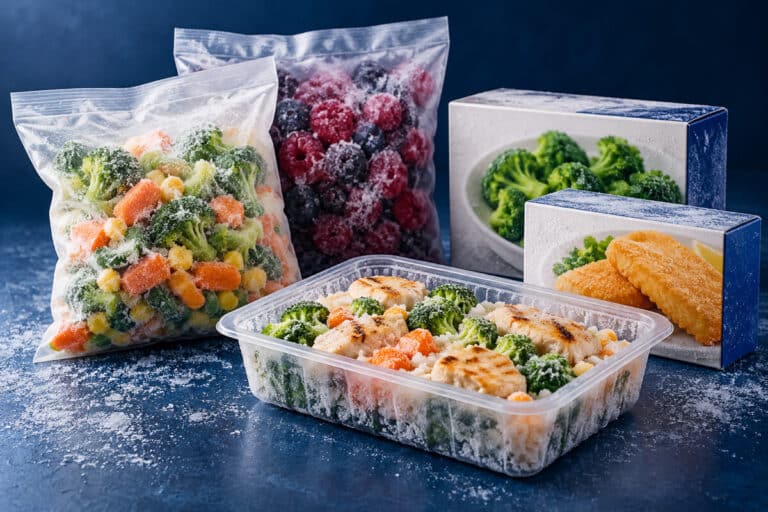

Frozen food packaging has to perform in conditions that expose weak materials quickly. Films can become brittle. Seals can fail. Cartons can absorb moisture. Trays need to survive freezing, transport, stacking and, in many cases, reheating.
Six European suppliers stand out for explicit frozen-food packaging capability: Amcor, Mondi, Coveris, Faerch, Discovery Flexibles and Polystar Plastics.
They cover different formats. Amcor supplies films, pouches, containers and rigid formats. Mondi combines flexible barrier papers with corrugated and solid-board packaging for deep-freeze applications. Coveris produces flexible films and recyclable mono-material structures. Faerch specialises in rigid trays, including freezer-to-oven CPET. Discovery Flexibles manufactures specialist frozen-food flow wrap and pouches. Polystar Plastics produces freezer film for supermarket and food-manufacturing applications.
: Amcor and Coveris are strongest where large frozen-food manufacturers need high-volume flexible packaging. Mondi offers one of the broadest paper and board alternatives. Faerch is especially strong in rigid freezer-to-oven trays. Discovery Flexibles and Polystar Plastics provide specialist UK-made flexible solutions for frozen vegetables, meals, meat, seafood and other freezer categories.
Top frozen food packaging suppliers in Europe
| Supplier | Main frozen formats | Main strength |
|---|---|---|
| Amcor | Films, laminates, pouches, tubs, containers and lids | Large global food-packaging platform with dedicated frozen range |
| Mondi | Flexible papers, bags, corrugated and solid-board boxes | Paper-based and fibre-led deep-freeze packaging |
| Coveris | Flexible films, pre-zipped bags, mono-material packs | Low-temperature sealing and recyclable frozen-food structures |
| Faerch | CPET and PP trays | Freezer-to-oven and freezer-to-microwave ready-meal packaging |
| Discovery Flexibles | Flow wrap, pouches and printed films | Specialist high-barrier frozen-food flexible packaging |
| Polystar Plastics | Freezer films and custom polythene packaging | Made-to-order freezer film for retailers and manufacturers |
Why frozen food packaging is technically difficult
Frozen food is stored at very low temperatures for long periods.
Packaging that works at room temperature can fail in a freezer.
Common problems include:
- film becoming brittle;
- seal cracking;
- puncture damage;
- carton weakening from condensation;
- freezer burn;
- moisture loss;
- oxygen entering the pack;
- ink or print damage;
- poor opening at low temperature.
A successful pack therefore has to protect the food throughout filling, freezing, storage, distribution, supermarket merchandising and consumer use.
For some products, that final consumer use includes moving directly from the freezer into an oven or microwave.
That creates another layer of material performance.
How we selected the six suppliers
We only included companies with clear frozen-food packaging products or applications.
Our criteria were:
- explicit frozen-food packaging capability;
- European manufacturing or customer support;
- food-contact expertise;
- commercial scale or specialist technical depth;
- current product ranges;
- relevance to supermarket and FMCG supply.
General packaging companies were excluded if their frozen-food capability could not be verified directly.
1. Amcor
Amcor is one of the largest packaging companies serving the global food industry and has a dedicated frozen-food packaging portfolio.
What frozen packaging does Amcor supply?
Amcor’s frozen-food range includes:
- flexible films;
- laminates;
- pouches;
- bags;
- containers;
- tubs;
- pots;
- lids;
- other rigid and flexible formats.
This breadth makes Amcor relevant across frozen vegetables, meals, meat, seafood, bakery and desserts.
Why flexible packaging matters in frozen food
Frozen vegetables and fries often use vertical form-fill-seal bags.
The film needs to remain flexible at freezer temperatures while running at high speed on packing machinery.
Important properties include:
- puncture resistance;
- low-temperature toughness;
- strong seals;
- print quality;
- moisture protection;
- easy opening.
High-barrier packaging
Some frozen products need more protection than others.
Fatty foods, meat, seafood and premium ready meals can benefit from higher oxygen barrier.
Amcor’s wider film and laminate portfolio allows structures to be tailored to product sensitivity.
Recyclability
Amcor has been developing recycle-ready mono-material structures to replace more complex laminates.
The challenge is maintaining freezer performance while simplifying material construction.
Company scale
Amcor is a large publicly traded international packaging group.
Its global revenue and market capitalisation cover many industries and should not be presented as European frozen-food packaging revenue.
Market share
No current audited percentage share of Europe’s frozen-food packaging market is publicly disclosed.
Why Amcor matters
Its biggest advantage is scale and material breadth.
A multinational frozen-food producer can work with Amcor across several countries, products and packaging formats.
2. Mondi
Mondi is one of Europe’s most important paper and flexible-packaging groups.
Frozen food is an explicit application across both its paper-based and corrugated packaging portfolios.
Frozen food packaging range
Mondi offers:
- functional barrier papers;
- flexible bags;
- solid-board boxes;
- corrugated boxes;
- protective liners;
- bulk packaging;
- deep-freeze transport packaging.
FunctionalBarrier Paper
Mondi’s FunctionalBarrier Paper range is designed to replace some plastic structures with fibre-based packaging.
The company offers barrier levels adapted to different products.
For frozen food, the material can provide:
- water-vapour resistance;
- moisture protection;
- grease resistance;
- sealability;
- printability;
- paper-stream recyclability.
Solid board for frozen food
Mondi also manufactures solid-board boxes designed for deep-freeze conditions.
Frozen products can create condensation and high humidity during distribution.
Conventional weak board can lose compression strength.
Deep-freeze board therefore needs stronger moisture resistance.
Corrugated logistics
Frozen food still needs secondary and transport packaging.
Mondi’s expanded food portfolio includes boxes for frozen applications, while Octabin solutions can be used in cold-chain operations for products such as frozen berries and peas.
Paper versus plastic
Mondi’s strongest differentiation is its fibre expertise.
Not every frozen product can move to paper packaging, but certain bags and cartons can reduce plastic use while still protecting the product.
Scale and valuation
Mondi is publicly listed.
Group revenue and valuation cover packaging and paper activities across many sectors.
Why Mondi matters
Its combination of primary and secondary packaging gives frozen-food manufacturers several options inside one group.
A business can develop the consumer pack and the outer transport case around the same cold-chain requirements.
3. Coveris
Coveris is a major European flexible-packaging manufacturer with explicit frozen-food capability.
The company operates multiple plants across Europe and supplies food manufacturers and retailers with printed films, bags and other flexible formats.
Low-temperature sealing
Frozen packaging often needs strong sealing at relatively low temperatures on fast form-fill-seal equipment.
Coveris offers pre-zipped films that seal at low temperature and are specifically described as suitable for frozen food.
Frozen applications
Coveris products can be used for:
- frozen vegetables;
- frozen fruit;
- frozen meat;
- frozen meals;
- other freezer products.
MonoFlex
Coveris has developed mono-material packaging under its MonoFlex families.
These structures aim to improve recyclability without sacrificing:
- seal quality;
- barrier;
- print;
- machinability;
- low-temperature durability.
Paper-based frozen packaging
Coveris also offers MonoFlex Fibre, a paper-based flexible-packaging family.
Frozen food is listed among the applications.
This gives brands another route when they want a stronger paper appearance and potentially simpler paper recycling.
Reclosure
Large frozen packs can benefit from zips or other reclose systems.
Consumers may use only part of a bag of frozen fruit, vegetables or fries.
Reclosure can improve freezer storage and reduce spillage.
Revenue and employees
Coveris is privately held.
Current frozen-food-specific revenue and employee counts are not disclosed separately.
Why Coveris matters
Its main advantage is high-volume flexible packaging combined with strong current development in recyclable mono-material structures.
4. Faerch
Faerch specialises in rigid food packaging and is particularly relevant to frozen ready meals.
Its CPET technology is designed to perform from deep-freeze temperatures through high-temperature cooking.
CPET freezer-to-oven performance
Faerch states that its CPET can operate from around -40°C in frozen storage to 220°C in an oven.
This gives manufacturers one pack that can move through:
- filling;
- freezing;
- distribution;
- consumer reheating.
Why rigidity matters
Ready-meal trays need to maintain shape during:
- denesting;
- filling;
- sealing;
- stacking;
- freezing;
- transport;
- heating.
Weak trays can deform and create sealing problems.
PP trays
Faerch also offers polypropylene solutions for chilled, frozen and microwave-ready meals.
PP is lightweight and tough and suits applications that do not require conventional-oven temperatures.
Recycled content
Faerch is developing closed-loop PET systems for food trays.
Its CIRPET+ technology uses recycled tray material in new food packaging.
This is increasingly important under European circularity targets.
Company scale
Faerch is a major European rigid-food-packaging manufacturer with factories and recycling operations across the region.
Its frozen-food share is not disclosed separately.
Why Faerch matters
For frozen meals, tray performance is central to both factory efficiency and consumer convenience.
Faerch is one of the strongest suppliers where the pack needs to move directly from freezer to oven or microwave.
5. Discovery Flexibles
Discovery Flexibles is a UK flexible-packaging manufacturer with a dedicated frozen-food packaging offer.
What does Discovery Flexibles make?
Its frozen range includes:
- flow-wrap films;
- stand-up pouches;
- large family packs;
- resealable packaging;
- single-layer films;
- multi-layer high-barrier films.
Applications
The company explicitly targets:
- frozen vegetables;
- ready meals;
- meat;
- seafood;
- plant-based products;
- desserts;
- large sharing packs.
High-barrier packaging
Premium frozen meals and seafood can need strong barrier performance.
Discovery Flexibles offers structures designed to protect:
- taste;
- texture;
- aroma;
- product integrity.
Resealable formats
Family-size frozen packs are often opened several times.
Reclose systems improve consumer convenience and reduce loose product in the freezer.
UK manufacturing
The company promotes UK-based manufacturing as a way to improve:
- lead times;
- supply-chain resilience;
- product-development speed;
- working capital.
Revenue, employees and valuation
Current annual revenue, workforce and company valuation are not published in the official frozen-food material reviewed.
Why Discovery Flexibles matters
It offers a specialist flexible-packaging route for manufacturers that want direct technical support rather than a very large multinational packaging group.
6. Polystar Plastics
Polystar Plastics is a UK polythene manufacturer with a dedicated frozen-food packaging range.
The company supplies supermarket chains and food manufacturers across the UK and mainland Europe.
Frozen-food film
Polystar’s freezer film is designed to remain strong at low temperatures.
This is essential because ordinary films can become brittle and crack when frozen.
Custom manufacturing
Polystar produces freezer packaging to customer dimensions.
This allows manufacturers to match film to:
- existing packing machines;
- bag size;
- product weight;
- seal width;
- handling requirements.
Food safety
The company positions its frozen food packaging as compliant with current food-safety requirements.
Buyers should still request the exact food-contact declaration and material specification for the proposed structure.
Applications
Freezer films can be used for:
- frozen vegetables;
- meat;
- bakery;
- prepared foods;
- bulk frozen ingredients.
Revenue and employees
Current frozen-food-specific financial data is not publicly disclosed.
Why Polystar matters
Its value is focused film manufacturing and custom dimensions.
For a UK or European frozen-food producer, a specialist polythene manufacturer can provide a simpler solution where complex multi-layer barrier is not necessary.
How do the six frozen-food packaging suppliers compare?
| Supplier | Best fit | Main advantage |
|---|---|---|
| Amcor | Large multi-category frozen-food businesses | Broad flexible and rigid portfolio |
| Mondi | Paper-led and transport packaging | Barrier paper, solid board and corrugated depth |
| Coveris | High-volume flexible frozen packs | Mono-material and low-temperature sealing technology |
| Faerch | Frozen ready meals | Freezer-to-oven CPET and rigid trays |
| Discovery Flexibles | Specialist frozen films and pouches | High-barrier UK-made flexible packaging |
| Polystar Plastics | Custom freezer films | Made-to-order low-temperature polythene packaging |
What packaging is used for frozen vegetables?
Frozen vegetables commonly use flexible bags.
The pack needs:
- low-temperature toughness;
- strong seals;
- puncture resistance;
- good print;
- moisture protection.
Vertical form-fill-seal films are common because they can pack large volumes quickly.
What packaging is used for frozen ready meals?
Common formats include:
- CPET trays;
- PP trays;
- paperboard cartons;
- lidding films;
- pouches.
The tray and lid need to be validated as one system.
Our ready-meal packaging supplier guide covers the broader chilled and ambient market as well as frozen products.
What packaging is used for frozen pizza?
Frozen pizza often uses:
- flow wrap or shrink film;
- corrugated or folding-carton outer packaging;
- board support where needed.
The packaging has to prevent freezer burn and physical damage while still giving a large printable branding surface.
What packaging is used for frozen meat and seafood?
Frozen meat and seafood may use:
- vacuum bags;
- high-barrier pouches;
- thermoforming films;
- rigid trays;
- bulk liners;
- corrugated transport cases.
Puncture resistance is especially important where products have bones or sharp edges.
What causes freezer burn?
Freezer burn happens when moisture leaves the food and ice crystals form or sublimate around the product.
Poorly sealed or overly permeable packaging makes the problem worse.
Good frozen packaging reduces moisture transfer and limits air exposure.
Why seal strength matters
A small seal failure can expose frozen food to:
- air;
- moisture loss;
- odours;
- contamination;
- physical damage.
Seals need to remain reliable after the pack becomes cold and rigid.
Why low-temperature toughness matters
Some plastics lose flexibility at low temperature.
This can create:
- cracks;
- corner failures;
- punctures;
- seal damage.
Frozen-food materials are formulated to remain tougher in these conditions.
What is freezer-to-oven packaging?
Freezer-to-oven packaging can move directly from frozen storage into a conventional oven.
CPET is one of the most established materials for this application.
Faerch states that its CPET systems can perform from around -40°C to 220°C.
This gives consumers convenience without transferring the meal into another dish.
What is freezer-to-microwave packaging?
PP and selected CPET formats can support microwave reheating.
Manufacturers need to validate:
- temperature;
- heating time;
- lid venting;
- tray deformation;
- consumer instructions.
How sustainability is changing frozen packaging
Frozen food has traditionally relied heavily on plastic because plastic performs well against moisture and low temperature.
Suppliers are now developing:
- mono-material PE and PP films;
- paper-based barrier packs;
- recycled-content trays;
- lighter films;
- recyclable board structures.
The challenge is not to reduce packaging performance.
Frozen food waste has its own environmental cost.
Can frozen-food packaging be paper-based?
Yes, for some applications.
Mondi and Coveris both offer fibre-based structures designed for frozen food.
Paper needs barrier treatment to handle:
- moisture;
- water vapour;
- grease;
- cold-chain handling.
Not every product can switch directly from plastic to paper.
Can frozen films be mono-material?
Increasingly, yes.
Coveris and other major film suppliers offer mono-material structures designed for recyclability.
The key is proving:
- freezer toughness;
- seal performance;
- barrier;
- machinability.
GTN’s mono-material food packaging supplier comparison explores this transition in more detail.
What should frozen-food manufacturers ask packaging suppliers?
- What is the minimum service temperature?
- Has the structure been used for this exact food?
- What barrier does it provide?
- Can it run on our existing packing machine?
- What seal window is required?
- Is it puncture resistant?
- What food-contact documents are available?
- Can it be recycled in our target markets?
- What is the minimum order?
- Can the supplier support a factory trial?
Why factory trials matter
Packaging performance cannot be judged only from a sample roll.
Manufacturers should run:
- full-speed line trials;
- freeze testing;
- drop testing;
- seal testing;
- storage trials;
- consumer reheating tests where relevant.
A recyclable material is not commercially useful if it creates line stoppages or broken packs.
How PPWR affects frozen-food packaging
The EU Packaging and Packaging Waste Regulation is pushing manufacturers towards:
- recyclability;
- material reduction;
- recycled content;
- design-for-recycling;
- better packaging data.
Frozen-food brands will need to redesign some complex structures while keeping low-temperature performance intact.
Which company is best for flexible frozen packaging?
Amcor and Coveris have the broadest large-scale flexible portfolios in this shortlist.
Discovery Flexibles and Polystar can be strong specialist alternatives, especially for UK and European customers needing closer development support.
Which company is best for frozen ready-meal trays?
Faerch has one of the clearest specialist positions in freezer-to-oven CPET trays.
Which company is best for paper-based frozen packaging?
Mondi has the broadest paper, solid-board and corrugated frozen-food portfolio in this shortlist.
Coveris also offers paper-based flexible structures.
Which supplier can provide secondary packaging?
Mondi is particularly strong because it manufactures corrugated and solid-board transport packaging as well as consumer-facing materials.
Which supplier is best for custom freezer film?
Polystar Plastics has a clear specialist custom freezer-film offer.
Discovery Flexibles also manufactures bespoke frozen-food flexible packaging.
How does frozen packaging connect to private label?
Supermarket own-label frozen food needs packaging that supports:
- retailer branding;
- cost targets;
- strong freezer performance;
- high-volume manufacturing;
- recycling targets.
GTN’s private-label frozen-food manufacturer guide covers the factories producing the food itself.
Frequently asked questions
What is the best packaging for frozen vegetables?
Flexible freezer-grade PE or laminated films are common because they remain tough and seal well at low temperature.
What is CPET?
Crystallised PET is a rigid material used for ovenable and freezer-to-oven trays.
Can frozen food use recyclable packaging?
Yes. Mono-material films, recyclable papers and recycled-content trays are increasingly available.
Does paper work in a freezer?
Yes, when the paper is designed with suitable moisture and water-vapour barrier properties.
Why does frozen packaging crack?
Some materials become brittle at low temperature or are damaged by impact, sharp food edges or weak seals.
What causes freezer burn?
Moisture loss and air exposure cause dehydration and surface damage. Strong barrier packaging helps reduce it.
Can a frozen tray go straight into an oven?
Some CPET trays can. The exact pack must be designed and tested for the intended temperature.
Are frozen-food pouches resealable?
They can be. Zips are useful for large multi-use packs such as frozen fruit or vegetables.
Should frozen packaging be tested after freezing?
Yes. Mechanical strength, seals and opening performance should be tested at real freezer temperatures.
Which supplier should a supermarket choose?
The answer depends on the product, pack format, production line, required barrier, sustainability target, volume and geographic supply requirements.
Editor’s Note: Frozen-food packaging capability was checked against current supplier product information.