
O-I Glass lowered its 2026 earnings outlook after reporting weaker European demand, lower prices and rising energy and freight costs in its third-quarter results released on 27 October.
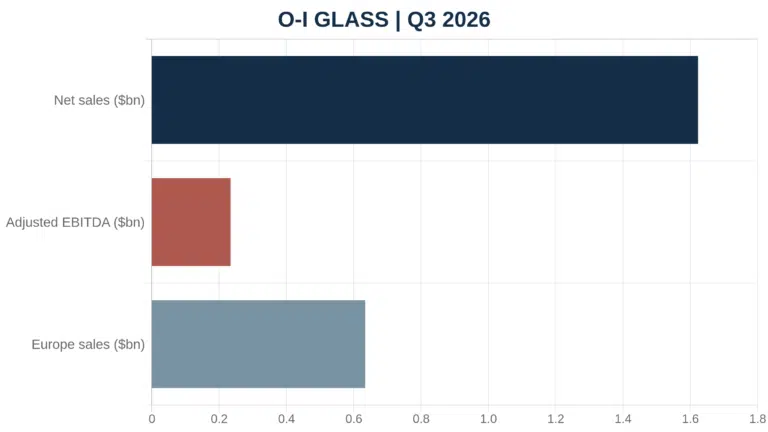
The US glass container manufacturer reported net sales of $1.62 billion for the quarter ended 30 September, down 2% year on year. Adjusted EBITDA fell to $234 million from $329 million as performance in Europe deteriorated.
European revenue was $634 million, around 8% lower than a year earlier. Both volumes and selling prices fell by nearly 4%, while the region’s segment operating profit dropped to just $2 million from $95 million.
The Americas held up better. Revenue reached $970 million, up more than 3%, while segment operating profit was $137 million, down slightly from $140 million. This contrast shows that the challenges are not uniform across the global glass-container market.
O-I now expects full-year adjusted EBITDA of $925 million to $950 million, down from its previous outlook. Management has pointed to weaker demand, higher freight and energy costs and a slower recovery in Europe.
The group has also discussed the possible closure of another European production site. A proposal does not mean a closure has been finalised, but food and beverage buyers should monitor its development where they depend on local glass packaging capacity.
For supermarket suppliers, demand for bottles and jars is affected by beverage consumption, consumer trading patterns, product mix and the economics of alternative packaging. Lower sales volumes at one glass manufacturer do not automatically prove a market-wide move away from glass.
Energy is a significant cost in glass manufacturing because furnaces run continuously at high temperatures. O-I said it has secured its European natural gas requirements for the fourth quarter, giving greater short-term cost visibility, although that does not remove wider pricing or demand pressure.
The procurement questions for manufacturers of sauces, preserves, oils, drinks and other packaged products are whether suppliers can maintain reliable local capacity, competitive contract terms and stable delivery schedules.
GTN previously included O-I Glass in its Estonian packaging market analysis. The company is also relevant to broader discussions of European glass packaging capacity and food supply-chain resilience.
O-I’s future updates will show whether pricing, cost reductions and the proposed European network changes improve profitability.
Editor’s Note: Based on O-I Glass’s official Q3 2026 release of 27 October and management’s 28 October earnings call. GTN examines the implications for supermarket and FMCG glass-packaging procurement.