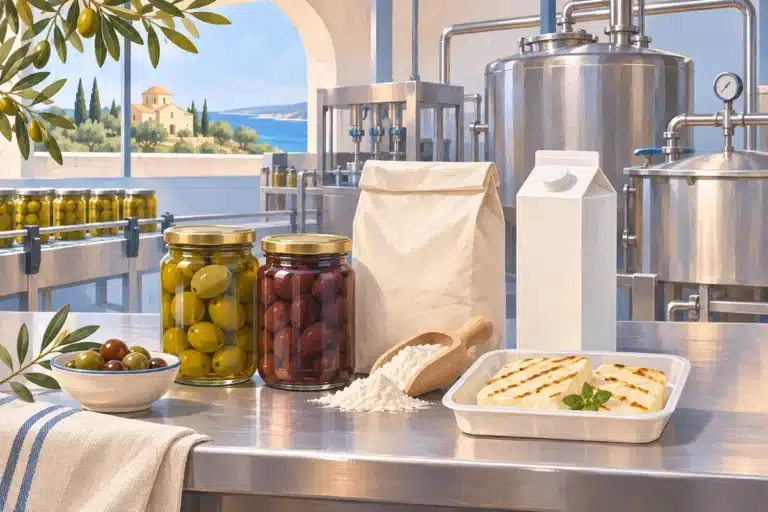

Cyprus offers verified private-label food manufacturing in halloumi, olives, olive oil, grain products, sauces and frozen prepared foods. Seven relevant suppliers to evaluate are Papouis Dairies, A. Hadjipieris, Ecoterra, Protino Foods, Lisko Foodstuff, Kornos Dairy/RDOMAIN and Ambrosia Oils. These are not interchangeable factories. Papouis and Hadjipieris have direct halloumi experience, Ecoterra explicitly advertises olive contract manufacturing, and Protino and Lisko offer grain-related private-label projects. Buyers should match category, certification and capacity rather than rank businesses using unrelated group revenue.
Updated 10 November 2026. This is an original, product-specific shortlist based on 2025–26 manufacturer and official trade material. Cyprus-owned and Cyprus-manufactured are distinct claims, as are a retailer’s own-label brand and the factory that produces it. No audited comparable national market share of private-label contract manufacturing was found for all seven. Company sizes and revenues are reported only where a dated company statement, official record or clearly labelled estimate supports them.
Private-label manufacturers in Cyprus: buyer comparison
| Company | Products | Evidence of contract work |
|---|---|---|
| Papouis Dairies | Halloumi PDO, anari and private-label cheese | 2025–26 trade or manufacturer statements identify private-label offer |
| A. Hadjipieris Ltd | Halloumi and anari cheese | 2025–26 trade or manufacturer statements identify private-label offer |
| Ecoterra Ltd | Olives, olive oil and contract-packed grocery | 2025–26 trade or manufacturer statements identify private-label offer |
| Protino Foods Ltd | Bulgur, grain products and frozen vegetables | 2025–26 trade or manufacturer statements identify private-label offer |
| Lisko Foodstuff Ltd | Bulgur and Mediterranean prepared food | 2025–26 trade or manufacturer statements identify private-label offer |
| Kornos Dairy / RDOMAIN Ltd | Halloumi and frozen cheese convenience foods | 2025–26 trade or manufacturer statements identify private-label offer |
| Ambrosia Oils (1976) Ltd | Cooking oil, margarine, sauces and bottled olive oil | Contract-work availability needs direct confirmation |
The distinction between manufacture, trading and distribution is central. A private-label retailer can contract a producer directly or work through an export agent. A trading company may market cheese from an approved factory without owning that factory. Buyers must therefore request the manufacturing-site name and current product-safety approvals, not simply the selling agent’s sales materials.
1. Papouis Dairies — Halloumi PDO, anari and private-label cheese
Company facts: Founded in 1967 in Athienou, Larnaca district; incorporated as Papouis Dairies Ltd in 2006; owned by the Pancyprian Organisation of Cattle Farmers since 2012. Its manufacturer history records approximately 180 employees at an earlier expansion stage, a 17,000 sq ft facility and 8,000–9,000 tonnes of annual halloumi capacity at that time. Its current homepage separately describes a 5,000 m² factory and 12 tonnes of daily halloumi capacity; these figures are from different company statements and should not be combined into a single production total. Exports reach more than 30 countries. Sources: Papouis Dairies company history and homepage.
Background and local operation: Established by Costas Papouis in Athienou in 1967, Papouis began with four staff and traditional halloumi and anari. The current limited company was formed in 2006. A larger factory opened in the Athienou industrial zone, and the company became part of the Pancyprian Organisation of Cattle Farmers in 2012. Papouis says its workforce reached approximately 180 employees following the expansion after its 2012 ownership change. This is a historical company-reported figure, not a November 2026 headcount.
Production scale and financial disclosure: Its 2026 Gulfood and SIAL listings state up to 10,000 tonnes of halloumi capacity and exports to more than 30 countries. The company explicitly says it makes supermarkets’ private labels. A capacity figure is not actual annual output, The company’s own historical account also reports exports to more than 30 countries and earlier capacity of 8,000–9,000 tonnes of halloumi annually; the newer 10,000-tonne figure refers to capacity rather than audited output.
Procurement questions: Ask for current PDO certification for the exact cheese, milk composition, approved production site, annual contract allocation, product shelf life, pack sizes and allergen documentation. Verify claims about supply to overseas retailers directly if these are important to the tender.
2. A. Hadjipieris Ltd — Halloumi and anari cheese
Company facts: Established in 1983; based in Athienou, Larnaca district. Hadjipieris is part of the OMIROS Dairies Group of Greece. Its current manufacturing information describes an existing 3,500 m² plant and a proposed new plant designed for 7,500 tonnes a year, within a stated €30 million five-year Cyprus investment programme. Planned capacity is not existing output. Source: Hadjipieris Dairy corporate website.
Background and local operation: The company’s official Gulfood 2026 profile traces its establishment to Antonis Hadjipieris in 1983 and the commissioning of a new dairy facility in Athienou in March 2009. It describes daily milk intake from established cow, sheep and goat suppliers and makes fresh and matured halloumi, along with fresh and dry anari.
Production scale and financial disclosure: The 2026 trade exhibitor classification includes ‘Private Label’. Hadjipieris now identifies itself as part of Greece’s OMIROS Dairies Group. Its company website describes an existing 3,500 m² Cyprus production facility and a new facility under development designed for 7,500 tonnes of annual capacity. It places the expansion within a €30 million OMIROS investment programme in Cyprus over five years. These are manufacturing and investment measures, not the dairy’s annual turnover or completed output.
Procurement questions: Check the exact PDO product specifications, proportions of milk types, certification validity, halal or kosher requirements where applicable, and whether a retailer-exclusive recipe can be supplied without conflicting with protected designation requirements.
3. Ecoterra Ltd — Olives, olive oil and contract-packed grocery
Company facts: Privately held, headquartered in the Nicosia area, with facilities at 125 Gerovouniou, Psimolofou 2630. Ecoterra’s company LinkedIn profile gives an employee-size range of 2–10, not an audited headcount. The company describes local olive sourcing, cold pressing, bottling, flexible pack sizes and private-label programmes for retail and foodservice. Sources: Ecoterra corporate website, LinkedIn company profile and SIAL Paris 2026 exhibitor listing.
Background and local operation: Cyprus-based Ecoterra’s current SIAL Paris 2026 exhibitor page identifies its operating address at Psimolofou near Nicosia. The company describes a focus on olives and olive oil, selling to retailers and foodservice operators, and specifically advertises private-label and contract-manufacturing services. The manufacturer has a clear grocery-category fit beyond halloumi.
Production scale and financial disclosure: The SIAL Paris 2026 exhibitor profile directly describes private-label and contract-manufacturing services. It does not quantify output or the proportion sold through retailer brands, so the more useful comparison is the supported product range and the production site named in a buyer quotation. Buyers must determine which olives and oil are of Cypriot origin and which ingredients may be imported.
Procurement questions: Request the factory, harvesting and bottling site details, olive oil category, authenticity testing, traceability, oil acidity specifications, packaging protection against light and oxygen, and label compliance. Ask for a commercial sample from the actual line before agreeing a launch.
4. Protino Foods Ltd — Bulgur, grain products and frozen vegetables
Company facts: Based in the Aradippou industrial area of Larnaca district. Its Gulfood 2026 trade-company presentation identifies production and private-label work covering bulgur and grain products, organic variants, sauces and selected frozen grocery products. The named manufacturing location and product lines provide buyer-relevant scale and sourcing information without assuming that different goods use the same production line. Source: Protino Foods Gulfood 2026 company profile.
Background and local operation: Protino operates in the Aradippou industrial zone, according to its Gulfood 2026 company profile. Its range includes bulgur wheat, breakfast cereals, bulgur-based meals, instant soups, sauces and selected frozen vegetables. The manufacturer says it supports private-label projects as well as its branded business, covering conventional and certified organic bulgur.
Production scale and financial disclosure: Its 2026 exhibition statement describes flexible packaging and food-safety controls across conventional and organic bulgur lines. Buyers should ask for line-specific capacity and minimum orders, particularly where frozen and ambient products require different infrastructure.
Procurement questions: Confirm the exact factory and line used for each product, gluten and allergen controls, organic certification, sourcing of durum wheat, packing sizes and whether frozen products are made or packed at a separate site. Specify shelf-life testing and retailer artwork responsibilities.
5. Lisko Foodstuff Ltd — Bulgur and Mediterranean prepared food
Company facts: Founded in April 1984; headquartered in Larnaca and manufacturing in the Aradippou industrial area since 1988. Lisko’s own account says its first factory covered 1,000 m², was doubled in 1997 and expanded again in 1999. Its published LinkedIn company-size band is 11–50 employees. Cyprus’s official trade brochure states exports account for more than half of company revenue; that proportion is not total turnover. Sources: Lisko corporate history, company LinkedIn profile and Cyprus 2025 Gulfood trade brochure.
Background and local operation: Cyprus’s official 2025 Gulfood national brochure describes Lisko as founded in 1984 with a base in Aradippou. It produces bulgur and organic bulgur, frozen legumes, pastry products, kunafa and pasta containing halloumi. Its agricultural sourcing is tied to local durum wheat, according to the brochure. The company is an important additional supplier candidate rather than being automatically counted within Protino.
Production scale and financial disclosure: The government’s trade brochure says more than 50% of Lisko’s revenue comes from exports and specifically identifies bulk and private-label partnerships. That percentage is a company-reported share of exports in its 2025 brochure, not a share of the private-label market. Lisko’s company profile places it in the 11–50 employee size band; this is a self-reported range rather than an audited headcount. Its own website says it moved into a 1,000 m² factory in Aradippou in 1988, doubled the space in 1997 and expanded again in 1999.
Procurement questions: Request explicit contract manufacturing terms, plant and allergen certification, packaging-line availability, proof of organic status for relevant SKUs, and the route for long-life versus frozen products. Ask how wheat harvest variations influence availability and prices.
6. Kornos Dairy / RDOMAIN Ltd — Halloumi and frozen cheese convenience foods
Company facts: Kornos Dairy is associated with the legal name RDOMAIN Ltd and a dairy processing site in Kornos, Nicosia district. Cyprus’s 2025 Veterinary Services approved-establishment register identifies Kornos Halloumi Cheese (RDOMAIN Ltd) under processing-plant approval number 0076. Its commercial product listing covers halloumi, anari and frozen cheese snacks, with private-label options. Sources: Cyprus Veterinary Services approved-establishment list and Kornos Dairy/RDOMAIN supplier profile.
Background and local operation: A Portuguese-language Europages B2B product listing identifies the commercial business as RDOMAIN Ltd and names Kornos Dairy as the operating name. The supplier describes a family-owned Cypriot dairy making halloumi and anari as well as frozen halloumi sticks, burgers, nuggets and croquettes. Its listing explicitly offers private-label solutions with a minimum order.
Production scale and financial disclosure: A product page lists an indicative minimum order of 200 cartons for a frozen cheese offer, but that is product-specific, may change and cannot be treated as a standing minimum for every SKU. Cyprus’s Veterinary Services approved-establishment list dated May 2025 independently identifies Kornos Halloumi Cheese (RDOMAIN Ltd) as dairy processing plant number 0076 in Kornos, Nicosia district. A September 2025 government register also records its cold-storage activity. This establishes the legal manufacturer and authorised site more firmly than the seller listing alone.
Procurement questions: Confirm whether the contracting party is RDOMAIN Ltd, the product manufacturing licence, current PDO status where relevant, freezing and thawing controls, pack format and delivery temperature. Ask for an exact quotation rather than assuming the directory’s minimum order covers all recipes.
7. Ambrosia Oils (1976) Ltd — Cooking oil, margarine, sauces and bottled olive oil
Company facts: Ambrosia Oils (1976) Ltd operates at 14–20 Pentadaktylou Street, Larnaca Industrial Estate. Its corporate timeline traces the business origin to 1967 and the move to its Larnaca site to 1976; some company directory descriptions use 1976 as the establishment year. The company reports approximately 200 products in six major categories and exports to more than 20 countries. It installed a 556 kWp photovoltaic system in 2024 and a new automatic sauce-filling line in 2025. Source: Ambrosia Oils official company history and product information.
Background and local operation: Ambrosia’s own company page says it was founded by Vias and Christis Demetriou in 1976, and identifies the Larnaca industrial estate as its base. The company’s current SIAL and Gulfood exhibitor profiles confirm local manufacturing of cooking oils, olive oil, margarine and sauces including ketchup, mayonnaise and mustard. The trade records also name FSSC 22000 and organic credentials for relevant products.
Production scale and financial disclosure: A specialist contract-manufacturing directory describes private-label oil and bottling capacity, although the company’s public product statements are stronger for own manufacture than for specific retailer own-label contracts. Any current private-label availability should be confirmed directly. Ambrosia’s own latest company history records a new automatic sauce-filling line installed in 2025 and a 556 kWp photovoltaic installation in 2024. It markets approximately 200 products in six main categories and states that it exports to more than 20 countries. These are published operational measures, rather than a financial estimate.
Procurement questions: Clarify whether the proposal covers domestic olive oil or imported oils bottled locally, the source of raw material, batch origin, refining, allergens in emulsified sauces, bottle manufacture, tamper evidence, fill accuracy and available private-label artwork and recipe options.
Why halloumi dominates many Cyprus private-label searches
Cyprus’s halloumi industry has international recognition and a specific EU protected designation of origin. Those attributes make it commercially attractive to overseas supermarkets seeking a clearly identifiable Cypriot speciality. They also impose rules. The cheese cannot be described as Halloumi PDO merely because it resembles a grilling cheese or is produced by a company based in Cyprus. The exact certified product, production process, milk and approved plant matter.
Cyprus’s Ministry of Energy, Commerce and Industry maintains a Halloumi PDO trade service with information on certified beneficiaries. Buyers should check that resource alongside the manufacturer’s current certificate and the relevant scheme controller. Producers listed in a fair catalogue are not automatically approved for every PDO variant, pack or destination.
Lidl Cyprus disclosed in July 2025 that it worked with more than 100 local suppliers, including 13 dairy and cheese producers, and that 2024 exports through its programmes totalled €28.8 million, of which €26 million related to halloumi. These figures describe Lidl’s stated supply/export programme, not the total turnover of any single dairy. They also illustrate the importance of supermarket specifications and export capability in the industry.
How the three competing directories differ
Comanufacturers.eu’s Cyprus list provides dozens of supplier and product classifications, notably dairy, yoghurt and cheese, but some entries rely on broad company descriptions rather than manufacturer-signed confirmation of a current retailer contract. Gulfood’s company catalogue contains direct producer claims about facilities, capacity and private-label offers, but remains a trade exhibitor directory and should not be treated as an audit. SIAL Paris’s October 2026 exhibitor catalogue is particularly useful for verifying named suppliers, categories and the presence of private-label programmes, yet it does not provide matched audited financial accounts or contractual terms.
This comparison cross-checks primary manufacturer histories, government trade brochures and the international event profiles. It distinguishes explicit private-label claims from the broader ability to manufacture branded products. It also excludes unrelated supplement and cosmetic manufacturers sometimes included in a general ‘private label Cyprus’ search.
What a supermarket should verify before sourcing
- Identify the actual factory. Confirm whether the supplier owns the plant or contracts production elsewhere.
- Verify the legal company. The brand, trading agent and processing factory may have different registered names.
- Approve the product category. A dairy plant cannot be assumed suitable for bulgur, oils or frozen prepared foods.
- Check current certifications. Request site-specific documents for BRCGS, IFS, FSSC or any scheme required by the retailer.
- Review PDO and origin claims. Confirm the exact Halloumi PDO accreditation or the origin of olive oil and grain products.
- Set ingredient and allergen rules. Milk and wheat are obvious examples, but packaging, cross-contact and recipe substitutions also matter.
- Get realistic minimum orders. Clarify whether quantities are cartons, pallets, recipes, packaging prints or total contract volume.
- Test the whole supply chain. Agree temperature and shelf life at the retailer’s distribution centre, not merely at factory dispatch.
- Protect retailer packaging. Confirm dielines, printing approvals, barcode ownership, label languages and unused material costs.
- Assess trial batches. Use representative final products and track manufacturing batches and shelf-life performance.
- Set change controls. Require advance notice if ingredients, processing sites, certifications or packaging materials change.
- Compare landed costs. Include freight, quality claims, storage, inspection and seasonality.
Private-label cheese versus grains and ambient grocery
Halloumi programmes depend on milk procurement, protected-origin certification, consistent texture and controlled refrigeration. The producer may need to reserve milk intake and production capacity months ahead. Shelf-life testing, brine balance and packaging seal integrity are important to product performance. Retailers should test how the cheese behaves when cooked according to label instructions.
Bulgur, cereals and other dried grains have different risks. Moisture control, insect protection, raw-material origin and food-contact packaging are critical. Frozen vegetables and halloumi snacks require maintained temperature and validated cooking instructions, and may use separate production areas. Olive oil requires chemical and authenticity tests, controlled light and oxygen exposure and clear category labelling.
These differences explain why a single score based on turnover, headcount or company age would not identify a best supplier. A larger dairy can be a poor fit for a small private-label cereal brief; an experienced grains factory cannot simply make PDO cheese.
Understanding revenue, employee numbers and market share
Financial transparency varies. Papouis provides a historical employee figure, Lisko publishes an employee-size band and export-revenue proportion, while Hadjipieris and Ambrosia disclose investment, facility or product-scale indicators. Manufacturers often quote installed annual capacity rather than actual production. Even when a company reports total revenue, it may include branded domestic sales, exports, ingredients and contract manufacturing. It is not credible to treat those totals as private-label-specific revenue.
Papouis’s historical page describes around 180 employees after an investment stage, while a newer trade listing provides a higher halloumi production capacity than an older company website. This should be presented as dated reporting, not a timeless current combined statement. An annual production capacity of 10,000 tonnes cannot be converted into a market share without verified actual output and total comparable market data.
Procurement teams evaluating financial stability should request matched-year statutory accounts, credit references and evidence of the relevant production site’s capacity. Do not extrapolate from a trade directory’s approximate employee band to an exact workforce figure.
Creating a strong private-label request for quotation
Start with the finished product rather than simply requesting ‘Cyprus private label’. Specify recipe, ingredient origin, retail price positioning, net weight, packaging, nutrition, allergen control, test requirements, expected annual volume and launch date. Say whether there is scope for the manufacturer to propose an existing formula or whether a fully exclusive recipe is required.
Give producers the same delivery basis so quotations can be compared. A lower factory price can become more expensive after export handling, distribution, packaging minimums and product waste. Ask about the estimated remaining shelf life on arrival and the treatment of out-of-specification goods. Where the supplier proposes a new recipe, agree who owns the technical file, test results and intellectual property.
Use a small commercial trial, not just free tasting samples, before confirming a wide retail listing. Samples should be produced under ordinary production conditions and carry full traceability. If the supplier changes facilities, it should provide a new production qualification rather than relying on the earlier trial.
Cypriot origin and international grocery buyers
Several manufacturers have export networks reaching the UK, EU countries and markets outside Europe. That helps with buyer discovery, but compliance is destination-specific. Imports may need different label wording, permitted claims, certificates and rules for chilled transport. A product exported to one country does not automatically qualify for another.
For a supermarket seeking locally produced Cyprus goods, request documentation on where the finished product is made and the provenance of major raw materials. A Cypriot manufacturer may import oilseeds, wheat or packaging components. That does not necessarily affect quality, but it changes the meaning of ‘locally sourced’ and can influence supply continuity.
Frequently asked questions
Which Cyprus producers make private-label halloumi?
Papouis Dairies directly states it supplies retailer private labels and reports substantial halloumi capacity. A. Hadjipieris is classified for private label in its 2026 trade listing. Kornos Dairy also advertises a private-label cheese and frozen-food offer. Each contract requires current factory and PDO checks.
Are there Cyprus private-label companies outside dairy?
Yes. Ecoterra offers olives and olive oil private-label services, Protino and Lisko have grain and prepared-food programmes, and Ambrosia manufactures oils and sauces with potential contract-packing capability that should be confirmed directly.
How large is Cyprus’s private-label manufacturing market?
The available manufacturer and trade statistics do not establish a like-for-like national contract-manufacturing market total. Retailers should assess each supplier’s product capacity and certification rather than infer market shares from unrelated sales. Lidl’s 2024 halloumi export figures relate to its programme, not the whole market.
What should retailers check before approving a factory?
Legal identity, plant certification, product and origin claims, production capacity, allergen control, recipe ownership, shelf life, packaging, traceability and a successful commercial trial.
Related GTN sourcing analysis
Compare Slovenian private-label food manufacturers, Croatian own-label producers, European private-label dairy manufacturers and Cyprus supermarket chains to distinguish supplier options from the retailers they seek to serve.
Editor’s Note: Based on 2025–26 Gulfood and SIAL trade profiles, company histories, the Cyprus government’s official trade brochure, Lidl Cyprus sourcing statements and the national Halloumi PDO producer service. Company facts are distinguished by source and year, including historical employment, published employee bands, production facilities and export figures; national private-label market shares are not inferred.