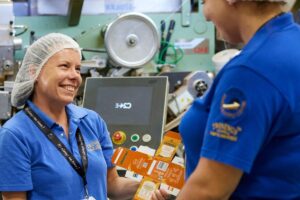


SalMar’s InnovaMar facility on Frøya, Norway. Archive photograph: SalMar.
SalMar reported a record third-quarter salmon harvest of 105,100 tonnes on 3 November, helping lift operational earnings to NOK 1.609 billion as production costs fell and selling prices improved.
The Norwegian producer’s operational EBIT per kilogram reached NOK 15.3. This is the group’s operating-performance measure, rather than its net profit after tax.
The result reflects more than additional fish. Processing plants handled record volumes, spreading costs across a larger output, while the Sales & Industry business benefited from stronger operations and sales.
For grocery seafood buyers, the distinction matters. A larger harvest can improve processing efficiency, but it does not establish that every product specification or delivery window has become easier to source.
Norwegian operations accounted for 99,900 tonnes of the quarter’s harvest. Icelandic Salmon returned to a positive result, while Scottish Sea Farms continued to face biological challenges despite harvesting more fish.
SalMar holds a 50% stake in Scottish Sea Farms. Its group harvest outlook includes its relative share of that business, so it should not be compared directly with a forecast that includes all Scottish production.
The company now expects a 2026 harvest of 347,000 tonnes, including that relative share. Norwegian guidance is unchanged, but expectations for Iceland and Scotland have been reduced.
The near-term picture is more restrained than the record-quarter headline suggests. SalMar expects slightly lower costs in Q4, alongside a smaller Norwegian harvest than in the final quarter of 2025.
That combination leaves buyers with two separate questions: how production costs are developing and how much salmon will be available during their purchasing period. Lower farming costs do not automatically produce a matching reduction in the price of finished fillets.
SalMar is among the food producers supplying Norway’s grocery sector, with farming and processing operations linking domestic production to international customers.
The industry is also investing further along the chain. Lerøy’s processing and distribution strategy targets NOK 2 billion in operating earnings from its value-added processing, sales and distribution segment by 2030. The businesses are different, but both show why processing performance deserves attention alongside farm output.
For retailers, whole-fish availability and the supply of ready-to-sell portions are related but distinct. Yield, trimming, pack size, freshness requirements and delivery frequency influence the cost of the product reaching the chilled cabinet.
A group harvest figure cannot resolve those details. It is most useful as context for discussions about contracted volumes, product origin and service levels, rather than as a forecast of retail prices.
SalMar expects limited global salmon supply growth in 2027. Its immediate test will be delivering the anticipated Q4 cost improvement while managing the lower Norwegian harvest.
Editor’s note: Based on SalMar’s results announcement dated 3 November 2026, checked against its corporate release. Grocery Trade News added seafood-procurement and processing context.