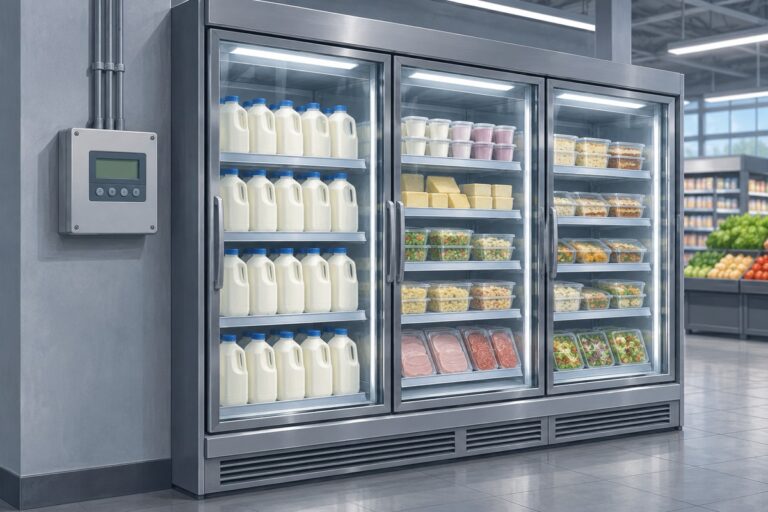

AI-generated illustration of refrigerated food cabinets and a control panel. It does not depict an affected business. Illustration: Grocery Trade News.
The UK’s food supply chain has been affected by cyberattacks targeting refrigeration systems, National Cyber Security Centre chief executive Richard Horne said on 3 November, following disruption at supermarkets across Europe.
Speaking on BBC Radio 4’s Today programme, Horne said the agency knew of a small number of UK impacts and had contacted organisations overnight about exposed technology. He said it was too early to identify those responsible. The full extent of the UK disruption remains unclear.
The confirmation brings the incident closer to British supermarket buyers, food manufacturers and chilled-food suppliers. Refrigeration failures can interrupt production and deliveries even when a retailer’s own stores remain operational.
It does not establish that UK supermarkets have suffered widespread disruption. Businesses alerted about vulnerable equipment should also be distinguished from those where an intrusion has been identified.
The latest European incidents emerged on Monday, 2 November. Retailers in several countries reported interference with refrigeration systems, with some removing chilled and frozen products from sale. The disruption follows the refrigeration attacks in France reported in October. Investigators have not established whether the incidents are connected.
For food businesses, the immediate concern extends beyond access to computer systems. Refrigeration controls influence the conditions in which products are stored. Changes to temperature settings or defrost schedules can therefore become a stock, food-safety and business-continuity problem.
The commercial consequences can spread along the supply chain. A processor unable to release a chilled consignment may leave a distributor short of stock. A retailer arranging replacement deliveries may then face higher transport costs, altered availability and additional checks on incoming products.
Horne linked the wider risk to ageing technology, delayed upgrades and systems that have remained exposed rather than securely separated from the internet. His comments highlight an operational responsibility that can sit between a food business, its IT team and its refrigeration contractor.
As UK supermarkets expand their use of connected technology, responsibility for maintaining those systems needs to be clear. A cabinet may continue cooling normally while its controller’s software, remote connection or security settings require attention.
France’s national cyber response body, CERT-FR, has already issued technical guidance on compromised refrigeration controllers. Its alert names Danfoss AK-SM and AK-SC systems, alongside Copeland and Dixell XWEB equipment. The notice was first published on 12 October and updated on 16 October.
CERT-FR advises removing direct internet exposure, checking configurations—including defrost schedules—and restoring remote access through a secure VPN or protected network. It also recommends manufacturer security measures, firmware updates and changes to default passwords.
The agency warns that resetting an unsupported device is insufficient if it remains exposed and vulnerable. Businesses should coordinate changes with their technical providers; the alert specifically notes the need to check insurance conditions before disconnecting data feeds to refrigeration contractors.
Danfoss separately publishes security advisories for its equipment. However, a documented product vulnerability should not automatically be described as the confirmed route into this incident. Establishing which equipment was present, how it was connected and what investigators have verified remains essential.
For procurement teams, this makes service arrangements part of the buying decision. Contracts need to establish who maintains controller software, manages remote access and responds to abnormal temperatures outside normal working hours.
Those responsibilities sit alongside the food-safety requirements facing UK supermarket suppliers. A restored connection or working controller does not, by itself, establish the condition of stock affected during an interruption.
The next priority is to establish the scale of the UK impact and secure exposed installations. Further findings from the NCSC, affected businesses and equipment providers will determine whether additional operational measures are needed.
Editor’s Note: Based on Richard Horne’s BBC Radio 4 Today interview reported on 3 November 2026, European incident reporting, CERT-FR’s October alert and Danfoss security advisories. Supply-chain implications are GTN analysis. Attribution and the full UK impact remain unconfirmed.