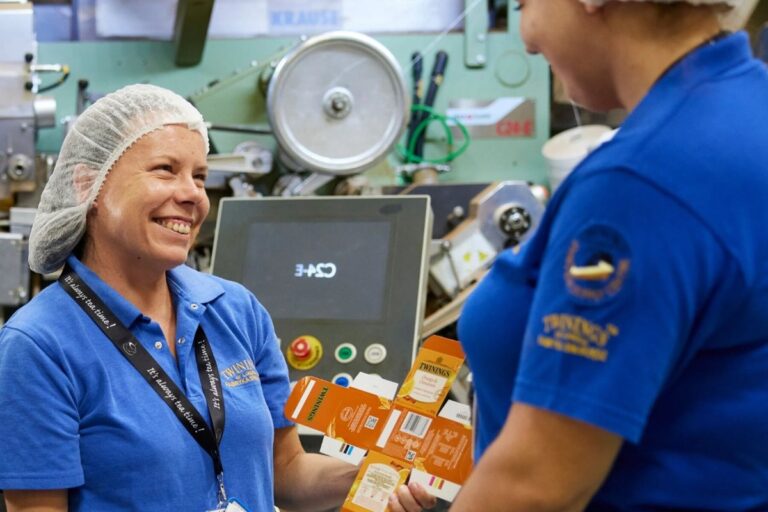

Twinings colleagues at the company’s production facility in Poland. Archive photograph: Associated British Foods.
Associated British Foods reported an 11% fall in grocery adjusted operating profit to £427 million on 3 November, as weaker US oils earnings outweighed growth across several food brands.
Grocery revenue reached £4.237 billion for the year ended 12 September 2026. Sales rose 3% at actual exchange rates and 2% at constant currency, with the addition of Hovis the main contributor to growth.
The division’s adjusted operating margin fell to 10.1%, from 11.6%.
Those figures show a business selling more by value while retaining less operating profit from each pound of revenue. They do not establish that existing brands grew at the same rate as the division, because acquired sales also contributed.
The US oils businesses were the main source of pressure. Lower consumer spending affected Mazola, while the Stratas joint venture faced weaker foodservice demand and lower margins.
For supermarket buyers, that is a more specific signal than a group-wide profit decline. Grocery includes brands and categories with different demand patterns, so performance in US cooking oils should not be treated as a direct measure of UK tea, bread or international-food sales.
ABF is one of the major FMCG companies supplying UK retailers. Its portfolio spans products bought for everyday staples, cooking and discretionary occasions, making the mix of businesses important when assessing the results.
Its acquisition of Hovis, completed in July, brought the bread business alongside Allied Bakeries, whose brands include Kingsmill. Combining those operations changes the scale of ABF’s UK bakery business, but integration benefits take time to reach the accounts.
For 2027, ABF expects grocery adjusted operating profit to be broadly unchanged. Higher input costs are expected to offset sales growth in most businesses, with an additional one-off effect from consolidating Hovis losses in its first year of ownership.
That creates a distinction between the near-term earnings effect and the longer-term case for the deal. ABF intends to use synergies to support marketing, innovation and a sustainably profitable bakery operation.
For retailers, the commercial questions concern the supply network and the proposition on shelf. Grouping brands under one owner does not, by itself, establish a change to delivery schedules, product specifications or agreed buying terms.
The results therefore give grocery procurement teams a mixed picture: pressure on supplier margins alongside investment and acquisition-led changes. They offer context for future negotiations, rather than a uniform signal about prices across ABF’s categories.
ABF remains on course to separate Primark from its food businesses in December 2027. The next stage for grocery is integrating Hovis while showing that sales growth and operational savings can offset the higher cost base.
Editor’s note: Based on ABF’s annual results released on 3 November 2026 and its completed Hovis transaction. Grocery Trade News added analysis of grocery margins, acquisition effects and implications for retail buyers.