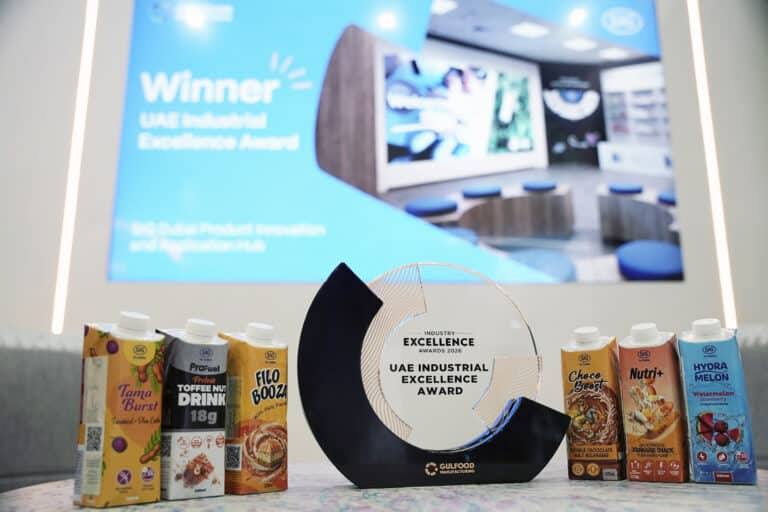

SIG signed agreements for 17 filling lines at Gulfood Manufacturing 2026, covering aseptic cartons, spouted pouches and bag-in-box systems for food and beverage producers across India, the Middle East and Africa.
Announced on 9 November, the agreements span three packaging formats. SIG did not identify the customers, disclose contract values or provide installation dates.
“It reflects both the breadth of our offering and the strength of our customer relationships,” said Anne Erkens, SIG’s chief executive.
The announcement provides a commercial outcome from the Dubai exhibition. However, it does not establish the binding status of individual agreements or when additional production capacity will become available.
For manufacturers and grocery suppliers, those details matter. Equipment specifications, factory readiness, testing and commissioning all affect how planned capacity translates into products available for sale.
SIG, among Europe’s major dairy packaging suppliers, operates across retail and larger-volume food and beverage applications. The choice of filling system influences pack formats, product handling and distribution requirements.
Aseptic processing involves commercially sterilising a product and filling it into sterilised packaging under controlled conditions. Properly processed and sealed products can remain shelf-stable without refrigeration before opening.
That can reduce dependence on chilled transport and storage. The practical benefit depends on the recipe, validated shelf life, packaging performance and the conditions in which products are distributed.
For a grocery supplier, additional filling capacity is therefore only part of the picture. Production efficiency and reliable delivery matter alongside the ability to offer the right product at the right price.
SIG also received the UAE Industrial Excellence Award for its Dubai Product Innovation & Application Hub.
Opened in 2021 at Dubai Silicon Oasis, the facility supports recipe development, processing trials and aseptic test filling. Customers can assess small batches before moving towards larger production runs.
“A filling line gives manufacturers the capacity to produce,” said Abdelghany Eladib, SIG’s president and general manager for India, the Middle East and Africa.
His comments linked manufacturing equipment with product-development support. Testing a recipe and its packaging together can help a producer identify practical problems before a wider launch.
SIG’s separate 3 November announcement set out six beverage concepts developed by the Dubai team.
Nutri+ was presented as a meal-replacement concept aimed at consumers undergoing GLP-1 treatments. ProFuel paired a lactose-free toffee-nut drink with 18g of protein, added fibre and no added sugar.
Choco Boost combined a double-chocolate milkshake-style drink with B vitamins. Hydra Melon used watermelon and strawberry flavours with electrolytes.
Tama Burst combined tamarind and plum. Filo Booza took inspiration from Middle Eastern desserts and included pistachio pieces.
These were development concepts. The announcements did not identify supermarket listings or confirm consumer launches for the six drinks.
For buyers, the distinction is useful. A concept demonstrates a possible product direction. A retail launch also requires commercial production, a supply agreement, pricing and distribution.
The agreements come during a wider change in SIG’s business. On 27 October, the company outlined a simpler structure centred on Aseptic Carton and Bag-in-Box & Spouted Pouch.
Its plans included improving the latter business through operational changes, a more focused portfolio and greater emphasis on aseptic applications. The group set medium-term targets of 3–5% organic revenue growth and an adjusted operating margin above 18%.
The Gulfood agreements cover both business areas. SIG has not disclosed how the 17 lines are divided between them, so the announcement cannot yet be used to assess their individual financial contribution.
Gulfood Manufacturing ran from 3 to 5 November at Dubai World Trade Centre.
Editor’s Note: This report draws on SIG’s releases of 9 November, 3 November and 27 October, alongside its technical information on aseptic packaging. The commercial significance lies in the breadth of the agreements. Their effect on food and beverage supply will become clearer when customers, production sites and commissioning plans are disclosed.
SIG says the planned lines are intended to expand manufacturing capacity across India, the Middle East and Africa.