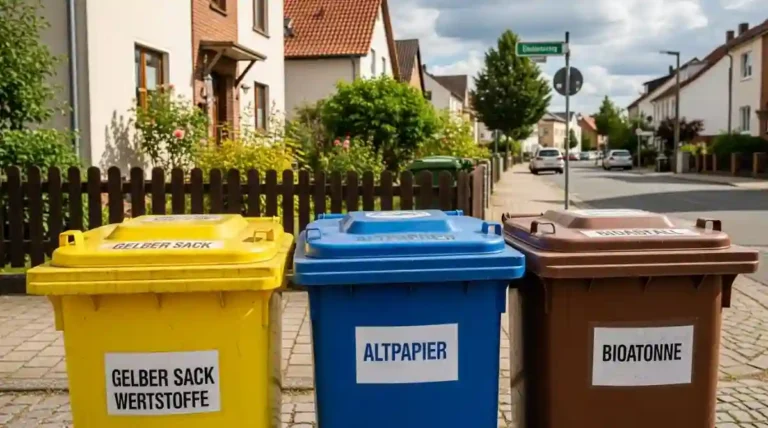

VerpackG is Germany’s Packaging Act. It is the main law that controls how packaging should be registered, licensed and recycled in the country.
LUCID is the central packaging register. Every producer must list their company and their brands there.
In simple terms, any supermarket supplier placing packaged goods on the German market in 2025 must take two steps:
- Register in LUCID
- Join an approved recycling system
Without these two steps, the product cannot legally be sold. This is why the rules around Germany VerpackG 2025 matter for retailers, FMCG suppliers, exporters and private-label partners.
What Changed in 2025
Germany strengthened VerpackG rules in 2025. The main changes are:
- Authorities are carrying out stricter LUCID audits.
- Penalties for incorrect or missing packaging data have increased.
- Non-EU exporters are receiving more checks at customs.
- Eco-modulated fees now reward recyclable packaging.
- Retailers have introduced tougher onboarding requirements, asking for more compliance documents before listing.
This guide explains what the law is, who must register, and what supermarkets should expect from their suppliers. It uses very simple language and focuses on practical steps for businesses working with packaged goods.
What VerpackG Actually Is
VerpackG is a national law. It makes companies responsible for the packaging they place on the German market.
Germany has strict recycling targets. The law ensures that producers contribute financially to the recycling system.
The idea is simple. Companies placing packaging into households should support the cost of collecting and recycling that packaging.
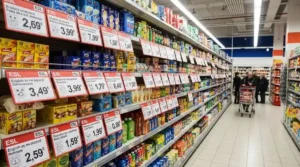
This applies to almost every product seen in supermarkets, including:
- Food and beverages
- Personal care
- Cleaning items
- Everyday groceries
The core message
Many guides explain VerpackG in difficult legal language, but the core message is easy to understand. If you sell packaged goods to German consumers, you must help pay for the waste created.
If you do not meet the requirements, your products can be removed from shelves.
Enforcement has increased in the past two years. Germany VerpackG 2025 brings even stronger checks on importers and private-label partners.
For supermarkets, this is no longer only a regulatory matter. It is a direct operational risk.
Why retailers and private-label suppliers must care
Any failure in packaging compliance can disrupt listings, delay shipments and damage supplier relationships.
Private-label is especially sensitive because the supermarket becomes the “brand owner.” This means they may carry the legal responsibility if something goes wrong.
In a market where private-label is a major share of sales, retailers need complete confidence that every supplier understands VerpackG.
How Germany Compares With Other EU Packaging Laws
Germany’s VerpackG is one of the strictest packaging laws in Europe. Other markets have their own rules:
- France requires the Triman label and its own EPR rules.
- Italy mandates environmental labelling on most packaging.
- The UK is introducing new EPR rules in 2025.
Germany stands out because it requires both LUCID registration and dual-system licensing for almost all consumer packaging.
Who Must Register With LUCID
Germany defines the word “producer” differently from many countries. The producer is not the manufacturer or the factory.
It is the company that first places a packaged product on the German market. Producers include:
- A brand owner selling products under their own name
- An importer bringing goods into Germany
- Online sellers sending products directly to German consumers
- Supermarkets selling private-label products, for those items
This wide definition covers brand owners, distributors, exporters, e-commerce sellers and private-label partners.
Many foreign suppliers do not realise they fall under the rule. This is especially true of small companies exporting food, cosmetics, beverages or household goods.
B2C and B2B packaging
Germany also separates packaging into two groups: B2C and B2B.
B2C packaging is the type that ends up in household waste. Examples are food wrappers, trays, bottles, tubes and jars. This type must always be licensed through a dual recycling system.
B2B packaging is used only in business environments, such as pallets or industrial cartons. It has different obligations, but it does not require the dual-system licence.
Supermarket goods almost always fall under B2C, so the full Germany VerpackG 2025 rules apply.
Real Retail Examples in 2025
Retailers in Germany have tightened compliance checks:
- REWE and Edeka require a valid LUCID ID before a product is listed.
- Aldi Süd and Aldi Nord often request proof of the dual-system contract.
- Lidl and Kaufland increasingly ask for recycling-ready packaging specifications for private-label items.
This makes compliance a condition of supply.
Summary of the Three Obligations Under Germany’s VerpackG (2025)
Obligation: LUCID Registration
What it requires: Sign up in the public LUCID Register and obtain an ID number
Who must do it: All producers placing packaged goods on the German market
Risk if missing: Product cannot legally be sold
Obligation: Dual System Licence
What it requires: Contract with an approved recycling operator and pay recycling fees
Who must do it: All producers of B2C packaging
Risk if missing: Fines, sales bans and retailer delisting
Obligation: Data Reporting
What it requires: Upload accurate packaging volumes that match dual-system declarations
Who must do it: All producers
Risk if missing: Audits, warnings and loss of retailer confidence
The Three Core Obligations
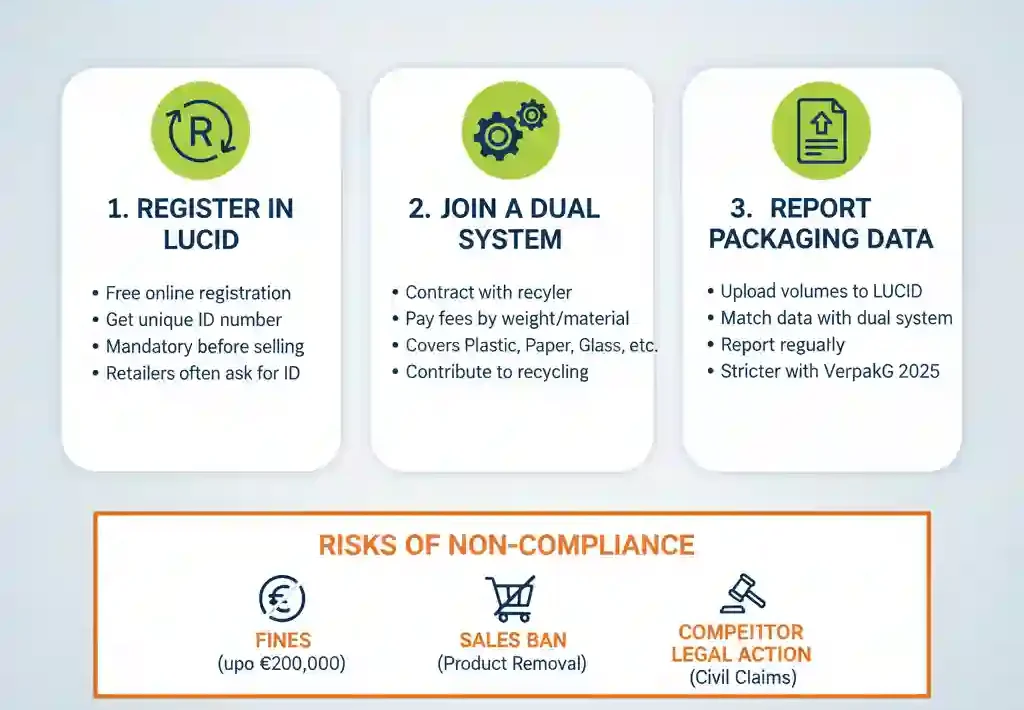
VerpackG requires every producer to complete three essential steps. These steps are the foundation of compliance. Missing any of them can lead to serious problems.
Register in LUCID
Every producer must create a LUCID account before selling any packaged product in Germany. The registration is free, and the company receives a unique identification number.
Retailers often request this number during supplier onboarding. Without the LUCID number, a producer cannot legally license packaging.
This first step is quick, but it is mandatory. Many exporters lose access to the market simply because they never completed this basic registration.
Join a Dual System
After registering in LUCID, the producer must sign a contract with an approved recycling operator. This is often called a dual system. These companies manage the collection and recycling of household packaging across Germany.
The producer must declare the amount of packaging they expect to sell. They then pay fees based on the weight and material.
The system covers materials such as:
- Plastic
- Paper
- Glass
- Aluminium
- Steel
- Composite packaging
Joining a dual system is the central part of producer responsibility. It ensures that companies contribute to the national recycling effort.
Report Packaging Data
The final obligation is reporting. Producers must upload packaging volumes to the LUCID register on a regular basis.
The reports must match the data provided to the dual-system operator. If the numbers do not match, the company may face audits or warnings.
Producers must know the exact weight of each packaging component, including labels, lids and closures.
Data reporting is becoming stricter under Germany VerpackG 2025. This applies especially to companies exporting to Germany from outside the EU.
Risks of Non-Compliance
Germany is known for strict, consistent enforcement. Authorities take action quickly when companies fail to meet their obligations.
Fines and sales bans
The most common consequence is a fine. Penalties can reach up to €200,000 per violation, and higher amounts are possible in repeated cases.
Another major consequence is a sales ban. Retailers must remove non-compliant products from shelves immediately.
This can damage sales, cause supply chain disruptions and lead to lost contracts.
Competitor action
Competitors can also take legal action. Germany allows companies to file civil claims if a competitor is breaking packaging rules.
This can result in legal notices, court hearings and compensation payments.
Many exporters are surprised when this happens. They assume packaging rules are only handled by authorities. In reality, competitor action is common.
A simple example
A simple example shows how this can affect real businesses. A small food producer from Italy exports olive oil to a German distributor.
The producer did not register in LUCID and did not license the packaging. When the shipment arrives, the distributor cannot place the product on the market.
The listing is cancelled, and the Italian producer loses access to the retailer. This type of problem has become more frequent as the Germany VerpackG 2025 updates increase scrutiny.
Supermarket Penalties and Supply Chain Disruptions
Non-compliance can trigger immediate operational problems:
- Retailers may freeze or delay listings until required documents are provided.
- Distributors can cancel orders if packaging data does not match the LUCID register.
- Customs authorities may also stop shipments entering Germany if the producer is not registered.
These delays can lead to missed promotions, lost contracts and supply chain disruption.
What Supermarkets Should Expect From Suppliers
Supermarkets in Germany now expect proper packaging compliance from every supplier, especially in 2025. Retailers typically ask for:
- A LUCID registration number, as proof that the supplier is listed in the official register
- A copy of the dual-system contract showing that packaging volumes have been licensed
- Packaging data, including material composition and total expected volumes for the year
- In some cases, recycling-ready packaging specifications, to ensure the product meets German recycling guidance
Private-label contracts
For private-label items, supermarkets usually include detailed VerpackG clauses in their contracts. These clauses define who is responsible for data reporting and what documents must be submitted.
Retailers want suppliers who understand the rules. Any mistake can lead to product withdrawals or delays.
As packaging rules tighten, supermarkets rely more on strong documentation from every partner in the supply chain.
Real Enforcement Examples
- Amazon Germany has blocked thousands of sellers for missing LUCID registrations.
- Several EU food exporters have had shipments held at customs when packaging data did not match their dual-system declarations.
- Retailers have also delisted private-label suppliers who failed to update packaging weights correctly, causing unexpected compliance failures.
Practical Checklist for Brands and Exporters
Companies preparing to enter the German market can follow a simple sequence of steps:
- Identify whether they qualify as a producer. If they place packaged products on the German market under their brand, they meet the definition.
- Register in LUCID, which is free and quick.
- Choose a dual system.
- Review packaging weights to declare expected volumes.
- Gather all documents in an organised way, because retailers or authorities may ask for proof at any time.
- Report packaging data regularly. Upload accurate numbers that match dual-system declarations.
- Update packaging information each year as formats or materials change.
These steps help prevent the common compliance problems faced by exporters unfamiliar with German law.
Practical Timeline for 2025 Compliance
- Day 1: Register in the LUCID system and obtain the producer ID
- Day 1–3: Sign a contract with a dual-system operator
- Week 1: Collect packaging weights for every component
- Month 1: Submit the first packaging volume forecast
- Quarterly: Report packaging data into LUCID
- Yearly: Update packaging information if materials or formats change
FAQ — Germany VerpackG and LUCID (2025)
Do non-EU exporters need a German representative?
Not always, but many appoint one to manage communication with authorities.
Does LUCID apply to Amazon FBA?
Yes. Sellers using Amazon FBA must register independently.
Does empty packaging count?
Yes. Empty jars, bottles, bags and containers are considered packaging.
Are cosmetics included?
Yes. Personal care and beauty products are fully covered by VerpackG.
What if my supplier refuses to register?
Retailers will block the product until the producer completes registration.
How long does LUCID approval take?
Registration is instant once the form is completed.
Conclusion
Packaging compliance is now a core condition for entering the German market. For supermarkets, FMCG brands, distributors and private-label suppliers, VerpackG is not optional and not a back-office task.
It determines whether a product can appear on shelves. The three pillars of compliance are:
- LUCID registration
- Dual-system participation
- Accurate data reporting
When companies understand these responsibilities, they avoid delays, sales bans and legal risks.
The Germany VerpackG 2025 rules continue to shape how products enter the market. Companies that prepare early will face fewer disruptions. They will also build stronger relationships with German retailers.
This guide gives a simple overview so teams can understand what is required. It is aimed at supply chain, sourcing, export management and packaging development teams.
In a highly regulated market like Germany, clarity and preparation are the biggest advantages.