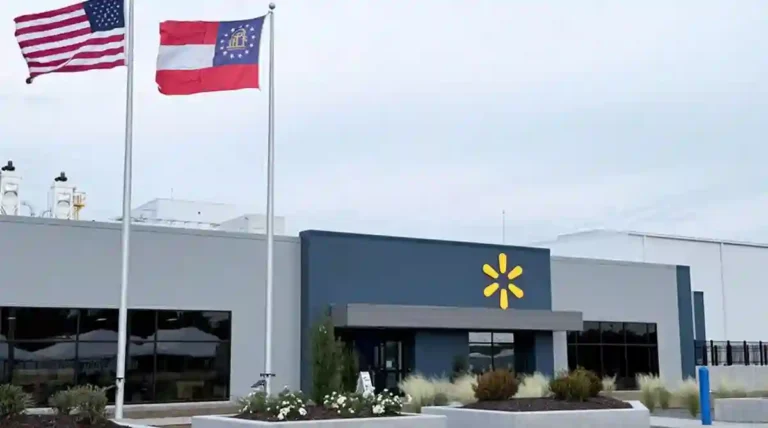

Walmart has opened a new milk processing plant in Valdosta, Georgia, marking its second owned and operated dairy facility in the United States. The $350 million site spans more than 300,000 square feet and will create over 400 jobs across the region.
The facility will supply milk for Great Value and Member’s Mark products, serving more than 650 Walmart and Sam’s Club stores across the Southeast. By processing and bottling milk in-house, Walmart gains greater control over freshness, pricing, and availability — a strategic shift that strengthens its private-label supply chain.
Walmart says the plant will source milk directly from regional dairy farmers. The goal is to shorten the route from farm to shelf, improve transparency in sourcing, and make supply more resilient during periods of cost pressure.
The opening in Georgia builds on Walmart’s earlier dairy investments, including sites in Indiana, Kansas, and an existing facility elsewhere in Georgia. It forms part of a broader move into in-house food manufacturing across high-volume staple categories.
Why This Move Matters
This expansion gives Walmart more direct control over a core everyday product. Tighter integration means steadier pricing, fewer bottlenecks, and better consistency for shoppers who rely on private-label milk as a household staple.
It also intensifies pressure on national dairy brands. When a retailer the size of Walmart handles its own processing, branded suppliers must compete not only on price and quality but also on speed and flexibility.
The move comes as fresh and perishable categories continue to shape shopper behaviour. Insights from the wider U.S. produce sector — covered in our US fresh produce market 2025 analysis — show how big retailers are investing heavily in freshness, sourcing, and supply chain efficiency. Walmart’s new plant aligns with this shift, embedding dairy into a broader fresh-food strategy.
Private label performance is another key factor. As noted in our US FMCG trends 2025 report, rising living costs and ongoing value-driven shopping have strengthened private-label demand. With this new facility, Walmart positions itself to capture even more of that growth through better cost control and consistent quality.
Walmart’s investment also reinforces its competitive advantage across the national grocery landscape. The retailer already leads the sector, topping the list in our Top 10 grocery stores in the U.S. ranking. Adding deeper control over core categories such as dairy makes it harder for rivals to match Walmart on price stability and supply resilience.
What Competitors Should Expect
Traditional supermarket chains that rely on third-party processors face a challenge matching Walmart’s vertical-integration capabilities.
Discount retailers with strong private-label programmes may strengthen partnerships or explore regional production options to narrow the gap.
National dairy brands may need to adjust their strategies as Walmart increases the share of private-label milk it produces internally.
What Happens Next
Industry analysts expect Walmart to continue investing in owned food-manufacturing sites, especially in categories closely linked to household budgets. Further expansion into dairy, ready-to-eat foods, bakery, and beverages is likely as the company grows its private-label offer.
In an environment shaped by fresh-food trends, private-label growth, and supply-chain efficiency, this new plant places Walmart in an even stronger competitive position heading into 2026.
Editor’s Note
All information in this article is based on Walmart’s official announcement issued on 2 December 2025, supported by industry reporting and background analysis on U.S. supermarket competition, FMCG trends, and fresh-produce market performance.