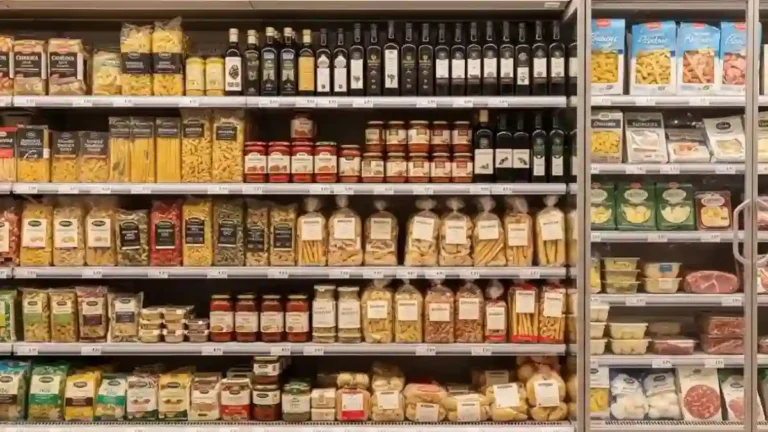

Private label in the food industry is no longer a secondary or defensive strategy. In Italy, it has entered a new phase. That phase is shaped by premiumisation, regional identity and growing interest from both distributors and producers.
What was once seen mainly as a value alternative is now becoming a strategic tool. It supports differentiation, export growth and margin control.
Across Europe, private label continues to gain ground as shoppers reassess value, quality and trust. But Italy’s private label story stands apart.
The country has a deep food culture, strong regional identities and globally recognised production standards. As a result, private label is evolving differently from markets such as the UK or Germany.
Italian private label does not compete purely on price. It is increasingly built around quality, provenance and authenticity.
This article examines how private label in the Italian food industry is changing and where growth is coming from. It also looks at what this shift means in practical terms for buyers, distributors and producers.
The focus is not on theory. It is on market structure, commercial opportunities and how the Italian ecosystem is adapting.
The Growth Of Private label In The Food Industry
Private label has been one of the most consistent growth stories in the European food industry over the past decade.
Rising living costs first accelerated demand, but growth has continued even as inflation pressures ease. This reflects a deeper change in how consumers see retailer-owned brands.
Where private label has gained share
Across Europe, private label has gained market share in core food categories:
- dairy
- ambient grocery
- frozen foods
- ready meals
Consumers increasingly see private label as offering comparable quality to branded products, often at a more attractive price. Improvements in sourcing, recipe development, packaging and quality assurance have played a major role in this shift.
How Italy caught up
Italy entered this trend later than some northern European markets. Historically, Italian consumers showed strong loyalty to national and regional brands. This was especially true in food categories linked to tradition and origin.
As a result, private label penetration stayed lower than in markets like the UK, Germany or Spain. However, this gap has narrowed significantly in recent years.
Growth in Italy has been driven less by aggressive price positioning and more by selective expansion. Retailers have invested in fewer but better-developed private label ranges. They focus on quality cues that resonate with Italian shoppers.
These categories have shown especially strong momentum:
- fresh pasta
- sauces
- bakery products
- chilled meals
- regional specialities
This pattern aligns with broader private label trends across Europe, where growth is increasingly tied to trust, quality perception and product relevance rather than price alone. In Italy, that shift is especially strong.
Private label is not replacing branded products wholesale. But it is becoming a credible and often preferred option in specific segments.
Premiumisation And Changing Consumer Expectations In Italy
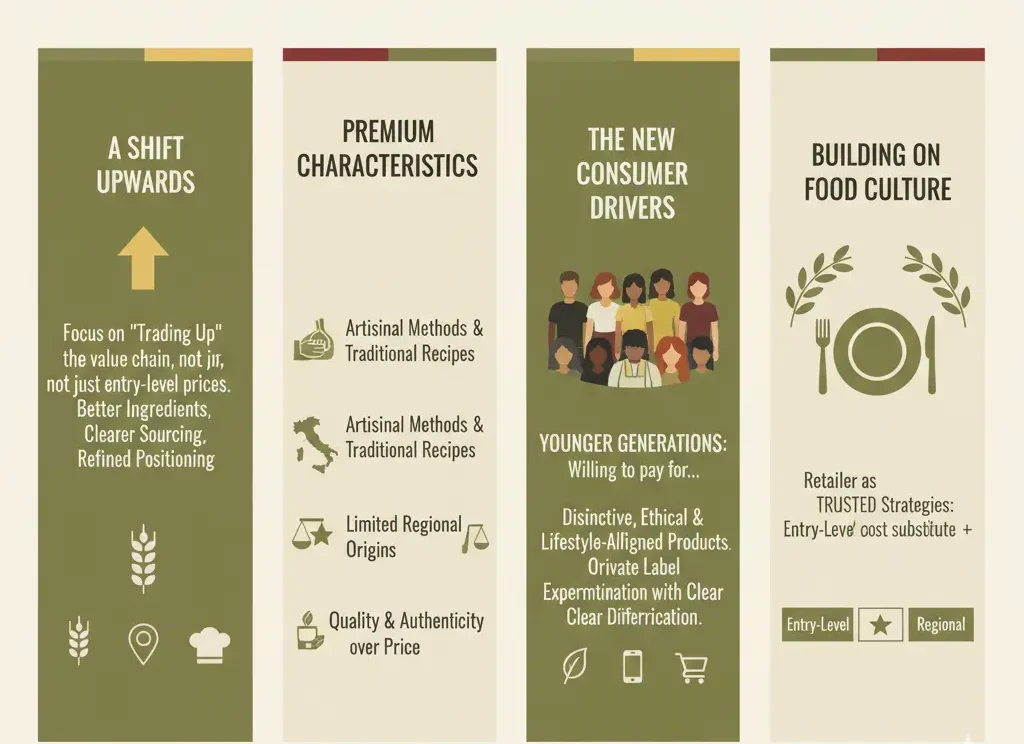
Premiumisation is one of the defining features of Italy’s private label evolution. Italian retailers have not expanded aggressively at entry-level price points. Instead, they have focused on moving private label up the value chain.
Premium private label in Italy is marked by:
- better ingredients
- clearer sourcing information
- more refined product positioning
Many ranges now highlight artisanal methods, traditional recipes or limited regional origins. This approach reflects how Italian consumers think about food. Quality and authenticity often matter more than price alone.
The role of younger shoppers
Younger consumers have played a key role in speeding up this shift. Value remains important, especially in everyday staples. Yet younger shoppers are more willing to pay for products that feel distinctive, ethical or aligned with their lifestyle.
They are also more open to trying private label. This is especially true when products offer clear differentiation rather than imitation.
Building on food culture
In Italy, premium private label does not contradict food culture. It builds on it.
Italian shoppers are already used to judging food by origin, ingredients and preparation. When private label products meet these expectations, the retailer brand becomes a trusted curator rather than a low-cost substitute.
This has encouraged retailers to develop multi-tier private label strategies. In these, entry-level products coexist with premium and regionally inspired lines.
The result is a more segmented private label offer. It mirrors branded category structures while keeping retailer control.
Regional Cuisine And “Made in Italy” As Private label Drivers
Italy’s regional diversity gives its private label market a structural advantage. Few countries can draw on such a wide range of recognised regional cuisines, local ingredients and traditional recipes.
This diversity has become a powerful tool for private label differentiation.
Retailers and distributors increasingly use regional identity to build credibility and trust. Products linked to specific regions, production methods or culinary traditions signal authenticity and quality. They do this without relying on national brands.
For consumers, these cues reduce perceived risk and strengthen emotional connection.
Origin and transparency
Regional private label ranges also let retailers tell clearer stories about origin and transparency. Information about sourcing, production standards and ethical practices becomes part of the value proposition. It is no longer just a regulatory requirement.
This is especially important as sustainability expectations rise across Europe.
In Italy, regional storytelling often reinforces premium positioning. A product linked to a specific area or tradition is not expected to be the cheapest option.
Instead, it competes on uniqueness and perceived craftsmanship. Private label, when done well, fits naturally into this framework.
Opportunities For Distributors In The Italian Private Label Market
For distributors, private label offers a level of strategic control that branded products cannot match. It gives greater influence over:
- pricing
- margins
- assortment
- long-term positioning
In Italy, where competition between retailers is intense, this control has become increasingly valuable.
Private label lets distributors differentiate beyond price promotions. They can curate ranges around quality, regional specialities or premium positioning. This builds stronger customer loyalty and reduces direct price comparisons with competitors.
Innovation and producer access
Innovation plays a central role here. Italian private label success is often tied to the ability to introduce new concepts, seasonal products or regionally inspired items that feel relevant and timely.
This requires close coordination with producers and a strong understanding of consumer expectations.
Access to the right producers is critical. Distributors that secure reliable partners with the capacity and flexibility to support private label development gain a clear advantage.
Efficient sourcing, quality consistency and the ability to scale selectively all influence long-term success.
Trade Events As Sourcing And Development Channels
Trade events play a practical role in supporting Italy’s private label ecosystem.
For distributors and buyers, industry fairs are not simply promotional platforms. They work as active settings where sourcing decisions and product development discussions take place.
Buyers use these events to:
- identify private label-ready producers
- assess product quality
- explore premium or regional concepts
Tastings, packaging reviews and direct discussions with producers allow faster evaluation than remote sourcing alone.
For private label specifically, trade events help shorten development cycles. Distributors can compare suppliers, test category ideas and start negotiations in one concentrated setting.
Italy’s food and drink trade events form part of the infrastructure that supports private label growth. They connect retailers with capable producers across regions and categories.
The Role Of Producers In Italian Private label Growth
For Italian producers, private label partnerships offer a route to scale, stability and international exposure.
Supplying private label lets producers enter new markets through established retail networks. This often carries lower commercial risk than launching branded products abroad.
Benefits for producers
Private label production can help smooth demand cycles and improve capacity use. Long-term agreements with distributors provide volume predictability. This is especially valuable for small and mid-sized producers.
Challenges for producers
However, private label also brings challenges. Producers must:
- maintain strict quality control
- adapt to customised specifications
- remain flexible in response to retailer requirements
Over-reliance on a single buyer can increase risk, especially if margins tighten or strategies change.
Successful producers balance private label production with branded output. This ensures diversification while using the strengths of each model.
Financial stability, operational discipline and clear partnership terms are essential to keeping this balance.
Packaging, Branding, And Quality Perception
Packaging has become one of the most visible signals of private label quality in Italy. As private label moves into premium territory, packaging design plays a critical role. It communicates origin, authenticity and sustainability.
Italian private label packaging increasingly mirrors the visual language of premium brands. It uses restrained design, a clear information hierarchy and materials that signal quality.
This is especially important in competitive retail settings where private label products sit alongside well-established brands.
In foodservice as well as retail, packaging helps position private label as a credible alternative rather than a compromise. Sustainability considerations also influence perception and purchasing decisions. These include recyclable materials and reduced plastic use.
This shift reflects wider packaging innovation in Italy, where design and material choices are closely linked to brand identity and shelf impact.
For private label, packaging is no longer a cost-driven afterthought. It is a strategic asset.
Frequently Asked Questions
Why is private label growing in Italy?
Growth has been driven less by aggressive pricing and more by selective expansion. Retailers have invested in fewer but better-developed ranges built around quality, provenance and authenticity.
Which Italian private label categories are growing fastest?
Fresh pasta, sauces, bakery products, chilled meals and regional specialities have shown especially strong momentum.
What do producers gain from supplying private label?
Private label offers producers a route to scale, stability and international exposure. Long-term agreements also provide volume predictability, which is especially valuable for small and mid-sized producers.
Market Outlook For Italian Private label
The outlook for Italian private label remains positive, but growth will be increasingly selective. Three factors will shape the next phase:
- continued premiumisation
- demand for sustainable and local products
- closer collaboration between distributors and producers
Growth is unlikely to come from volume expansion alone. Instead, success will favour those who invest in quality consistency, strong partnerships and clear positioning.
Margin pressure, retailer power and operational complexity will remain constraints, especially for smaller producers.
Italian private label is evolving into a mature, export-capable segment of the food industry. As it does, it is redefining the role of retailer brands. They are no longer low-cost alternatives, but credible expressions of Italian food culture adapted to modern retail realities.