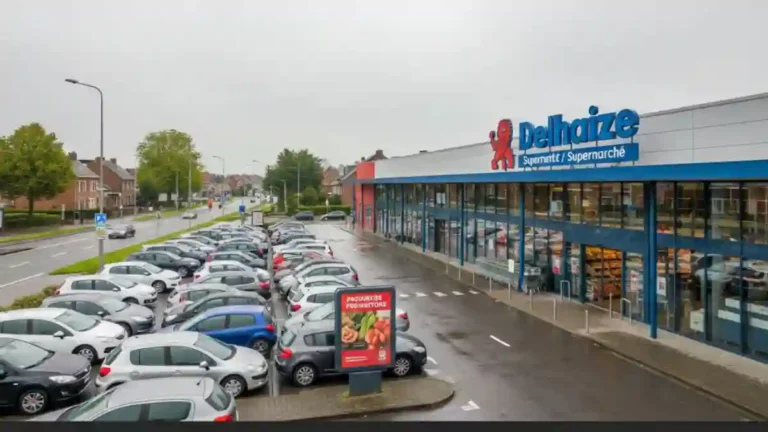

Belgium may be a small country, but it has one of the most competitive grocery retail markets in Europe.
In 2025, supermarkets in Belgium operate in a mature, high-pressure environment shaped by strong discounters, demanding shoppers, and well-developed private label strategies.
The Belgian grocery market matters because it often sets patterns seen later in nearby countries.
Price discipline is strict.
Margins are thin.
Retailers move fast when competitors shift.
For FMCG suppliers, exporters, packaging producers, and retail-technology providers targeting the Belgium FMCG landscape, this is a market that rewards preparation and punishes shortcuts.
The Belgian Grocery Market at a Glance
Belgium’s grocery sector is characterised by high store density and limited population growth.
Most consumers already have access to multiple supermarkets within a short distance.
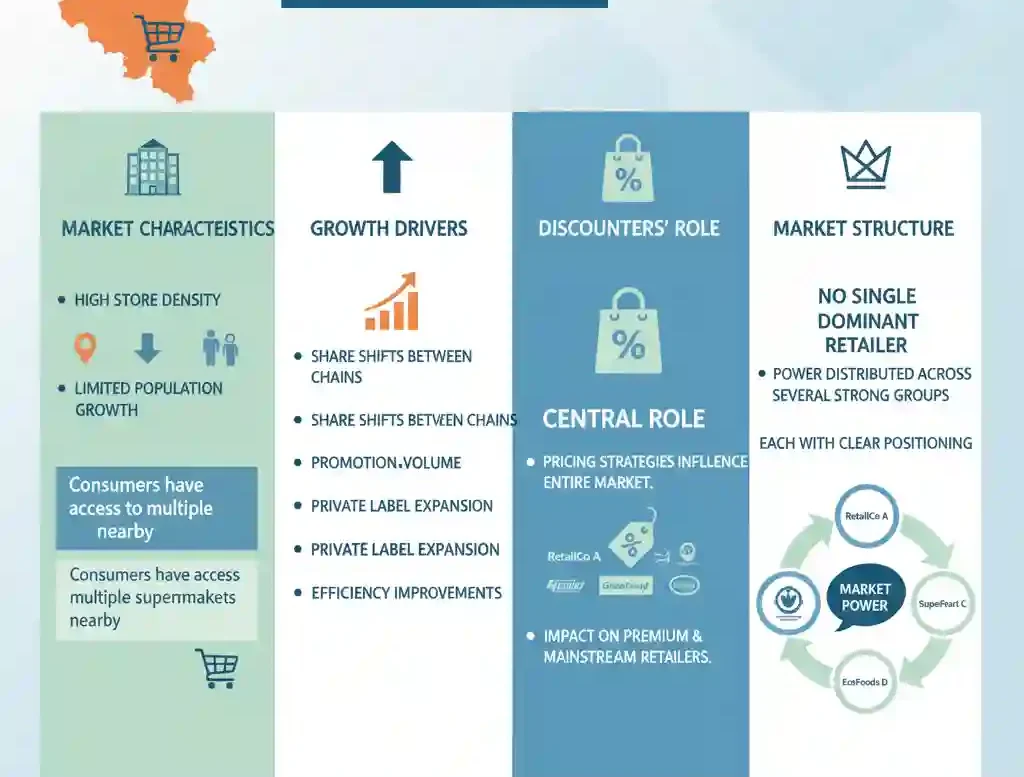
This means growth comes less from new store openings and more from:
Share shifts between chains
Promotion-driven volume
Private label expansion
Efficiency improvements
Discounters play a central role.
Their pricing strategies influence the entire market, including premium and mainstream retailers.
Unlike some larger European countries, Belgium does not rely on one dominant retailer.
Instead, market power is distributed across several strong groups, each with a clear positioning.
This structure makes Belgium a reference point for suppliers planning broader FMCG market entry in Western Europe.
Colruyt Group: Price Leadership as a System
Colruyt is the most influential food retailer in Belgium.
Its impact goes beyond its own stores and shapes pricing expectations across the entire market.
The chain is built around everyday low pricing rather than short-term promotions.
Prices are monitored continuously against competitors and adjusted when needed.
Store formats are functional and efficient.
Assortments are controlled, with limited duplication and clear price tiers.
Private label is central to Colruyt’s strategy.
Its own-brand portfolio spans value, core, and premium segments, giving the group strong leverage in supplier negotiations and logistics planning.
Colruyt’s sustainability initiatives focus on energy efficiency, transport optimisation, and waste reduction — always aligned with cost discipline.
Technology investment prioritises forecasting, supply-chain control, and internal systems rather than customer-facing innovation.
For suppliers in the Belgium FMCG ecosystem, Colruyt represents scale, stability, and strict cost expectations.
Delhaize: Quality, Fresh, and Loyalty-Driven
Delhaize operates at the premium end of supermarkets in Belgium, though price still matters.
The chain competes on food quality, fresh categories, and range depth.
Its network includes large supermarkets, neighbourhood stores, and a strong franchise model.
Urban convenience plays a growing role.
Private label is positioned around quality, health, and sustainability rather than just price.
This creates space for suppliers offering differentiated ingredients, clean-label products, and value-added food packaging.
Delhaize is advanced in loyalty and data usage.
Personalised offers, digital coupons, and omnichannel services influence purchasing behaviour.
From a supplier perspective, Delhaize is relevant for:
Premium private label development
Sustainable packaging solutions
Retail technology partnerships tied to loyalty and data
Carrefour Belgium: Promotion-Led Mainstream Retail
Carrefour remains one of the most visible international players in Belgium.
Its strategy has shifted over time, with less emphasis on hypermarkets and more focus on flexible formats.
The chain relies heavily on promotions to maintain price competitiveness.
Weekly offers and seasonal campaigns drive traffic and volume.
Private label plays an important role but competes directly with strong A-brand presence.
This mixed model benefits suppliers that can support both branded and own-label strategies.
Carrefour’s technology investments focus on checkout efficiency, pricing systems, and logistics.
Sustainability messaging exists but is secondary to value perception.
For packaging suppliers, Carrefour’s promotional intensity creates demand for promo-ready packaging formats and fast turnaround capabilities.
Aldi Belgium: Disciplined Discount Retail
Aldi is a key price setter in the Belgian market.
Its limited-assortment model defines expectations around cost and efficiency.
Stores are compact and range discipline is strict.
Private label dominates the assortment, with minimal A-brand presence.
In recent years, Aldi has invested in store upgrades and fresh food presentation.
However, price leadership remains the core promise.
For suppliers, Aldi offers limited entry points.
Listings are few, volumes are high, and cost pressure is intense.
Packaging requirements are standardised and efficiency-focused, making Aldi relevant mainly for suppliers with strong cost-optimised packaging production.
Lidl Belgium: Value with a Broader Offer
Lidl competes directly with Aldi but with a slightly broader and more flexible proposition.
It positions itself as value without sacrificing quality.
Stores are modern, with strong emphasis on bakery and fresh food.
Weekly non-food promotions continue to attract traffic.
Private label is the backbone of Lidl’s assortment, including premium and organic ranges.
The chain communicates sustainability more actively than most discounters.
This creates opportunities for suppliers offering sustainable packaging, recyclable materials, and clear on-pack environmental messaging.
SPAR, Belgium: Local and Convenience-Focused
SPAR operates mainly through neighbourhood and convenience formats.
Most stores are independently operated, giving them flexibility in assortment and sourcing.
Price positioning is less aggressive than discounters.
Local relevance, service, and convenience matter more.
Private label exists but plays a smaller role.
Local and regional brands often have stronger visibility.
SPAR is suitable for niche FMCG suppliers, regional producers, and companies testing smaller-batch packaging formats in the Belgian market.
Intermarché Belgium: Cooperative and Growing
Intermarché has a smaller footprint in Belgium but continues to expand selectively.
Its cooperative structure gives store owners autonomy within a shared framework.
Positioning is mainstream with a value focus.
Private label plays an important role, supported by group manufacturing assets in France.
Cross-border sourcing influences pricing and assortment decisions.
For suppliers, this can open doors to multi-country listings using aligned specifications and shared packaging standards.
Summary Table: Major Supermarket Chains in Belgium
| Chain | Format Focus | Store Count (Band) | Positioning |
|---|---|---|---|
| Colruyt | Supermarkets | 200+ | Value / Price-led |
| Delhaize | Supermarkets, Convenience | 700+ (incl. franchise) | Premium / Quality |
| Carrefour | Hyper, Supermarket, Convenience | 600+ | Mainstream / Promo |
| Aldi | Discount Supermarkets | 400+ | Discounter |
| Lidl | Discount Supermarkets | 300+ | Discounter+ |
| SPAR | Convenience / Local | 300+ | Local / Service |
| Intermarché | Supermarkets | 150+ | Mainstream Value |
Store counts shown as broad bands to reflect ongoing network changes.
Shopper Behaviour in Belgium
Belgian shoppers are highly price sensitive and promotion driven.
They compare retailers actively and switch stores easily.
Weekly leaflets remain influential, though digital channels are gaining ground.
Loyalty cards play a major role, especially at Delhaize and Carrefour.
Language is a critical factor.
Packaging, promotions, and shelf communication must match Dutch-speaking and French-speaking regions accurately.
Cross-border shopping is common, particularly near France, the Netherlands, and Luxembourg.
This reinforces price awareness and range comparison.
Private label acceptance is high.
Belgium is one of Europe’s most developed private label grocery markets, with strong consumer trust in retailer brands.
Technology and Operations in Belgian Supermarkets
Technology adoption in Belgium is pragmatic.
Retailers invest where there is a clear return.
Self-checkout is widespread, especially in urban stores.
Scan-and-go solutions are expanding gradually.
Data is used primarily for promotions, loyalty optimisation, and demand forecasting.
Advanced in-store digital experiences are less common than in Nordic or UK markets.
These trends align with broader retail technology in supermarkets, where efficiency outweighs experimentation.
What This Means for Suppliers
Belgium is not an easy entry market.
But it is a structured and predictable one.
Pricing must be competitive and transparent.
Mid-priced products without differentiation struggle.
Promotional support is expected.
Retailers plan frequent price actions and require supplier participation.
Packaging must be bilingual and compliant.
Errors in labelling, language, or sustainability claims can delay or block listings.
Private label offers significant opportunities, especially for flexible producers.
Retailers actively seek partners that can support cost control, quality consistency, and fast development cycles.
All of this reflects the wider dynamics of the Belgium FMCG environment, where operational reliability matters as much as product quality.
Final Takeaway
In 2025, supermarkets in Belgium operate in one of Europe’s most disciplined grocery markets.
Discounters shape pricing.
Private label drives margins.
Shoppers remain highly informed and demanding.
For FMCG suppliers, packaging companies, and retail-technology providers, success in Belgium depends on preparation, localisation, and long-term commitment — not quick wins.