
Private label manufacturing in Greece is not about chasing volume. It is a controlled sourcing market shaped by long-standing retailer relationships, strict audit requirements, and suppliers that buyers rarely change once approved.
For European buyers in 2026, Greece plays a very specific role. It is not the cheapest option and not a testing ground for new concepts. It is a reliable, EU-based supply base that has become more strategic as retailers work to de-risk their supply chains.
This report ranks the top five private label manufacturers in Greece using the same criteria buyers use in real procurement decisions: existing retailer contracts, proven production capacity and recent expansion signals, export reliability within the EU, a clear focus on private label, and audit and ESG readiness.
Why Greece Is a Strategic Hub for Private Label in 2026
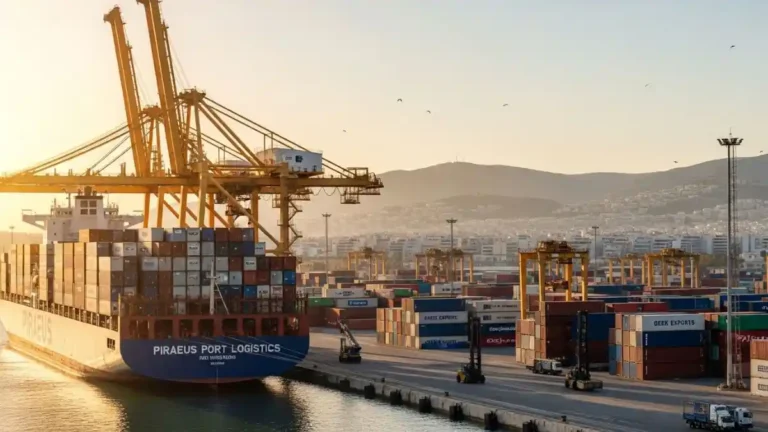
Greece has become a strategic sourcing hub for European private label in 2026. Its value is no longer only in competitive labour costs. Retailers increasingly rely on Greek suppliers to de-risk supply chains and shorten lead times, especially amid disruptions such as those affecting the Suez Canal. Piraeus port provides a direct gateway to import raw materials from Asia, process them locally, and ship products into the EU faster than sourcing directly from Asia.
This report focuses on ambient and non-chilled private label production. Chilled dairy products, including Greek yogurt, feta, and ice cream, follow a separate sourcing model and are dominated by specialist producers like Hellenic Dairies (Olympus) and Kri Kri. These categories are intentionally excluded to keep the analysis relevant for European retailers seeking stable dry-goods and packaged food suppliers.
How This Ranking Works
Manufacturers are ranked using buyer-weighted criteria, not revenue or brand visibility.
Ranking logic:
- Long-term retailer contracts
- Proven production capacity
- Share of output dedicated to private label
- EU export footprint
- Retail audit and ESG readiness
Revenue alone is not a deciding factor.
Marketing presence is irrelevant.
5 Private Label Manufacturers in Greece
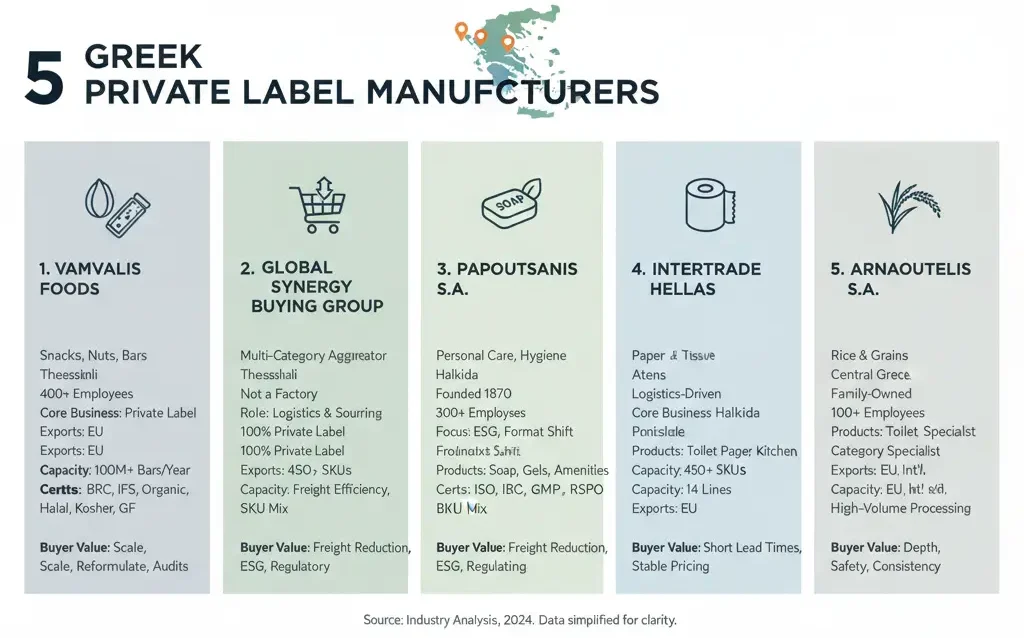
1. Vamvalis Foods S.A.
Category: Snacks, nuts, functional bars
Headquarters: Thessaloniki
Ownership: Private, family-led
Employees: 400+
Vamvalis Foods is the anchor supplier in Greek private label food manufacturing.
By 2026, it is no longer just a nuts and bars producer.
It is a functional snack platform supplying European retailers at scale.
What They Produce
- Roasted nuts and seeds
- Dried fruit
- Protein bars
- Functional snack bars (vegan, low-sugar, high-protein)
- Organic snack ranges
Private Label Role
- Private label is the core business
- Long-run retail programmes
- Limited brand conflict
Retailer Fit
- Discounters
- Supermarkets
- Value-driven premium private label
Export Markets
- Germany
- Italy
- Nordics
- Central Europe
- Select UK contracts
Capacity Signals
- 100m+ bars annually
- Multiple high-speed production lines
- Dedicated private label R&D for reformulation
Certifications
- BRC
- IFS
- EU Organic
- Halal
- Kosher
- Gluten-free compliance
Buyer Reality
Retailers stay because Vamvalis can:
- Reformulate without disruption
- Scale quickly
- Pass audits routinely
Key risk buyers manage:
Raw material volatility in nuts, cocoa, and protein inputs.
2. Global Synergy Buying Group (GSBG)
Category: Multi-category private label aggregation
Headquarters: Thessaloniki
Ownership: Private group
GSBG is not a factory.
It is a private label logistics and sourcing engine.
For buyers in 2026, its value is not margin arbitrage.
It is freight efficiency and complexity reduction.
What They Supply
- Packaged foods
- Grocery staples
- Household goods
- Selected personal care SKUs
Private Label Role
- 100% private label focused
- Framework contracts
- No consumer brands
Retailer Fit
- Discounters
- Multi-category retail groups
- Wholesalers reducing supplier count
Export Markets
- EU
- Mediterranean
- Selected Middle East buyers
Capacity Signals
- 450+ active SKUs
- Parallel supplier base
- Centralised quality and compliance control
Certifications
- ISO 9001
- BRC Agents & Brokers
- IFS Broker
Buyer Reality
GSBG allows retailers to:
- Fill containers with mixed SKUs
- Reduce partial-load freight
- Lower total landed cost, even if unit price is higher
Key risk buyers manage:
Higher per-unit pricing versus direct factory sourcing.
3. Papoutsanis S.A.
Category: Personal care and hygiene
Headquarters: Halkida
Founded: 1870
Ownership: Publicly listed / controlled group
Employees: 300+
Papoutsanis is not selling soap in 2026.
It is selling format change and ESG compliance.
What They Produce
- Bar soap
- Liquid soap
- Shower gels
- Body care
- Hotel and travel amenities
Private Label Role
- Significant private label share
- Long-term retail programmes
- Stable formulations
Sustainability & Format Shift
- Solid cosmetics (waterless formats)
- Refill systems
- Packaging reduction projects
- Hotel-to-retail crossover SKUs
Retailer Fit
- Drugstores
- Supermarkets
- Hospitality supply chains
Export Markets
- EU
- Selected international markets
Certifications
- ISO 9001
- ISO 22716 (Cosmetics GMP)
- RSPO compliance
Buyer Reality
Papoutsanis is chosen because it:
- Reduces plastic exposure
- Supports ESG targets
- Delivers regulatory certainty
Key risk buyers manage:
Energy costs in chemical processing.
4. Intertrade Hellas
Category: Paper and tissue products
Headquarters: Athens
Ownership: Private, ecosystem-linked
Intertrade Hellas is a logistics-driven private label paper supplier.
By 2026, its advantage is location as much as capacity.
What They Produce
- Toilet paper
- Kitchen rolls
- Napkins
- Professional tissue products
Private Label Role
- Core business
- Long-volume retail contracts
- Minimal branding
Capacity Signals
- 14 production lines
- Multi-site production including Inofita industrial zone
- Near-port converting capability
Export Markets
- EU supermarkets
- Wholesale and professional buyers
Buyer Reality
Retailers value:
- Short lead times
- Predictable output
- Stable pricing structures
Key risk buyers manage:
Pulp commodity price swings.
5. Arnaoutelis S.A.
Category: Rice and grains
Headquarters: Central Greece
Ownership: Family-owned
Employees: 100+
Arnaoutelis is a category specialist, not a generalist.
It plays a quiet but critical role in private label staples.
What They Produce
- Rice (multiple origins)
- Grain blends
- Retail and bulk formats
- Ancient grain and mixed blends
Private Label Role
- Core activity
- Long-term supply relationships
Export Markets
- EU retailers
- International wholesalers
Capacity Signals
- High-volume processing
- Advanced cleaning and ecological fumigation
- Stable throughput
Buyer Reality
Chosen for:
- Category depth
- Food safety reliability
- Export consistency
Key risk buyers manage:
Water scarcity in Central Greece.
Product Categories & Retail Fit
| Manufacturer | Core Categories | Best Retail Fit | Private Label Depth |
|---|---|---|---|
| Vamvalis Foods | Snacks, functional bars | Discounters, supermarkets | High |
| GSBG | Multi-category | Retail groups | High |
| Papoutsanis | Personal care | Drugstores | Medium–High |
| Intertrade Hellas | Paper goods | Supermarkets | High |
| Arnaoutelis | Rice, grains | Staples buyers | High |
Capacity & Export Strength
| Manufacturer | Capacity Signal | Export Reach | Contract Stability |
|---|---|---|---|
| Vamvalis Foods | 100m+ units/year | EU-wide | Long-term |
| GSBG | 450+ SKUs | EU/MENA | Framework |
| Papoutsanis | Integrated site | EU | Multi-year |
| Intertrade Hellas | 14 lines, near-port | EU | Volume-based |
| Arnaoutelis | Category scale | EU/global | Specialist |
2026 Competitive Edge vs Buyer Risk
| Manufacturer | 2026 Edge | Buyer Risk |
|---|---|---|
| Vamvalis Foods | High-protein & vegan snack capability | Raw material volatility |
| GSBG | Freight optimisation, mixed-SKU containers | Higher unit cost |
| Papoutsanis | Solid cosmetics & refill formats | Energy costs |
| Intertrade Hellas | Near-port logistics | Pulp price swings |
| Arnaoutelis | Ancient grains & blends | Water scarcity |
Who Retailers Actually Trust
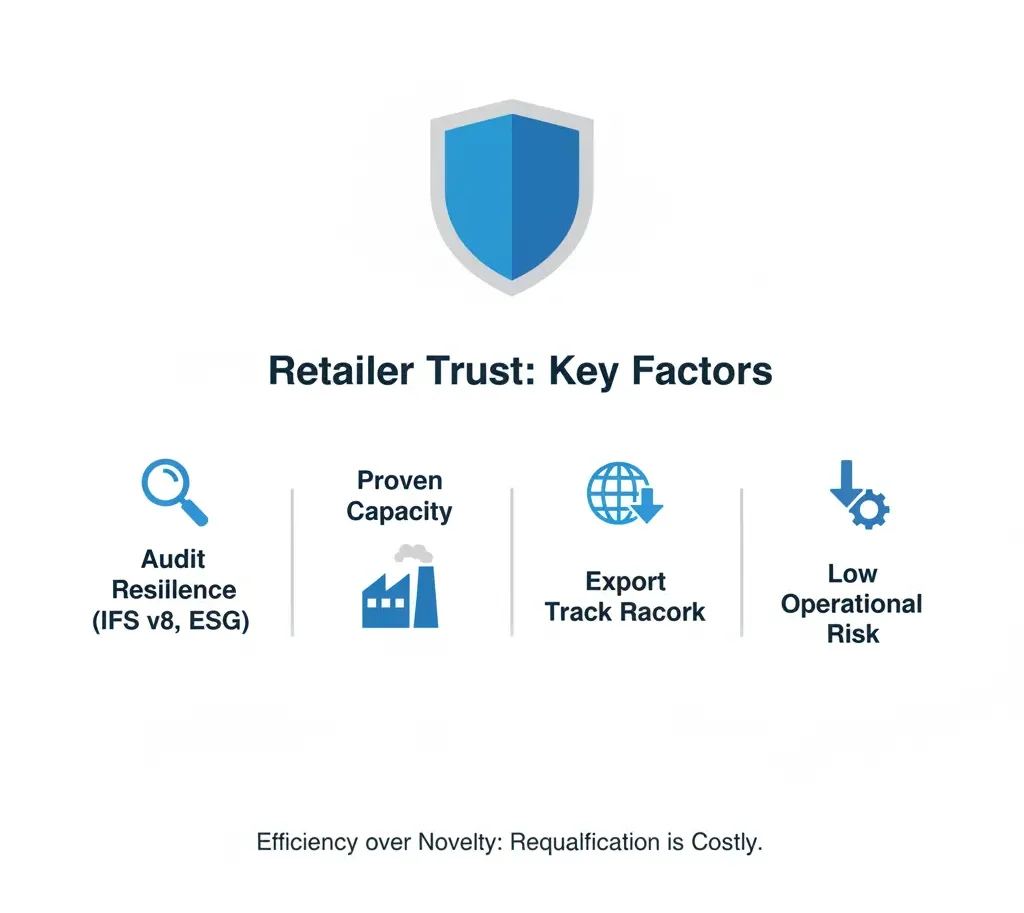
Buyers do not chase novelty.
They look for:
- Audit resilience (IFS Food v8, ESG alignment)
- Capacity proof
- Export track record
- Low operational risk
Suppliers survive because retailers do not want to requalify factories.
Market Outlook: Greek Private Label to 2030
Greek private label manufacturing is expected to grow selectively through 2030. The strongest expansion is likely in functional snacks, household essentials, and basic personal care products that carry measurable ESG value.
At the same time, growth will remain limited for mass-market colour cosmetics and ultra-low-margin commodity FMCG, where Greece has less competitive strength.
Overall, the trend points to a market with fewer suppliers, deeper long-term contracts, and higher expectations from European retailers in terms of quality, compliance, and sustainability.
Final Buyer Takeaway
Greece has become an important sourcing hub for European private label in 2026. Its advantage is no longer just competitive labour costs. Retailers increasingly turn to Greek suppliers to reduce supply chain risk and secure shorter lead times, particularly in the face of disruptions such as those affecting the Suez Canal. The port of Piraeus allows manufacturers to import raw materials from Asia, process them locally, and ship products into the EU faster than sourcing directly from Asia.
This report focuses specifically on ambient and non-chilled private label production. Chilled dairy products, including Greek yogurt, feta, and ice cream, follow a different sourcing model and are dominated by specialist producers such as Hellenic Dairies (Olympus) and Kri Kri. These categories are intentionally excluded to keep the analysis focused on dry goods and packaged foods that provide stable, reliable supply for European retailers.
Editor’s Note: This analysis uses publicly available private label data and reflects the market as of 2026. Figures and insights are for reference and may change with new developments.