
A robot-powered delivery service has launched in Barnsley, UK, marking a new step in how automation is moving into everyday retail logistics. The pilot gives thousands of households access to autonomous last-mile delivery, as retailers and delivery platforms test new ways to reach customers faster and at lower cost.
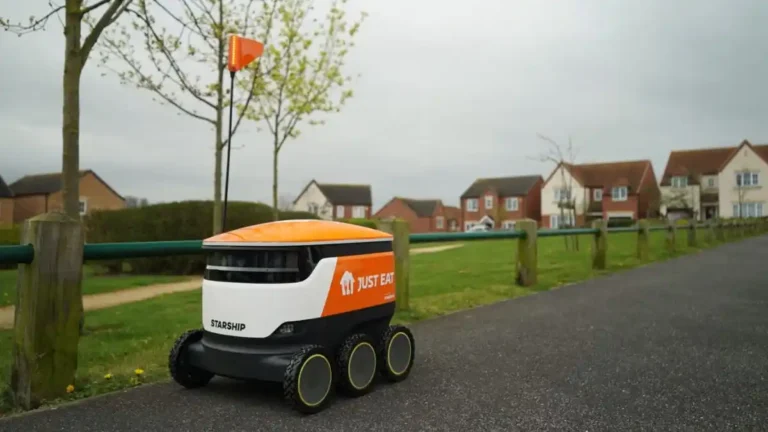
The rollout is led by Just Eat in partnership with Starship Technologies. The service is now live across parts of North East Barnsley, covering around 11,000 households in areas including Carlton, Athersley, Monk Bretton and Lundwood.
A small fleet of pavement-based robots is being used to deliver orders directly from local outlets to customers’ doors. The machines operate with advanced autonomy, navigating pavements, avoiding obstacles and crossing roads without human control.
While the current focus is on restaurant meals, the wider relevance sits firmly in retail technology. Last-mile delivery remains one of the most expensive and complex parts of the supply chain, and automation is increasingly being tested as a solution.
There is already a clear link to grocery. Co-op has been working with Starship robots in several UK locations, using the technology to deliver everyday essentials from local stores. That overlap is where the long-term impact for supermarkets becomes clearer.
Globally, Starship has completed nearly 10 million deliveries and operates thousands of robots across multiple markets. In the UK, the company has been active since 2018 and is now expanding into more towns as part of a wider rollout strategy.
The Barnsley launch also ties into broader regional ambitions, as the town positions itself as a centre for applied technology and innovation. Autonomous delivery is expected to play a role in how new systems are tested at community level before wider adoption.
Why it matters
For UK supermarkets, this is less about food delivery and more about what comes next. Autonomous robots offer a potential way to cut last-mile costs, reduce reliance on drivers and improve delivery speed in dense local areas.
The technology is particularly relevant for convenience formats, where short-distance delivery is common and margins are tight. If scaled, it could reshape how neighbourhood stores compete with rapid delivery platforms.
There is also a sustainability angle. Replacing short car trips with small electric robots could help retailers reduce emissions linked to local deliveries, an area under increasing pressure from regulators and consumers.
The Barnsley pilot is still early, but it signals a direction of travel. Automation is moving closer to everyday retail operations, and grocery is likely to be one of the next sectors to see wider adoption.
Editor’s Note: This article is based on official company release material and supporting industry context to reflect wider retail and grocery implications.