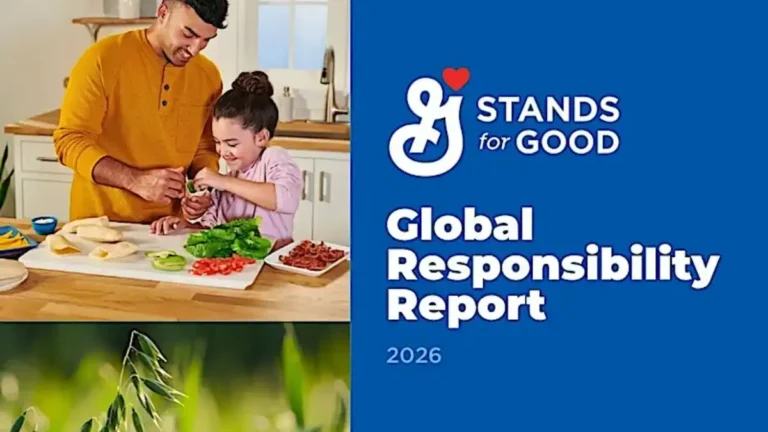

General Mills has released its 2026 Global Responsibility Report, detailing progress across food innovation, sustainability, and community programs during fiscal year 2025. The report covers operations across global markets and highlights advancements in packaging, regenerative agriculture, emissions reduction, and food donations as the company strengthens its long-term environmental and social commitments.
The update focuses on three core areas — Food, Planet, and People — and reflects ongoing changes across General Mills’ global supply chain, manufacturing network, and brand portfolio.
What is a Global Responsibility Report?
A Global Responsibility Report is a corporate disclosure document that outlines a company’s environmental, social, and governance (ESG) performance. It typically tracks progress on sustainability goals, ethical sourcing, emissions, waste reduction, and community investment across global operations during a defined financial year.
At a glance
- Report covers fiscal year 2025 performance (May 2024–May 2025)
- More than 800,000 acres engaged in regenerative agriculture
- 95% of packaging is recyclable or reusable by weight
- 14% reduction in total value chain greenhouse gas emissions
- Over $83 million in global food and charitable donations
- 7.9 billion meals enabled through philanthropic partnerships
- Zero waste to landfill achieved across owned manufacturing sites
What did General Mills report in its 2026 Global Responsibility Report?
General Mills reported progress across its Food, Planet, and People priorities for fiscal 2025. The company highlighted long-term ESG advances across agricultural programs, emissions reductions, packaging improvements, and food donation initiatives. The report also confirms continued alignment with its “Accelerate” business strategy.
How is General Mills changing food and ingredients?
General Mills continues adjusting its product portfolio to reflect evolving consumer preferences and regulatory expectations. The company is removing certified colors from U.S. cereals and K-12 school foods, while expanding organic, whole grain, gluten-free, and protein-focused offerings across global brands.
What progress was made in sustainability and packaging?
The company reports major environmental gains across manufacturing and packaging systems. Around 95% of packaging by weight is now recyclable or reusable. It has achieved zero waste to landfill at owned facilities and reduced total value chain emissions by 14%, alongside a 55% reduction in Scope 1 and Scope 2 emissions.
How is the company supporting people and communities?
General Mills expanded its social impact through food donations and employee engagement. More than $83 million was contributed in food and charitable support, while philanthropic partners enabled 7.9 billion meals. Employee programs also supported thousands of nonprofits, alongside strong workplace satisfaction and belonging scores.
What is the industry context for ESG in packaged food?
Food manufacturers are under increasing pressure to improve transparency, reduce emissions, and strengthen supply chain sustainability. Companies like General Mills are scaling regenerative agriculture and packaging reforms to meet retailer expectations, consumer demand, and stricter global reporting standards.
What happens next?
General Mills is expected to continue scaling regenerative agriculture programs toward its 2030 targets while expanding packaging circularity and emissions reduction efforts. Future reporting cycles will likely focus on deeper supply chain decarbonization and broader adoption of sustainable sourcing across its global brand portfolio.
In the US FMCG sector, major packaged food companies are tightening climate and sourcing commitments in response to retailer and investor expectations. This will keep ESG performance central to competition, shaping both sustainability strategies and product innovation across the industry.