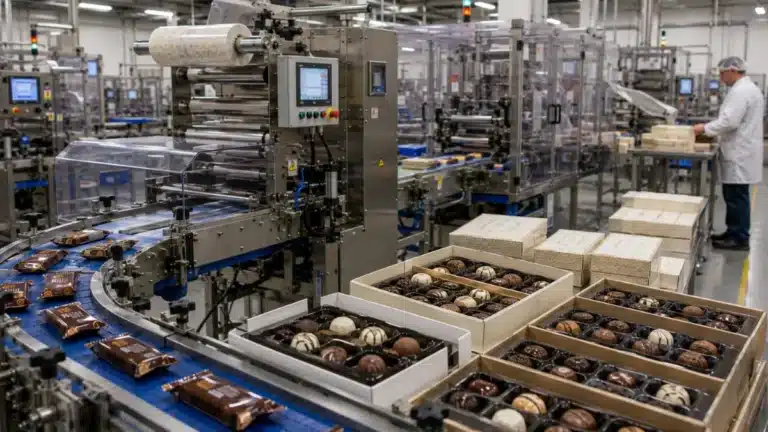

The top confectionery packaging suppliers in Belgium include TG Packaging, Ecomec Belgium, Pattyn, ANL Packaging, Van de Velde Packaging and VPK Group, alongside specialist machinery, carton and flexible-packaging suppliers serving the country’s chocolate industry. Unlike Germany or Italy, Belgium does not have ten large domestic confectionery packaging machinery OEMs.
Instead, its strength is spread across several areas:
- Machinery integration
- Refurbished equipment
- Bulk chocolate packing
- Thermoformed praline trays
- Premium cartons
- Retail-ready corrugated packaging
That structure reflects the Belgian confectionery market itself. Premium presentation matters, but so do export protection, efficient packing and retailer-specific formats.
For manufacturers and private-label suppliers, the best Belgian partner therefore depends heavily on where the packaging sits in the production and retail chain.
Top confectionery packaging suppliers in Belgium
| Rank | Company | Operating model | Strategic role |
|---|---|---|---|
| 1 | TG Packaging | Belgian integrator | Flow wrapping and feeding |
| 2 | Pattyn | Belgian OEM | Bulk chocolate packaging |
| 3 | ANL Packaging | Belgian manufacturer | Praline and chocolate trays |
| 4 | Ecomec Belgium | Equipment specialist | Refurbished confectionery machinery |
| 5 | Van de Velde Packaging | Belgian manufacturer | Premium chocolate cartons |
| 6 | VPK Group | Belgian manufacturer | Corrugated and retail-ready packs |
| 7 | Refacom | Belgian supplier | Flow-pack and shrink systems |
| 8 | Smurfit Westrock Belgium | Belgian operation | Corrugated retail and transit packs |
| 9 | Natra Malle | Belgian confectionery operation | Packaging-linked chocolate production |
| 10 | Graphic Packaging Belgium | Belgian operation | Paperboard food packaging |
The first six companies have the strongest direct Belgian confectionery-packaging evidence in this ranking. Positions seven to ten represent broader packaging capability relevant to confectionery. They do not have the same level of category specialisation.
That distinction matters. Belgium’s market should not be presented as if it contains ten equivalents of Germany’s Theegarten-Pactec or Italy’s SACMI.
Why Belgium needs a different ranking methodology
Belgium is globally associated with chocolate, but chocolate production and packaging machinery are different industries.
Companies making tempering machines, moulds, enrobers and cooling tunnels were therefore excluded. The exception was where they had a meaningful downstream packaging role.
The ranking instead covers four parts of the supply chain:
- Packaging machinery and line integration for wrapping and industrial packing.
- Refurbished confectionery machinery for manufacturers investing below new-equipment cost.
- Thermoformed packaging for pralines, assortments and delicate products.
- Carton and corrugated packaging for retail presentation, shelf-ready formats and transport.
That broader definition gives supermarket buyers and confectionery manufacturers a more accurate picture of the Belgian market.
1. TG Packaging
- Belgian base: Belgium
- Operating model: Machinery supplier and systems integrator
- Revenue: Not publicly disclosed
- Best suited to: Flow wrapping, feeding and integrated confectionery packing
TG Packaging takes first place because it has one of the clearest direct links between Belgian packaging engineering and confectionery production.
Its systems cover horizontal flow wrapping as well as product feeding and handling. Confectionery is a named application rather than being grouped loosely under general food.
Why feeding and integration matter
That distinction is important. Chocolate pieces, bars and other confectionery products often arrive at the wrapper at high speed.
The machine itself is only part of the problem. Products must be correctly spaced, orientated and fed without causing stoppages or excessive damage.
TG Packaging can combine wrapping equipment with customised infeed and feeding solutions. Its machinery portfolio includes high-speed HFFS technology suited to confectionery. Depending on the equipment chosen, production can reach several hundred packs per minute.
The company should nevertheless be described accurately. TG Packaging is mainly a Belgian machinery supplier and integrator, rather than the ground-up manufacturer of every packaging machine in its portfolio.
For private-label confectionery producers, integration matters when one line must handle several product dimensions or retailer pack specifications.
Why TG Packaging makes the Top 10: It provides direct Belgian access to confectionery flow wrapping combined with the feeding and line engineering required around the wrapper.
2. Pattyn
- Headquarters: Bruges area, Belgium
- Founded: More than 70 years of company history
- Operating model: Belgian machinery OEM
- Customers: More than 1,200 across 70+ countries
- Best suited to: Bulk chocolate, ingredients and industrial bag-in-box packaging
Pattyn gives Belgium something the market has fairly little of. It is a sizeable domestic packaging machinery manufacturer with direct chocolate applications.
What it supplies
Its role is very different from TG Packaging. Pattyn focuses heavily on industrial bulk packaging. Its solid chocolate packaging systems handle products including chocolate drops, chunks and curls.
A complete line can cover:
- Case erecting
- Bag insertion
- Weighing and filling
- Bag closing
- Case closing
- Palletising
This is not the packaging consumers normally see on supermarket shelves. It is nevertheless important to the confectionery supply chain.
Chocolate manufacturers often move ingredients and semi-finished products between factories or supply them to industrial customers. Chocolate drops, inclusions and other products need controlled bulk packing before transport.
Automating that process reduces manual handling. It can also improve consistency in case and liner preparation.
Pattyn’s international footprint also matters. The company reports more than 1,200 customers across over 70 countries. For larger confectionery groups, that installed base can help when standardising equipment across production sites.
Why Pattyn makes the Top 10: It is a genuine Belgian packaging machinery OEM with direct, documented expertise in automated bulk chocolate packaging.
3. ANL Packaging
- Belgian base: Belgium
- Operating model: Thermoformed packaging manufacturer
- Production footprint: Three factories
- Employees: Around 425
- Annual output: Around one billion trays
- Best suited to: Pralines, assortments and premium confectionery trays
ANL Packaging is one of the most important companies in this ranking. Its connection with chocolate is structural rather than incidental.
Biscuits and chocolate were among the markets from which the company’s packaging business grew. Today its thermoformed range covers assortment trays, line trays, transport trays, display packaging and formats suited to seasonal confectionery.
Key facts
The scale is significant. ANL reports three factories, around 425 employees, 37 thermoforming machines and about one billion trays produced annually.
Why the tray matters
For Belgian praline manufacturers, the tray does several jobs at once:
- It separates individual pieces.
- It protects delicate decorations.
- It controls movement inside the carton.
- It can shape how the assortment looks when consumers first open the box.
That makes thermoformed inserts especially important for premium supermarket and gifting ranges.
Private label adds another requirement. Retailers can specify different assortment sizes or presentations. Meanwhile, the chocolate manufacturer needs to keep tray loading and cartoning efficient.
Why ANL Packaging makes the Top 10: It combines substantial Belgian production scale with direct expertise in one of chocolate packaging’s most important formats: the protective presentation tray.
4. Ecomec Belgium
- Belgian operation: Belgium
- Operating model: Used and refurbished machinery specialist
- Revenue: Not publicly disclosed
- Best suited to: Confectionery manufacturers seeking proven wrapping equipment
Ecomec occupies a category of its own. It does not compete directly with new machinery manufacturers. Instead, it specialises in buying, selling and refurbishing used confectionery processing and packaging equipment.
Its focus on confectionery is unusually narrow. Packaging inventory has included equipment from established machinery brands such as SAPAL, Rasch and Carle & Montanari. This has covered chocolate bars, pralines, eggs, balls and other wrapped products.
Why refurbished machinery matters
This matters commercially because new machinery is not the right investment for every factory.
A small or medium-sized Belgian chocolatier may need extra capacity for a seasonal contract. Another manufacturer may want a second line without committing the capital needed for new equipment.
Older confectionery factories can also depend on machinery platforms that are no longer made. Refurbishment can therefore extend productive life or give access to equipment at a different investment level.
What buyers should check
The risks are equally clear. Buyers need to consider spare parts, controls, safety upgrades and documentation. They also need to check whether older machinery can handle the intended packaging material.
Why Ecomec makes the Top 10: Few Belgian companies specialise so directly in the secondary market for confectionery wrapping and packaging machinery.
5. Van de Velde Packaging
- Headquarters: Wetteren, Belgium
- Operating model: Packaging manufacturer
- Revenue: Not used as a standalone ranking measure
- Best suited to: Premium chocolate cartons and presentation packaging
Belgian chocolate depends heavily on presentation, and Van de Velde Packaging serves that part of the market.
The company works across premium printed packaging, including applications for chocolate. Its production capabilities cover design, printing, die-cutting, folding and gluing.
That makes the company especially relevant to praline boxes, seasonal assortments and premium confectionery. In these products, the carton forms a major part of the consumer offer.
Why it matters to supermarket buyers
For supermarkets, premium private label has raised the importance of this packaging layer. The product inside may be made efficiently at scale. But the finished box still has to set a premium tier apart from mainstream confectionery on shelf.
Seasonality adds complexity. Easter, Christmas and Valentine’s ranges can bring short production campaigns with different graphics, carton dimensions and assortment configurations.
A converter able to manage those requirements close to Belgium’s chocolate production base has a practical advantage.
The company should be identified as being based in Wetteren, rather than Dendermonde.
Why Van de Velde Packaging makes the Top 10: It adds direct Belgian premium-carton expertise to a confectionery market where presentation remains commercially important.
6. VPK Group
- Headquarters: Aalst region, Belgium
- Operating model: Belgian packaging group
- Core relevance: Corrugated, shelf-ready and protective packaging
- Best suited to: Retail displays, transport cases and secondary confectionery packaging
VPK represents another stage of the confectionery packaging chain. The chocolate may already have its wrapper, tray and retail carton. It still needs to move through warehousing, distribution and supermarket operations without excessive damage or unnecessary handling.
Confectionery case study
VPK’s direct confectionery evidence includes work with Belgian producer Geldhof Confectioners. For its chocolate-coated cuberdons, VPK developed a corrugated solution combining the tray and lid into an autolock design.
The project is useful because it shows packaging as an operational issue rather than simply graphic design. The redesigned format reduced material cost compared with the previous solution. It also simplified stock handling.
Why it matters to supermarket buyers
For grocery retailers, corrugated packaging increasingly has to perform several roles. It protects products in transit and supports efficient shelf replenishment. In some cases, it becomes the display unit shoppers see.
That is especially relevant for confectionery promotions and seasonal ranges.
Why VPK makes the Top 10: It brings documented Belgian confectionery experience in corrugated packaging where logistics, shelf presentation and cost meet.
7. Refacom
- Headquarters: Lot, Belgium
- Operating model: Machinery and packaging-material supplier
- Revenue: Not publicly disclosed
- Best suited to: Flow wrapping and general flexible-packaging projects
Refacom sits lower in the ranking because its confectionery specialisation is not as strong as the six companies above it.
The company supplies packaging machinery alongside films and related materials. Its equipment range includes horizontal flow-pack systems that can wrap individual products in flexible material.
That technology clearly applies to confectionery, particularly bars, biscuits and regularly shaped products.
How it fits the market
However, Refacom should not be described as a specialist Belgian confectionery OEM. Its model is closer to a regional packaging technology supplier that represents and integrates machinery from specialist manufacturers.
That can still be useful to smaller Belgian confectionery businesses. Not every manufacturer wants to manage separate relationships for the machine, film and supporting packaging equipment. A local supplier can simplify specification, installation and service.
Why Refacom makes the Top 10: It provides Belgian manufacturers with local access to flow-pack machinery and packaging materials, although its confectionery credentials are broader than the category leaders.
8. Smurfit Westrock Belgium
- Belgian presence: Multiple operations
- Operating model: International packaging group with Belgian manufacturing presence
- Core relevance: Corrugated and paper-based secondary packaging
- Best suited to: Retail-ready, display and transport packaging
Smurfit Westrock enters the ranking through scale and downstream relevance rather than specialist chocolate wrapping machinery.
Its role is corrugated and paper-based packaging used around consumer products as they move into retail. For confectionery manufacturers, this can include cases, shelf-ready formats, promotional displays and other secondary packaging.
Why it matters to supermarket buyers
That part of the chain becomes especially important for supermarket supply. A case designed only for transport can create extra handling at store level. Retail-ready formats aim to reduce that work by helping products move from distribution packaging to the shelf more efficiently.
Promotional confectionery creates another requirement. Chocolate and sweets are often sold through temporary displays around Easter, Christmas, Halloween and other events. Corrugated packaging can therefore become part of merchandising rather than staying invisible in the back room.
Smurfit Westrock is not being ranked as a Belgian confectionery specialist. Its inclusion reflects the importance of large-scale corrugated supply to confectionery distribution and retail execution.
Why it makes the Top 10: It adds large-scale Belgian corrugated capability relevant to shelf-ready, promotional and transport packaging.
9. Natra Malle
- Belgian operation: Malle
- Operating model: Confectionery manufacturing operation with packaging capability
- Core relevance: Chocolate production and finished-product packing
- Best suited to: Understanding the manufacturer side of private-label packaging
Natra is an unusual inclusion. It sits mainly on the manufacturing side rather than being a conventional packaging supplier.
Its Belgian activities are relevant to chocolate production, including products serving retail and private-label markets. That gives the operation practical experience with the packaging demands of large confectionery customers.
How it fits the ranking
For this ranking, however, the distinction must stay explicit. Natra should not be presented as a packaging machinery OEM or independent carton converter. Its relevance is the integration of chocolate manufacturing and packaging within a commercial confectionery operation.
That manufacturing view is useful because private-label packaging decisions are rarely separate from factory economics. Different customer specifications can affect line scheduling, packaging-material inventory, changeovers and minimum production runs.
Why Natra appears: It demonstrates the integrated production-and-packaging model used in Belgian confectionery, although it is a weaker fit than the specialist suppliers above.
10. Graphic Packaging Belgium
- Belgian presence: Belgium
- Operating model: International paperboard packaging group
- Core relevance: Folding cartons and paperboard food packaging
- Best suited to: High-volume consumer carton applications
Graphic Packaging completes the ranking as a broader paperboard supplier with Belgian operations.
The group has extensive international experience in consumer packaging. This includes folding cartons and paperboard formats for food and beverage applications.
Those capabilities are relevant where chocolate bars, multipacks, boxed sweets and related products need printed paperboard packaging.
What buyers should check
Its scale also matters for multinational FMCG procurement. Large manufacturers often need converters that can support similar packaging structures across several European markets, not just one domestic factory.
However, the evidence standard needs to be stated clearly. Graphic Packaging’s broad food-packaging capability is stronger than the currently verified evidence for Belgium-specific confectionery projects. It therefore ranks below Belgian specialists such as ANL, Van de Velde and VPK.
Why Graphic Packaging makes the Top 10: It adds industrial-scale paperboard converting capability, but should be viewed as a broad food-packaging supplier rather than a Belgian confectionery specialist.
Which Belgian supplier fits each confectionery packaging need?
- For flow wrapping and machinery integration, TG Packaging is the strongest starting point in this ranking.
- For bulk chocolate packing, Pattyn has the clearest specialist machinery position.
- For praline trays and chocolate assortment inserts, ANL Packaging stands out.
- For used or refurbished confectionery wrapping machinery, Ecomec occupies a distinctive niche.
- For premium chocolate cartons, Van de Velde Packaging provides the strongest direct Belgian fit.
- For corrugated transit and retail-ready confectionery packaging, VPK has documented Belgian application evidence.
Refacom provides another local route into flexible-packaging machinery. The larger international packaging groups become more relevant when procurement moves towards scale, multi-country supply or broader corrugated and carton requirements.
This is why comparing these companies only by turnover would be misleading. They solve different parts of the packaging problem.
Belgian chocolate makes packaging unusually important
Belgium’s confectionery reputation is strongly tied to chocolate, pralines and premium products. That changes the packaging requirement.
A low-cost sharing bag of sweets needs efficient filling, accurate weight control and reliable sealing. A box of Belgian pralines needs protection, product separation and presentation. Premium gifting adds cartons, inserts, decorative finishes and protective outer packaging.
Export creates another pressure. Belgian chocolate travels far beyond its domestic market. Packaging therefore has to survive handling and distribution while protecting the product’s appearance.
The wider Belgian chocolate industry has also grown around a mix of industrial manufacturers, premium brands and smaller chocolatiers. That creates demand for very different packaging investment levels.
A multinational factory may automate case packing and palletising. A smaller chocolatier may invest in refurbished wrapping machinery. Or it may buy premium cartons and trays without installing a fully automated line.
Belgium’s packaging supply chain reflects that diversity.
Private label changes the commercial equation
Private-label confectionery puts packaging procurement under a different type of pressure.
Retailers may source comparable products while requesting different pack sizes, assortment counts, graphics, trays or shelf-ready cases. That increases the number of packaging components a manufacturer has to manage.
The hidden operational cost
The operational cost is not limited to buying cartons or film:
- Every format change can affect production scheduling.
- Additional SKUs create inventory.
- Short runs can increase waste.
- New carton dimensions may require machine adjustments.
Packaging suppliers therefore compete partly on their ability to make those changes manageable. ANL’s tray capabilities, Van de Velde’s premium cartons and VPK’s corrugated solutions address different parts of that requirement.
On the machinery side, flexible feeding and wrapping systems can reduce the cost of moving between products.
For supermarket buyers, this means packaging design should be discussed with manufacturers before specifications become fixed. A visually attractive pack that creates excessive factory complexity can end up feeding back into the product cost.
Premium presentation still matters
Few grocery categories make packaging part of the product experience as strongly as premium chocolate:
- The tray determines how pralines are arranged.
- The carton creates the first visual impression.
- Printing and finishing show whether the product sits in an everyday, premium or gifting tier.
- The outer packaging then has to protect that presentation until the consumer opens it.
This creates an interesting tension. Confectionery manufacturers need visually distinctive packaging. Yet retailers and supply chains continue to push for lower material use, simpler structures and operational efficiency.
The answer is not automatically lighter packaging. Removing material can cause product damage or reduce stacking performance. Changing tray construction can affect automated loading. Altering a carton can create problems elsewhere in the line.
Packaging therefore has to be assessed as a complete system.
Retail-ready packaging connects factory and supermarket
Secondary packaging deserves more attention in confectionery procurement. The finished consumer pack still has to reach a distribution centre and then the supermarket shelf.
This is where companies such as VPK become especially relevant. A well-designed corrugated format can protect products during transport while reducing the handling needed in store.
Seasonal confectionery makes this even more important. Easter, Christmas and Valentine’s ranges arrive within fairly narrow selling windows. Retailers may need large quantities moved quickly from distribution centres into promotional locations.
Display-ready packaging can support that process. The commercial value is therefore wider than the price of the corrugated case. Labour, shelf replenishment, product damage, transport use and merchandising all need to be considered.
Machinery investment does not always mean buying new
Ecomec highlights another feature of the Belgian confectionery market. Refurbished machinery remains commercially relevant.
Confectionery equipment can have a long operating life. Mechanical platforms built years ago may stay productive if controls, safety systems and worn parts are properly maintained or upgraded.
For SMEs, this creates another investment route. A refurbished wrapper can cost less than a new high-speed system. It may provide enough capacity for seasonal or specialist production.
Whole-life cost
But buyers need to examine the whole-life cost. Availability of spare parts matters. So do electrical documentation, guarding, control-system support and compatibility with current packaging materials.
A cheap machine becomes expensive quickly if downtime cannot be resolved.
The right comparison is therefore not simply new price versus used price. It is expected productive output over the planned ownership period.
Industry outlook
Belgium’s confectionery packaging market is likely to remain more fragmented than Germany’s machinery sector or Italy’s packaging-equipment clusters. That is not necessarily a weakness.
The Belgian supply chain combines machinery integration, industrial bulk packing, specialist refurbished equipment, thermoformed trays, premium cartons and corrugated packaging. This matches the structure of the country’s confectionery industry:
- Large industrial chocolate manufacturers need automation and export packaging.
- Premium chocolatiers need presentation.
- Private-label producers need flexibility.
- Supermarkets need retail-ready cases and reliable supply.
The strongest packaging projects increasingly connect those requirements rather than treating each component separately.
Procurement teams should therefore evaluate suppliers by the part of the confectionery chain they actually control.
A tray manufacturer should not be compared directly with a flow-wrapper supplier. A machinery integrator should not be assessed like a carton converter. That distinction is central to understanding the Belgian market.
Frequently Asked Questions
Who are the leading confectionery packaging suppliers in Belgium?
The evidence is strongest for TG Packaging, Pattyn, ANL Packaging, Ecomec Belgium, Van de Velde Packaging and VPK. Refacom, Smurfit Westrock Belgium, Natra Malle and Graphic Packaging Belgium complete the ranking with broader packaging relevance.
Why doesn’t Belgium have ten large confectionery packaging machinery OEMs?
Belgium’s strength is spread across machinery integration, refurbished equipment, bulk packing, trays, cartons and corrugated packaging. Chocolate production and packaging machinery are different industries.
Which Belgian supplier makes praline trays?
ANL Packaging stands out for praline trays and chocolate assortment inserts. It reports three factories, around 425 employees and about one billion trays produced annually.
What happens next?
Cost pressure will remain a major influence on confectionery packaging investment.
Chocolate manufacturers face expensive raw materials, labour costs and retailer negotiations. Packaging changes therefore need to justify themselves operationally as well as visually.
At the same time, packaging-material requirements are changing. Converters and machinery suppliers will need to prove that new structures can work under real factory conditions.
For manufacturers, this means testing seal performance, line speed, product protection, waste and changeover behaviour. They should not rely only on material specifications.
Private label will keep flexibility high on the agenda. Retailers want differentiation, but factories need to limit unnecessary complexity. Suppliers that can simplify trays, cartons, cases or machinery changeovers can therefore influence costs beyond the price of the package itself.
For buyers comparing confectionery packaging suppliers in Belgium, the best starting point is the packaging stage: primary wrapping, bulk packing, praline trays, premium cartons or retail-ready distribution.
Only then does a meaningful supplier comparison begin.
Editor’s Note
This ranking uses a broader methodology than GSN’s equivalent Germany and Italy confectionery packaging features.
Belgium does not have ten large domestic confectionery packaging machinery OEMs. Filling the ranking exclusively with machinery companies would therefore require either foreign subsidiaries or businesses whose main activity is chocolate processing rather than packaging.
GSN instead assessed the Belgian confectionery packaging supply chain across machinery integration, bulk packaging equipment, refurbished machinery, thermoformed trays, folding cartons and corrugated retail packaging.
Chocolate World was excluded because its core expertise is chocolate moulding and processing rather than packaging. Betec was also left outside the final ranking because its strongest confectionery credentials remain on the processing side, despite having some downstream automation capability.
The evidence is strongest for TG Packaging, Pattyn, ANL Packaging, Ecomec Belgium, Van de Velde Packaging and VPK. Refacom and the remaining lower-ranked companies have broader packaging relevance and should not be interpreted as having the same level of confectionery specialisation.
No private-company revenue figures have been estimated.
Parent-company turnover has also not been presented as Belgian subsidiary revenue.
The ranking is editorial. It is based on Belgian presence, confectionery relevance, technical role, manufacturing or integration capability and usefulness to commercial buyers. It is not based on sponsorship or company size alone.