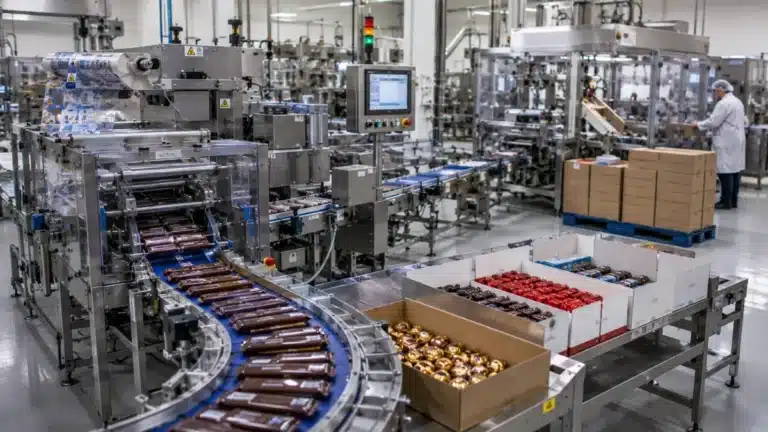

The top confectionery packaging suppliers in Germany are Theegarten-Pactec, LoeschPack, Gerhard Schubert, Syntegon, ROVEMA, Hastamat, Rasch Technologies, Kremers Verpackungsmaschinen, SN Maschinenbau and HDG Verpackungsmaschinen. Together, they cover:
- High-speed candy wrapping
- Chocolate bars and tablets
- Robotic cartoning
- Flow wrapping
- Weighing
- Vertical bagging
- Horizontal pouch packaging
Germany has particular depth in this field. German confectionery machinery companies generate about €650 million in annual industry turnover. They account for almost 30% of global confectionery machinery trade, according to VDMA.
At the same time, retailer-specific formats, private-label production and packaging-material changes are shifting the focus. Flexibility and total line efficiency now matter more, not simply maximum machine speed.
Top confectionery packaging suppliers in Germany
| Rank | Company | FY Revenue | Strategic role |
|---|---|---|---|
| 1 | Theegarten-Pactec | Not disclosed | High-speed candy and chocolate wrapping |
| 2 | LoeschPack | Not separately disclosed | Chocolate tablets, bars and gum |
| 3 | Gerhard Schubert | €450m group* | Robotic confectionery packaging |
| 4 | Syntegon | €1.75bn (2025) | Integrated bar and food packaging |
| 5 | ROVEMA | Not disclosed | High-speed confectionery bagging |
| 6 | Hastamat | Not separately disclosed | Weighing, feeding and flow wrapping |
| 7 | Rasch Technologies | Not disclosed | Hollow and speciality chocolates |
| 8 | Kremers | Not disclosed | Sensitive sweets and premade bags |
| 9 | SN Maschinenbau | Not disclosed | HFFS confectionery pouches |
| 10 | HDG Verpackungsmaschinen | Not disclosed | High-speed HFFS pouches |
Schubert’s current company site states €450 million turnover for the Schubert Group. It should not be read as standalone Gerhard Schubert GmbH revenue.
The ranking considers direct confectionery application evidence, packaging specialisation, technology breadth, operating scale and international support. It is not a ranking by revenue.
A specialist lower in the list may be the stronger procurement choice for a particular product.
Why Germany matters for confectionery packaging
Germany’s wider food-processing and packaging machinery industry reached a record production value of almost €17 billion in 2025, up 4.9%. Packaging machinery alone accounted for nearly €9 billion after especially strong growth.
Confectionery is an important specialist segment within that machinery base.
VDMA’s confectionery machinery division represents around 40 companies. They cover processing and packaging for chocolate, sugar confectionery, bars, wafers, bakery products and snacks. VDMA puts sector turnover at about €650 million and Germany’s share of global confectionery machinery trade at almost 30%.
The depth of the German machinery base matters for supermarket and private-label suppliers. Packaging requirements increasingly cross several stages:
- Individual wrapping
- Bagging
- Multipacking
- Retail cartons
- Distribution cases
1. Theegarten-Pactec
- Headquarters: Dresden
- Revenue: Not publicly disclosed
- Core operations: High-speed confectionery wrapping and cartoning
- Best suited to: Hard candies, jellies, chocolates and high-volume individual wrapping
Theegarten-Pactec takes first place because confectionery packaging sits at the centre of its engineering business.
Its machinery covers hard candies, jellies, toffees, chocolate products and other preformed confectionery. It works across twist, fold and flow-pack formats. It also supplies feeding, buffering and secondary packaging systems.
Key machines
The clearest evidence of its high-speed position is the EK4. It reaches up to 2,300 individually wrapped products per minute in double twist. Applications include hard candy, éclairs, toffees and deposited chocolate products.
But speed alone does not explain the ranking:
- The MCH platform handles products including jellies, chocolate balls and eggs in several wrapping styles at up to 1,200 pieces per minute.
- The FPH5 adds high-speed flow packing.
- Combined systems can connect primary wrapping to multipack production.
- A high-speed cartoning system for already wrapped products gives it relevance beyond the individual wrapper.
Why it matters to supermarket buyers
For supermarket confectionery manufacturers, that breadth matters when very high volumes must move from individual wrapping into multipacks or display cartons. It helps avoid a downstream bottleneck.
The company states that several machines can process modern films and paper-based packaging materials. For procurement teams, those are machine-capability claims. The exact material still needs to be validated at the required production speed.
Why Theegarten-Pactec makes the Top 10: Few German suppliers combine such high individual-piece speeds with direct confectionery expertise across feeding, primary wrapping and downstream packaging.
2. LoeschPack
- Founded: 1919
- Headquarters: Altendorf, Bavaria
- Parent: Piepenbrock Group
- Revenue: Not separately disclosed
- Best suited to: Chocolate tablets, bars, chewing gum and confectionery
LoeschPack has more than a century of packaging history. But its position here rests on current chocolate machinery rather than heritage.
The company specialises in packaging systems for confectionery. It is especially strong in chocolate tablets and bars, chewing gum and related products. Its own current technical literature names confectionery packaging as a core area and reports an export ratio of roughly 90%.
Key 2026 development
A major 2026 development is the LTS-DUO, unveiled at interpack in May. It is a two-stage high-performance fold-wrapping machine developed specifically for chocolate bars.
That builds on LoeschPack’s established chocolate-tablet technology, where wrapping and cartoning can be linked into one integrated process.
Why it matters to private-label buyers
For private-label production, the key point is format handling rather than the age of the company. Chocolate suppliers serving several supermarket customers can face changes in bar size, wrapping material, carton design and multipack configuration.
LoeschPack’s focused chocolate expertise gives it a strong position where the main product is a tablet, bar or chewing-gum format rather than loose confectionery.
The company is part of the Piepenbrock Group. Parent-company financial or workforce figures should therefore not be presented as standalone LoeschPack figures.
Why LoeschPack makes the Top 10: Its specialist position in chocolate-tablet and bar wrapping, backed by current 2026 machinery development, makes it one of Germany’s clearest confectionery packaging specialists.
3. Gerhard Schubert
- Founded: 1966
- Headquarters: Crailsheim
- Group turnover: €450 million, current company figure
- Group employees: Around 1,900
- Best suited to: Robotic confectionery packing, cartons and assortments
Schubert approaches confectionery packaging from automation and robotics rather than conventional twist wrapping.
Its modular TLM packaging architecture is used across confectionery, food and other consumer-goods sectors. The company combines robotic product handling with top-loading, cartoning, flow wrapping and integrated packaging projects.
Schubert’s confectionery credentials include projects for major manufacturers. Its wider customer base includes companies such as Ferrero, Nestlé and Mondelēz.
Why it matters to supermarket buyers
This makes the company especially relevant when the packaging challenge involves assortments, delicate product handling or retail cartons.
Pralines, for example, may need to be identified, orientated and placed into defined carton positions without visible damage. Seasonal and premium assortments can make this harder because product mixes and carton layouts change.
That is commercially important for supermarkets. Premium private-label confectionery, gift boxes and seasonal ranges often rely on secondary packaging for much of their shelf presentation.
Schubert’s current careers information states €450 million in turnover for the Schubert Group and 1,900 employees worldwide. These are group figures, not standalone revenue for Gerhard Schubert GmbH.
Why Schubert makes the Top 10: It adds high-level robotics and flexible secondary packaging to a market that would otherwise be dominated by conventional wrappers and baggers.
4. Syntegon
- Headquarters: Stuttgart
- Major German operations: Including Waiblingen
- 2025 revenue: €1.75 billion
- 2025 employees: Around 7,300
- Best suited to: Integrated chocolate, bar and high-speed packaging projects
Syntegon is the largest business in this ranking by disclosed revenue. But company size is not why it is included.
Its food portfolio contains direct packaging technology for chocolate and bars. This combines product distribution, flow wrapping, cartoning and downstream automation.
This is especially relevant to manufacturers producing chocolate bars, cereal bars, nutrition products and other regularly shaped confectionery at industrial scale.
Key facts
Syntegon also has one of the largest international service footprints in the group. That matters to multinational FMCG companies running similar lines in several countries. Machinery standardisation and lifecycle support can influence their procurement.
The latest financial information is current:
- €1.75 billion of revenue in 2025, up 10%.
- €1.86 billion of order intake.
- Around 7,300 employees at 49 locations in more than 20 countries.
- 7,344 employees at year-end, according to its 2025 sustainability reporting.
For private-label manufacturers, the attraction is less about corporate scale than integration. Product distribution, wrapping and downstream packaging need to stay in sync when formats or recipes change.
Why Syntegon makes the Top 10: It combines direct chocolate and bar packaging technology with the scale and service network required for complex international manufacturing operations.
5. ROVEMA
- Founded: 1957
- Headquarters: Fernwald, Hesse
- Revenue: Not publicly disclosed
- Core operations: Vertical form-fill-seal packaging
- Best suited to: Candies, gummies and other bagged confectionery
ROVEMA gives the ranking a different type of packaging expertise.
Chocolate bars and individual sweets often get most of the attention. But supermarkets sell huge volumes of confectionery in bags. Gummies, hard candies, wrapped sweets, chocolate pieces and mixed products all need accurate dosing followed by fast flexible packaging.
Key machines
ROVEMA serves that market directly. Its BVC 250 Candy was developed specifically for confectionery and snacks. The vertical form-fill-seal machine reaches nominal output of up to 300 bags per minute.
It can produce several bag styles, including pillow bags, gusseted bags and stand-up formats.
ROVEMA also offers the BVC 165 TwinTube for high-speed confectionery and snack applications. Its stated output reaches 500 bags per minute, depending on the application.
The BVC 250 Candy can process mono-material, multilayer, paper and paper-composite packaging structures, according to ROVEMA. That shows technical compatibility options. It is not proof that one material is environmentally superior or will run identically in every application.
Why it matters to private-label buyers
For private label, bagging is especially relevant. Retailers can differentiate confectionery through bag weight, shape, graphics and sharing formats without fundamentally changing the sweet inside.
Why ROVEMA makes the Top 10: Its dedicated high-speed confectionery VFFS technology makes it one of Germany’s strongest suppliers for retail bags rather than individual wraps.
6. Hastamat
- Founded: 1953
- Headquarters: Lahnau, Hesse
- Employees: Around 100
- Revenue: Not separately disclosed
- Best suited to: Feeding, weighing and flexible confectionery packaging
Hastamat is a useful counterweight to the larger automation groups. Its strength lies in the processes around weighing and product movement.
Its confectionery systems cover feeding, distribution, buffering and multihead weighing. The company says its CP-series combination weighers can perform up to 240 weighing cycles per minute, depending on application.
Why weighing matters
That is important for loose confectionery. The wrapper or bagger can only keep its rated speed if the right amount of product arrives consistently. Gummies, wrapped candies and irregular sweets create different handling problems from uniform chocolate bars.
Hastamat’s current corporate literature gives these details:
- Founded in Lahnau-Waldgirmes in 1953.
- Employs around 100 people.
- Exports roughly 80% of its output.
The company and LoeschPack are both part of the wider Piepenbrock structure. But they stay separate in this ranking because their machinery roles differ materially. LoeschPack is especially strong in chocolate and gum wrapping. Hastamat adds weighing, feeding and flexible packaging expertise.
For supermarket suppliers, accurate weighing has a direct margin impact. Overfilling thousands of retail bags gives product away. Underfilling creates compliance problems.
Why Hastamat makes the Top 10: It adds specialist dosing, weighing and feeding capability that is critical to high-volume bagged confectionery production.
7. Rasch Technologies
- Founded: 1950
- Headquarters: Hürth, North Rhine-Westphalia
- Employees: Around 40
- Revenue: Not publicly disclosed
- Best suited to: Chocolate eggs, hollow figures and speciality confectionery
Rasch is smaller than the groups above it. But its specialist knowledge gives it a clear reason to be here.
The company has been developing confectionery machinery since 1950 and began producing wrapping machines in 1952. Today it focuses heavily on customised packaging systems for hollow and speciality chocolate products.
What it supplies
Its portfolio includes machines for eggs, balls, hollow figures and flat-bottom chocolate products.
The RG platform, for example, can handle eggs, balls and hollow articles in several wrapping styles. Other machines are dedicated to chocolate eggs, lollipops and moulded chocolate pieces.
Why it matters to supermarket buyers
That is an important niche. A seasonal chocolate rabbit or egg cannot simply be treated like a rectangular bar. Shape, fragility and decorative foil presentation create a different engineering problem.
This gives Rasch special relevance to Easter, Christmas and premium confectionery. In these categories, supermarkets depend heavily on seasonal ranges, and private-label presentation can be a significant differentiator.
Rasch’s current company information states around 40 employees and apprentices at its Hürth operation.
Why Rasch makes the Top 10: It brings genuine specialist expertise in hollow and irregular chocolate products that the larger general packaging groups do not replicate in the same way.
8. Kremers Verpackungsmaschinen
- Headquarters: Kempen, North Rhine-Westphalia
- Revenue: Not publicly disclosed
- Core operations: Premade bags, clipping, dosing and filling
- Best suited to: Marshmallows, wine gums and fragile confectionery
Kremers earns its position through application evidence rather than corporate size.
Its confectionery portfolio serves sweets with awkward handling traits, including marshmallows and wine gums. The company names these factors as affecting the choice of dosing and packaging system:
- Adhesion
- Dust
- Low product weight
- High volume
That is a commercially useful distinction. Sticky gummies or lightweight marshmallows cannot always be treated like hard candy. Feeding and dosing need to reflect the product’s physical behaviour before the pack is sealed.
What it supplies
Kremers offers premade-bag equipment through its Zippack series. It also offers clipping technology for sensitive products.
Its Clipper 60KM-B is used for fragile products including confectionery, chocolate figures and other delicate foods. Its design aims to minimise unnecessary drop heights during handling.
For smaller and medium-sized private-label manufacturers, this type of flexibility can be more relevant than buying a very high-speed line designed around one product.
Why Kremers makes the Top 10: It provides direct German packaging expertise for difficult loose and fragile confectionery applications, particularly where premade bags or careful handling are required.
9. SN Maschinenbau
- Founded: 2002
- Headquarters: Wipperfürth, North Rhine-Westphalia
- Employees: Around 300
- Revenue: Not publicly disclosed
- Best suited to: Stand-up and zipper pouches for confectionery
SN Maschinenbau strengthens the ranking by adding dedicated horizontal form-fill-seal pouch technology.
Its confectionery portfolio explicitly covers snacks and sweets. Its horizontal machines produce retail pouches in different sizes and formats.
Key facts
The FBM 22 duplex system reaches a stated realistic output of up to 140 pouches per minute. This depends on product, filling behaviour and pouch dimensions. Other SN systems serve smaller production needs at lower speeds.
This matters because pouch packaging serves a different supermarket offer from a conventional pillow bag. Stand-up and resealable formats suit sharing packs, premium sweets and products meant to stay open across several occasions.
SN’s history also gives the company more depth than its 2002 founding date suggests. Its pouch-packaging technology traces back through earlier German machinery businesses. The present company has grown to around 300 specialists at two locations in Wipperfürth.
For private-label confectionery, HFFS pouches can offer more differentiation in shape and closure than conventional high-speed VFFS bags.
Why SN Maschinenbau makes the Top 10: It has explicit confectionery application evidence and gives German buyers a strong HFFS option for stand-up and other retail pouch formats.
10. HDG Verpackungsmaschinen
- Headquarters: Lindlar, North Rhine-Westphalia
- Revenue: Not publicly disclosed
- Core operations: Horizontal form-fill-seal packaging
- Best suited to: Candy and confectionery pouches
HDG takes the final position after a stricter technical audit. It is not included simply because it makes food-packaging equipment.
Its own RB-400 technical documentation lists candy and confectionery among the typical dry-product applications for its high-speed HFFS packaging line.
Key facts
The RB-400 can produce three-side-seal, four-side-seal, stand-up and contoured pouches. Reclosure options include zippers and other closure systems.
Depending on the machine configuration, HDG states output ranging up to 400 pouches per minute.
How it compares
This puts the company in a different competitive position from ROVEMA. ROVEMA’s strongest confectionery evidence is around vertical bagging. HDG gives manufacturers another horizontal pouch route.
It also overlaps somewhat with SN Maschinenbau, but that is justified. Both are German HFFS specialists with direct confectionery evidence. Their different machine platforms give procurement teams more than one credible domestic supplier to evaluate.
Why HDG makes the Top 10: Its documented high-speed HFFS technology explicitly covers candy and confectionery and supports stand-up and reclosable retail pouch formats.
Which German supplier fits each confectionery application?
The strongest supplier depends on what needs to be packed.
- For high-speed hard candy and individual sweets: Theegarten-Pactec has the clearest specialist position, with the EK4 reaching up to 2,300 pieces per minute.
- For chocolate bars and tablets: LoeschPack is particularly specialised, while Syntegon brings broader integrated line capability.
- For robotic cartons, assortments and secondary packaging: Schubert is the clearest specialist in the ranking.
- For vertical retail bags: ROVEMA offers dedicated high-speed confectionery machinery.
- For weighing and feeding loose sweets: Hastamat brings specialist multihead weighing and product-handling capability.
- For hollow chocolate figures and seasonal products: Rasch is the most specialised supplier.
- For fragile sweets and premade bags: Kremers covers applications including marshmallows and wine gums.
- For HFFS stand-up and reclosable pouches: SN Maschinenbau and HDG provide two German alternatives.
This application-based view is more useful to procurement teams than treating all ten companies as interchangeable.
Supermarkets and private label are changing line requirements
Confectionery packaging decisions increasingly reflect what happens at retail.
A contract manufacturer may produce similar sweets for several supermarket customers. Yet each may have different requirements for unit count, bag weight, wrapping material, pouch style, retail carton or shelf-ready case.
That changes the economics of packaging machinery. Maximum speed remains important for mainstream confectionery. But a machine that takes too long to change between formats can become expensive when production runs are shorter.
Private label also operates at several price tiers. High-volume value sweets need tight control over product giveaway and packaging costs. Premium ranges can need more complex cartons, pouches, decorative wraps or seasonal presentation.
How German suppliers cover both ends
Germany’s supplier base reflects both ends of that market:
- Theegarten-Pactec and ROVEMA provide very high throughput for individual sweets and bags.
- Schubert addresses flexible robotic packing.
- Rasch handles unusual chocolate shapes.
- SN and HDG provide pouch options that can support more differentiated retail presentation.
For supermarket suppliers, speed, flexibility and pack cost increasingly need to be evaluated together.
Packaging materials are becoming a machinery issue
Switching packaging material is not simply a purchasing decision.
Paper-based structures, recyclable mono-material films and other alternatives can behave differently from conventional laminates. The differences show up during feeding, folding and sealing.
Theegarten-Pactec states that the EK4 can process modern films and paper-based materials. Its FPH5 is designed to process recyclable mono films and paper-based packaging materials.
ROVEMA similarly states that the BVC 250 Candy can work with mono-material, multilayer, paper and paper-composite structures.
These are useful machine specifications. But they should not be turned into broad environmental claims.
For procurement teams, the practical test is whether the exact substrate can run at the required output. It must also keep seal quality, shelf-life protection and acceptable waste.
That becomes especially important for chocolate, where product sensitivity and barrier requirements can limit packaging choices.
Germany’s engineering base remains a competitive advantage
The wider machinery numbers help explain why so many specialist companies appear on this list:
- German food-processing and packaging machinery production reached almost €17 billion in 2025.
- Packaging machinery output approached €9 billion.
- German exports of food-processing and packaging machinery reached around €11 billion.
The confectionery segment is smaller but highly export-oriented. VDMA puts Germany’s share of global confectionery machinery trade at almost 30%.
The geographical spread is also notable:
- Dresden provides Theegarten-Pactec.
- Bavaria is home to LoeschPack.
- Schubert is based in Baden-Württemberg.
- ROVEMA and Hastamat operate in Hesse.
- Rasch, Kremers, SN and HDG form a significant cluster in North Rhine-Westphalia.
For international confectionery manufacturers, the advantage is access to different specialist technologies rather than one uniform German machine-building model.
Frequently Asked Questions
Who is the leading confectionery packaging supplier in Germany?
Theegarten-Pactec takes first place in this ranking. Its EK4 reaches up to 2,300 individually wrapped products per minute in double twist.
How big is Germany’s confectionery machinery sector?
VDMA puts sector turnover at about €650 million. Germany accounts for almost 30% of global confectionery machinery trade.
Is this ranking based on revenue?
No. The ranking considers confectionery application evidence, specialisation, technology breadth, scale and international support. A specialist lower in the list may be the stronger choice for a particular product.
What happens next?
German packaging machinery entered 2026 from a position of record production. But it faces the same pressures as much of European manufacturing: cost control, uncertain investment cycles and changing customer requirements.
VDMA expects moderate growth of around 3% for German food-processing and packaging machinery in 2026 after the strong 2025 result.
For confectionery packaging, investment decisions are likely to become more demanding rather than simply larger. Manufacturers need to assess these factors across the life of the line:
- Output
- Changeover time
- Product damage
- Labour requirements
- Packaging-material compatibility
- Energy use
- Technical support
Supermarket and private-label contracts add another variable. One production line may need to serve several retail specifications.
That favours different suppliers for different jobs:
- Theegarten-Pactec and LoeschPack bring deep primary-wrapping expertise.
- Schubert and Syntegon address larger automation projects.
- ROVEMA and Hastamat cover high-volume bagging and weighing.
- Rasch handles speciality chocolate.
- Kremers, SN and HDG add flexible solutions for fragile products and retail pouches.
For buyers comparing confectionery packaging suppliers in Germany, the strongest shortlist should start with the product, pack format, expected changeover frequency and required output—not company size alone.
Editor’s Note
This ranking was developed through a research-first verification process focused on companies headquartered or operating as German machinery manufacturers with direct, identifiable confectionery packaging capability.
The final list deliberately excludes major German confectionery-processing companies where the available evidence is primarily for cooking, forming, depositing, enrobing or other production equipment rather than packaging.
This avoids mixing confectionery production machinery with the packaging category.
Companies were assessed on direct confectionery application evidence, technical specialisation, packaging breadth, operating scale, international support and relevance to current retail production.
Financial figures are included only where the reporting entity is clear.
Syntegon’s €1.75 billion figure is fiscal 2025 group revenue. Schubert’s €450 million figure is identified as Schubert Group turnover rather than standalone Gerhard Schubert GmbH revenue. Revenue has not been estimated for privately held suppliers where dependable current figures were not established.
Material and sustainability statements have also been treated carefully. Where manufacturers state that machines can process paper, mono-material films or other substrates, this is described as technical compatibility rather than independent proof of environmental performance.
The ranking is editorial and is not based on sponsorship.
A higher position does not mean a supplier is automatically the best choice for every confectionery packaging project.