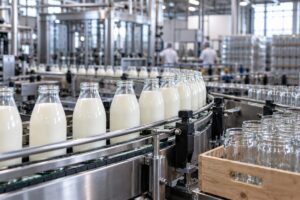


French private label is not built only by specialist own-brand factories. Much of the real supply power sits with large agrifood groups that also run major national brands.
These are the 10 private label manufacturers France by revenue, but not pure private label-only specialists. They are the companies supplying supermarket own-brand products at scale, alongside their branded portfolios.
For retail buyers, revenue still signals who controls factories, raw material access, logistics, and category depth at national level. This ranking covers groups including Lactalis Group, Danone, Agrial, Savencia Fromage & Dairy, LDC Group, Sodiaal, Terrena, Bigard Group, Cooperl, and Fleury Michon.
What is private label strategic exposure?
Private label strategic exposure means a manufacturer has the scale, production capacity, or retail relationships to supply supermarket own-brand products, even if private label is not its main business. In France, this often includes dairy, meat, poultry, prepared food, and cooperative groups with strong retail supply links.
At-a-glance table: France private label exposure by RevNow
| Rank | Entity / HQ | FY Revenue | Key Impact |
|---|---|---|---|
| 01 | Lactalis Group / Laval | ~€31.2B | Largest dairy scale; selective private label capacity |
| 02 | Danone / Paris | ~€27.3B | Brand-led giant with limited strategic PL exposure |
| 03 | Agrial / Caen | ~€7.1B | Cooperative power with high retail supply exposure |
| 04 | Savencia / Viroflay | ~€6.9B | Cheese and dairy scale across branded and retail channels |
| 05 | LDC Group / Sablé-sur-Sarthe | ~€6.2B | Poultry leader with strong PL and branded mix |
| 06 | Sodiaal / Paris | ~€5.8B | Dairy cooperative deeply linked to retail supply |
| 07 | Terrena / Ancenis | ~€5.6B | Cooperative scale across meat and agricultural supply |
| 08 | Bigard Group / Quimperlé | ~€4.5B | Major meat processor for French retail channels |
| 09 | Cooperl / Lamballe | ~€3.2B | Pork cooperative with PL and foodservice strength |
| 10 | Fleury Michon / Pouzauges | ~€0.84B | Prepared meals player with branded and PL exposure |
1. Lactalis Group
Founded / HQ / FY Revenue / Employees
1933 / Laval, France / ~€31.2B (Prelim 2026) / ~85,000
Core Segments
- Milk and cream
- Cheese (global portfolio)
- Butter and dairy ingredients
- Chilled dairy and exports
Operational Relevance
Lactalis operates one of the largest dairy processing networks in the world. In France, its footprint covers milk collection, transformation, and distribution at national scale. This vertical integration gives it a structural advantage when retailers need consistent supply for staple categories like milk, butter, and cheese.
Private label is not the company’s core focus, but it remains part of its industrial model. When capacity allows, Lactalis supports supermarket contracts across dairy basics. For retailers, that means access to large volumes without supply risk, particularly during periods of demand fluctuation.
Its ability to switch between branded and contract production is critical. Dairy is a high-frequency category in France supermarket retail, and few players can maintain this level of consistency across regions.
2. Danone
Founded / HQ / FY Revenue / Employees
1919 / Paris, France / ~€27.3B (Prelim 2026) / ~96,000
Core Segments
- Fresh dairy products
- Plant-based alternatives
- Specialized nutrition
- Bottled water
Operational Relevance
Danone’s business model is heavily brand-driven, with global products positioned in premium and health-focused categories. Unlike other French agrifood groups, its exposure to private label is limited and selective.
However, its production infrastructure still matters to the wider market. Danone operates advanced manufacturing sites across Europe, with capabilities in fermentation, formulation, and packaging that few competitors can match. This makes it a potential partner for highly specific or high-value private label contracts, even if these remain a small part of its overall output.
Retailers do not rely on Danone for volume private label supply in the same way they do with cooperatives or meat processors. Instead, its relevance sits in category influence, pricing benchmarks, and innovation pipelines.
3. Agrial
Founded / HQ / FY Revenue / Employees
2000 / Caen, France / ~€7.1B (Prelim 2026) / ~22,000
Core Segments
- Dairy (incl. ingredients and consumer products)
- Fresh produce (salads, vegetables)
- Beverages (cider, drinks)
- Prepared foods
Operational Relevance
Agrial sits at the centre of France’s private label ecosystem. Unlike brand-led multinationals, the cooperative model is built around supplying markets efficiently, often prioritising volume and long-term retail contracts over brand margin.
Its structure integrates farming, processing, and distribution. That gives retailers a reliable supply chain from raw material to finished product. In categories like fresh salads and dairy, Agrial operates as a key partner for supermarket own-label ranges.
The group’s flexibility across multiple categories also matters. Retailers can consolidate sourcing across fresh and processed segments with one supplier, which simplifies procurement and strengthens long-term partnerships.
4. Savencia Fromage & Dairy
Founded / HQ / FY Revenue / Employees
1956 / Viroflay, France / ~€6.9B (Prelim 2026) / ~21,000
Core Segments
- Cheese (specialty and mass market)
- Butter and creams
- Dairy ingredients
- International dairy exports
Operational Relevance
Savencia operates a balanced model between branded products and retail supply. Its strength lies in cheese, a category where France has both strong national demand and export value.
In private label, Savencia plays a consistent but controlled role. It supports supermarket ranges where scale and expertise are required, particularly in processed and specialty cheese formats. Its technical capabilities in formulation and maturation give it an edge in quality-sensitive segments.
The group also benefits from international diversification. This spreads risk and allows capacity optimisation across markets, which indirectly supports private label production when needed.
5. LDC Group
Founded / HQ / FY Revenue / Employees
1968 / Sablé-sur-Sarthe, France / ~€6.2B (Prelim 2026) / ~24,000
Core Segments
- Poultry (fresh and processed)
- Prepared meals
- Foodservice supply
- Export poultry products
Operational Relevance
LDC is one of the most important suppliers to French retailers in protein categories. Its integrated model spans breeding, processing, and distribution, giving it tight control over quality and volume.
Private label plays a major role in its business. Unlike brand-first multinationals, LDC operates a dual model where supermarket contracts sit alongside strong national brands. This makes it a critical partner for retailers building out poultry and ready-meal ranges.
The group’s scale also allows it to manage price volatility in feed and livestock. That stability is valuable for retailers trying to maintain consistent private label pricing in a sensitive category.
LDC’s half-year sales update for 2026–27 separates acquisition-led growth from underlying volumes and sets out poultry supply and pricing pressures relevant to supermarket buyers.
6. Sodiaal
Founded / HQ / FY Revenue / Employees
1964 / Paris, France / ~€5.8B (Prelim 2026) / ~9,000
Core Segments
- Milk and dairy products
- Cheese
- Dairy ingredients
- Export dairy supply
Operational Relevance
Sodiaal is one of France’s core dairy cooperatives, deeply embedded in retail supply chains. Its model is built around farmer-members, which ensures consistent raw milk sourcing across regions.
Private label is central to its operations. The cooperative supplies a wide range of supermarket own-brand dairy products, from basic milk to more processed items. Its scale allows it to support national distribution while maintaining stable supply.
Because it is not driven by brand margins in the same way as multinationals, Sodiaal can align more closely with retailer pricing strategies. That makes it a preferred partner for large-volume categories.
7. Terrena
Founded / HQ / FY Revenue / Employees
2004 / Ancenis, France / ~€5.6B (Prelim 2026) / ~14,000
Core Segments
- Meat and poultry
- Agricultural supply
- Processed foods
- Feed and livestock services
Operational Relevance
Terrena operates across the full agricultural value chain, from farm inputs to finished food products. This gives it a strong position in supplying retailers with meat and protein-based private label products.
Its cooperative structure supports long-term supply agreements, making it a reliable partner for supermarkets. In meat categories, where traceability and sourcing are critical, this integrated model is a key advantage.
Terrena also plays a role in stabilising supply during market disruptions, thanks to its control over upstream production.
8. Bigard Group
Founded / HQ / FY Revenue / Employees
1968 / Quimperlé, France / ~€4.5B (Prelim 2026) / ~15,000
Core Segments
- Beef processing
- Pork processing
- Processed meat products
- Retail and foodservice supply
Operational Relevance
Bigard is the leading meat processor in France, supplying both branded and private label products across retail channels. Its strength lies in scale and category dominance in fresh meat.
Private label is a significant part of its business. Retailers rely on Bigard for consistent supply across multiple meat categories, particularly in fresh and packaged formats.
The company’s logistics network ensures nationwide distribution, which is critical for supermarket chains operating at scale.
9. Cooperl
Founded / HQ / FY Revenue / Employees
1966 / Lamballe, France / ~€3.2B (Prelim 2026) / ~7,000
Core Segments
- Pork production and processing
- Fresh and processed meat
- Foodservice supply
- Animal nutrition and feed
Operational Relevance
Cooperl is one of France’s largest pork cooperatives, operating a fully integrated model from feed production to meat processing. This gives it strong control over costs, quality, and traceability.
Private label is a key part of its business. Retailers depend on Cooperl for consistent pork supply across fresh and processed formats, especially in high-volume categories. Its ability to manage the full value chain reduces supply volatility and supports stable pricing.
The group also maintains a strong presence in foodservice, which helps balance production flows and optimise capacity across channels.
10. Fleury Michon
Founded / HQ / FY Revenue / Employees
1905 / Pouzauges, France / ~€0.84B (Prelim 2026) / ~3,300
Core Segments
- Ready meals
- Deli meats
- Plant-based and convenience foods
- Foodservice and retail supply
Operational Relevance
Fleury Michon operates in prepared and convenience food categories, where private label demand is growing. While the company is best known for its branded products, it has expanded its role in contract manufacturing for retailers.
Its production capabilities in chilled ready meals and deli products make it relevant for supermarkets developing higher-quality private label ranges. These categories require more technical processing and shorter shelf-life management, which limits the number of capable suppliers.
The company’s focus on product quality and innovation also supports retailers aiming to move private label beyond entry-level positioning.
Industry outlook
France’s private label market will continue to expand, but the structure will remain concentrated around large agrifood groups and cooperatives.
Retailers are likely to deepen partnerships with key suppliers to secure:
- long-term production capacity
- stable sourcing across categories
- consistent quality at scale
At the same time, cooperative consolidation is becoming a defining trend. The potential strengthening of ties between Agrial and Terrena could create a supplier with over €12 billion in combined revenue, shifting negotiation dynamics.
Private label growth will not be driven by new entrants.
It will be shaped by how existing large players balance branded priorities with retail contracts.
For buyers, the strategy is clear.
Success depends on securing capacity from the same companies driving France FMCG, France private label, and France supermarket supply chains.
Editors’ Note: This report is based on latest available company disclosures, cooperative reports, and 2025–2026 revenue estimates. Rankings follow RevNow methodology, reflecting total company revenue rather than private label-only turnover.
Retailer finances can also influence private-label sourcing conditions, as seen in Casino’s decision to withhold €65 million of loan interest while debt talks continue.