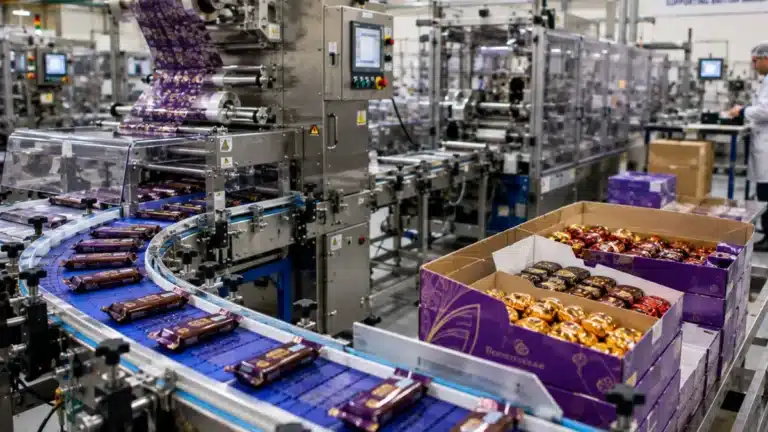

The top confectionery packaging suppliers in the United Kingdom are Bradman Lake Group, A.M.P Automation, Sewtec Automation, Loynds International, T. Freemantle, GIC, Gainsborough Engineering Company, Redpack Packaging Machinery, Marden Edwards and Premier Forrester. They cover:
- Flow wrapping
- Candy wrapping
- VFFS bagging
- Robotic handling
- Cartoning
- Overwrapping
- End-of-line automation
The UK market is different from Germany or Italy. It has fewer large pure-play confectionery packaging groups. But it has a strong base of specialist machine builders and automation engineers.
This matters for manufacturers supplying supermarkets and private label. Their production moves between sharing bags, multipacks, seasonal chocolate, premium boxes and retailer-specific shelf-ready formats.
Top confectionery packaging suppliers in the UK
| Rank | Company | Operating model | Strategic role |
|---|---|---|---|
| 1 | Bradman Lake Group | UK OEM | Integrated wrapping and cartoning |
| 2 | A.M.P Automation | UK OEM / automation | Robotics and retail-ready packing |
| 3 | Sewtec Automation | UK automation house | Bespoke high-speed systems |
| 4 | Loynds International | UK OEM / hybrid | Candy and chocolate wrapping |
| 5 | T. Freemantle | UK OEM | Cartoning and sleeving |
| 6 | GIC | UK OEM | VFFS confectionery bagging |
| 7 | Gainsborough Engineering | UK OEM | VFFS and bagging systems |
| 8 | Redpack Packaging | UK OEM / hybrid | Horizontal flow wrapping |
| 9 | Marden Edwards | UK OEM | Chocolate-box overwrapping |
| 10 | Premier Forrester | UK integrator | Specialist confectionery lines |
The ranking considers direct confectionery evidence, UK engineering presence, technology depth, retail relevance and ability to support commercial production. It is not based on company size alone.
There is also an important distinction between the companies. Most are British machinery manufacturers. Others design and integrate complete automation projects or supply specialist machinery from international technology partners.
That difference should be part of any procurement decision.
1. Bradman Lake Group
- UK base: Beccles, Suffolk, with additional UK operations in Bristol
- Parent: Langley Holdings
- Revenue: Not separately disclosed
- Best suited to: Integrated confectionery lines from primary wrapping to case packing
Bradman Lake takes first place because few UK suppliers cover as much of the packaging line.
What it supplies
Its capabilities include:
- Product feeding
- Horizontal flow wrapping
- Roll wrapping
- Robotic handling
- Cartoning
- Tray forming
- Case packing and other end-of-line operations
Chocolate and confectionery are established applications.
That breadth changes the procurement conversation. A chocolate manufacturer may not simply need a faster wrapper. It may need products distributed from processing, wrapped, grouped and loaded into retail cartons before being packed for distribution. Bradman Lake can work across those interfaces.
The business also includes important British packaging heritage. Autowrappers technology sits within the Bradman Lake portfolio, so Auto Wrappers should not be treated as a separate company in this ranking.
Its current development work also matters. Bradman Lake continued to promote newer flow-wrapping technology around interpack 2026, rather than relying only on older installed machinery.
Why it matters to supermarket buyers
For supermarket suppliers, the strongest argument is integration. Chocolate bars, biscuits and other wrapped confectionery can move into multipacks, cartons and cases. The manufacturer does not have to manage completely separate packaging projects.
This becomes more important for private label, where a factory may need several retailer-specific configurations from the same production assets.
Why Bradman Lake makes the Top 10: It offers one of the broadest UK-engineered combinations of primary, secondary and end-of-line confectionery packaging.
2. A.M.P Automation
- Founded: Modern A.M.P business established in 1990, with machinery heritage extending further back
- Headquarters: Gainsborough, Lincolnshire
- Facility: Around 100,000 sq ft
- Employees: Around 130
- Best suited to: Robotic product handling, chocolate assortments and shelf-ready packaging
A.M.P Automation solves a different problem from a conventional wrapper manufacturer. Its strength is handling products between processes.
The Gainsborough company builds robotic pick-and-place, product collation, case packing and other automated systems. Chocolate and confectionery are important sectors within that work.
What it supplies
A.M.P’s IPax systems can handle:
- Wrapped chocolate and cereal bars
- Naked chocolates
- Mixed chocolate assortments
- Products moving into shelf-ready packaging
That last application gives it especially strong supermarket relevance.
A documented automated multipack system uses vision-guided delta robots. It handles products at up to 120 picks per minute before grouped products move towards flow wrapping.
Why it matters to private-label buyers
For private-label factories, robotic handling can make it easier to switch between pack configurations. A line may make essentially the same confectionery product but need different counts or retail packs for Tesco, Sainsbury’s, Aldi, Lidl or another customer.
A.M.P also gives the article an important historical angle. Gainsborough has been linked with packaging engineering for generations, including Rose Brothers and Forgrove machinery heritage.
Why A.M.P makes the Top 10: It combines British engineering with direct confectionery robotics, multipacking and retail-ready packaging expertise.
3. Sewtec Automation
- Headquarters: Wakefield, West Yorkshire
- Current ownership: Automated Industrial Robotics
- Revenue: Not publicly disclosed as a standalone UK figure
- Best suited to: Bespoke high-speed confectionery automation
Sewtec belongs near the top because standard packaging machinery is not always enough.
The Wakefield business designs and builds custom automated production and packaging systems. Confectionery is an established part of that work.
Its systems can combine product handling, carton erecting, loading, case packing and other processes around a manufacturer’s existing production equipment.
Why custom automation matters
This is especially relevant at large FMCG plants. Older factories often contain machinery installed at different times from different suppliers. Replacing the entire line may not make financial sense.
Custom automation can instead remove manual processes or connect existing equipment. Sewtec has worked with major international manufacturers and has direct experience in confectionery automation.
Ownership
Its ownership also needs to be described accurately. Automated Industrial Robotics acquired Sewtec in 2024. That does not make Sewtec a foreign machinery distributor. Design and engineering operations continue from Wakefield.
For private-label manufacturers, bespoke automation is useful where customer requirements create unusual pack combinations. It also helps with frequent product changes that standard machinery cannot handle efficiently.
Why Sewtec makes the Top 10: Its value lies in solving difficult automation problems around existing confectionery production and packaging lines.
4. Loynds International
- Headquarters: Blackpool, Lancashire
- Experience: More than 30 years
- Revenue: Not publicly disclosed
- Best suited to: Candy, chocolate, fudge and lollipop wrapping
Loynds is one of the most confectionery-focused companies in the UK ranking. Its machinery portfolio covers both confectionery production and packaging.
What it supplies
Packaging equipment includes flow wrappers, double-twist wrapping systems and machinery for small sweets and chocolate products.
The Candy Mini Wrap, for example, can reach stated speeds of up to 800 pieces per minute. Other systems cover products including fudge, caramel, chocolates and larger bars.
Who it suits
That makes Loynds relevant to a wider range of businesses than the largest multinational confectionery factories. Smaller producers, regional manufacturers and growing private-label suppliers may not need the scale or automation offered by Bradman Lake or Sewtec.
Loynds has also invested in practical customer testing. Its Blackpool operation includes confectionery testing and demonstration facilities. Customers can assess equipment and production processes there before committing to machinery.
The company’s documented work with Stanton & Novelty Confectioners provides further evidence of real confectionery application rather than generic food-machinery claims.
Why Loynds makes the Top 10: Confectionery is central to its machinery business, giving it depth across candy, chocolate and specialist wrapping applications.
5. T. Freemantle
- Established: 1970s
- UK base: Scunthorpe, North Lincolnshire
- Parent: Lifco AB
- Revenue: Not separately disclosed
- Best suited to: Cartons, sleeves and secondary retail packaging
T. Freemantle enters the ranking because confectionery packaging does not end when the product gets its primary wrapper.
Chocolate bars, bags and individual products often need to be loaded into cartons, sleeves, trays or multipacks before reaching supermarkets. Freemantle specialises in that stage.
What it supplies
Its British-built machinery covers top-load and end-load cartons, sleeving, carton forming and other secondary packaging formats. The company also names chocolate and confectionery as a specific machinery sector.
Why it matters to private-label buyers
This has direct private-label relevance. A manufacturer may run the same basic product through primary packaging. But it may change the secondary carton for different retailers, promotional campaigns or price tiers.
Secondary packaging can therefore become one of the main sources of changeover complexity.
Premium chocolate is another important application. The carton is often a major part of the retail offer rather than simply transport packaging.
Freemantle is now owned by Sweden’s Lifco, but its machinery operation remains based in North Lincolnshire. Parent-company revenue should not be presented as T. Freemantle’s standalone turnover.
Why T. Freemantle makes the Top 10: It adds genuine UK-built cartoning and sleeving expertise to a ranking that would otherwise be too heavily weighted towards primary wrapping.
6. GIC
- Full name: Gainsborough Industrial Controls
- Founded: 1984
- Headquarters: Gainsborough, Lincolnshire
- Revenue: Not publicly disclosed
- Best suited to: Bagged sweets, gummies and confectionery sharing packs
GIC is one of the clearest British options for vertical form-fill-seal packaging. Its machines are designed and built in Gainsborough, and snacks and confectionery are established applications.
That gives GIC a clear place in this ranking. Supermarkets sell large volumes of sweets through pillow bags, sharing formats and other flexible packs. Those products need accurate feeding and weighing alongside reliable bag forming and sealing.
What it supplies
GIC’s current machinery can handle several formats, depending on the configuration:
- Pillow packs
- Gusset packs
- Quad packs
- Doy packs
- Zip packs
The company’s newer GIC8000 also shows that the range continues to develop. It targets high-speed pillow-pack applications including snacks and confectionery.
Why it matters to private-label buyers
Private label strengthens the commercial case for this type of equipment. One confectionery manufacturer can fill different weights and pack designs for several retailers using the same production line.
Weight control is especially important. Small amounts of unnecessary overfill become expensive across millions of bags.
Why GIC makes the Top 10: It provides direct UK manufacturing capability for one of supermarket confectionery’s most important formats: flexible retail bags.
7. Gainsborough Engineering Company
- Headquarters: Gainsborough, Lincolnshire
- Operating model: UK OEM
- Revenue: Not publicly disclosed
- Best suited to: VFFS and flexible bagging projects
Gainsborough Engineering Company is a separate business from GIC, despite the similar location and machinery category.
That distinction matters. Both companies operate in Gainsborough and both take part in Britain’s vertical packaging machinery sector. But procurement teams should not treat them as related entities.
What it supplies
Gainsborough Engineering designs and manufactures vertical form-fill-seal machinery and related packaging systems in the UK.
Its role in this ranking is therefore around flexible bagging projects rather than individual chocolate wrapping or secondary cartoning.
The Gainsborough connection
The company highlights another important point about the UK market: Gainsborough is a genuine packaging-engineering cluster. A.M.P Automation, GIC and Gainsborough Engineering all operate there, although they serve different machinery needs.
That concentration has practical benefits for the wider British packaging sector. Engineering skills in machine building, controls, product handling and packaging automation stay available within one regional manufacturing base.
For confectionery procurement teams, Gainsborough Engineering is most relevant when the requirement centres on bagging rather than decorative wrapping or boxed assortments.
Why Gainsborough Engineering makes the Top 10: It adds another genuine UK VFFS manufacturing option and reinforces the depth of packaging engineering around Gainsborough.
8. Redpack Packaging Machinery
- Headquarters: Norwich, Norfolk
- Experience: More than 45 years
- Revenue: Not publicly disclosed
- Best suited to: Horizontal flow wrapping for bars and other confectionery
Redpack is another genuine British machine builder. But its manufacturing model needs to be described carefully.
The company builds horizontal form-fill-seal machinery at its Norwich operation. Flow wrapping is relevant across chocolate bars, confectionery pieces, biscuits and other products that need a sealed flexible pack at speed.
A hybrid model
Redpack also offers vertical packaging for confectionery through equipment supplied with Comek. That creates an important distinction: Redpack’s HFFS machinery is its own UK manufacturing activity, while its VFFS range includes partner technology.
This hybrid model is common in packaging machinery. A supplier may build its strongest technology in-house. It then adds complementary equipment from specialist partners to provide a broader line.
For supermarket manufacturers, flow wrapping remains especially important for count-line confectionery and multipack production. Format flexibility becomes more valuable when the same factory handles branded products, private label and promotional runs.
Why Redpack makes the Top 10: It combines long-established UK flow-wrapper manufacturing with access to complementary confectionery bagging technology.
9. Marden Edwards
- Headquarters: Nottingham
- Core operations: Overwrapping and shrink wrapping
- Revenue: Not publicly disclosed
- Best suited to: Premium chocolate boxes and presentation packaging
Marden Edwards fills a narrow but commercially important gap. Its strength is not wrapping individual sweets. It specialises in overwrapping finished cartons and other packaged products.
Why it matters to supermarket buyers
For premium confectionery, that can matter a great deal. A chocolate assortment box may already contain individually wrapped or tray-loaded chocolates. But the finished carton can still need a tight transparent overwrap for presentation, tamper evidence and protection.
Marden Edwards has documented confectionery installations involving chocolate assortment boxes and premium chocolate products. Its work with Willie’s Cacao also provides UK chocolate-sector evidence.
This niche becomes especially relevant around gifting and seasonal trading. Christmas chocolate boxes, Valentine’s ranges and premium supermarket confectionery depend heavily on presentation.
The technology can also help manufacturers keep a consistent retail finish across cartons produced in different runs.
Why Marden Edwards makes the Top 10: It brings specialist British overwrapping expertise for premium boxed confectionery, a packaging stage not adequately covered by the other nine suppliers.
10. Premier Forrester
- Established: 2018
- Operating model: UK supplier and systems integrator
- Revenue: Not publicly disclosed
- Best suited to: Seasonal chocolate and specialist integrated projects
Premier Forrester is deliberately classified differently from most companies above it. It is not being presented as a British manufacturer of every machine it supplies.
The business acts as a UK machinery supplier and integrator across food, bakery and confectionery. It brings together technology from specialist international manufacturers.
What it supplies
Its confectionery relevance includes access to Chocal Packaging Solutions technology for products such as chocolate eggs and hollow figures.
That gives Premier Forrester a useful position in the UK market. Seasonal confectionery is commercially significant for British supermarkets. Easter eggs, chocolate figures and Christmas ranges need equipment that can handle unusual shapes and presentation formats.
Those products create very different packaging problems from a standard chocolate bar or bag of gummies.
A specialist integrator can also help manufacturers combine processing and packaging equipment from different suppliers. They do not have to buy every stage from one OEM.
Why Premier Forrester makes the Top 10: It gives UK manufacturers access to specialist confectionery technology for applications, particularly hollow and seasonal chocolate, not strongly covered by domestic OEMs.
Which UK supplier fits each confectionery application?
- For complete integrated packaging lines, Bradman Lake has the broadest UK-built offer in this ranking.
- For robotic chocolate handling, assortments and retail-ready packaging, A.M.P Automation and Sewtec are stronger starting points.
- For candy and chocolate wrapping, Loynds offers direct confectionery specialisation. Redpack is relevant where horizontal flow wrapping is central to the project.
- For cartons, sleeves and secondary presentation packaging, T. Freemantle has an especially clear role.
- For VFFS bags and sharing packs, GIC and Gainsborough Engineering provide UK manufacturing options.
- For premium chocolate-box overwrapping, Marden Edwards is the specialist.
- For seasonal and hollow chocolate products, Premier Forrester gives UK manufacturers access to specialist international machinery through a domestic integration partner.
The best supplier therefore depends on the product, pack format and production volume.
The ranking should not be read as saying that Bradman Lake is automatically a better choice than GIC for a bag of gummies. Nor does it say that GIC is preferable to Marden Edwards for a premium chocolate box.
The Gainsborough packaging cluster
One of the more interesting findings from the research is the concentration of packaging engineering in Gainsborough, Lincolnshire. A.M.P Automation, GIC and Gainsborough Engineering all operate there.
They are separate companies, and their technology also differs:
- A.M.P concentrates heavily on custom automation, robotics and product handling.
- GIC builds VFFS packaging machinery.
- Gainsborough Engineering also operates in vertical packaging and related systems.
The roots run deeper than the current companies. Gainsborough has a long history in packaging machinery through names including Rose Brothers and Forgrove. A.M.P traces part of its own machinery heritage through those businesses.
This matters because machinery clusters retain engineering knowledge. Controls specialists, fabricators, automation engineers and packaging technicians do not exist in isolation from the manufacturing base around them.
For UK food manufacturing, Gainsborough remains an unusually concentrated centre of packaging machinery expertise.
Why supermarkets and private label matter
The UK grocery market puts packaging machinery under particular pressure because private label is deeply embedded in supermarket ranges.
A confectionery factory may produce similar sweets for several retailers while changing the final pack:
- One customer might require a 150g pillow bag.
- Another could want a resealable format.
- Premium private label may require a carton, sleeve or more elaborate presentation.
- Promotional products can introduce multipacks or different counts.
Seasonality adds another layer. Easter eggs, Christmas assortments, Halloween sweets and Valentine’s chocolate can create short production windows. These are followed by rapid changeovers back to core lines.
What buyers should measure
That changes machinery economics. A very fast machine can still be expensive to run if changing between retailer formats creates hours of downtime or excessive product and film waste.
For procurement teams, useful measures therefore include changeover time, product giveaway, damaged product rates, film waste, labour requirements and overall line efficiency.
Maximum rated speed remains important. It is no longer enough on its own.
Secondary packaging is becoming more important
Primary packaging gets much of the attention in confectionery. But supermarket requirements extend further down the line.
Retail cartons, shelf-ready cases, display packs and multipacks decide how efficiently products move through distribution centres and stores.
This is where companies such as A.M.P, T. Freemantle and Bradman Lake become especially relevant:
- Shelf-ready packaging can reduce handling in store.
- Robotic case packing can remove repetitive manual work at the factory.
- Automated carton loading can maintain output when primary wrappers become faster.
The relationship between primary and secondary machinery therefore matters. Installing a faster wrapper achieves little if operators then have to pack the extra output into cartons by hand.
For larger confectionery plants, procurement increasingly needs to consider the complete packaging flow rather than an isolated machine.
Packaging materials are changing the engineering brief
UK confectionery manufacturers are also dealing with changes in packaging materials.
Paper-based structures, mono-material films and other alternatives can behave differently from conventional laminates. That affects sealing temperature, friction, folding, machine speed and product protection.
Chocolate creates extra constraints because barrier performance and temperature sensitivity matter.
Machinery suppliers increasingly discuss compatibility with alternative substrates. But those statements need careful interpretation.
A machine being technically capable of processing paper or recyclable film does not prove that every version of that material will run at full speed. Nor does machine compatibility prove the environmental performance of the finished package.
For buyers, the right approach is practical: test the exact product and intended substrate under realistic production conditions.
Seal quality, waste, output, shelf-life requirements and product protection should be measured before a material change reaches full commercial production.
Frequently Asked Questions
Who are the top confectionery packaging suppliers in the UK?
The ranking is led by Bradman Lake Group, A.M.P Automation and Sewtec Automation. It also includes Loynds International, T. Freemantle, GIC, Gainsborough Engineering, Redpack, Marden Edwards and Premier Forrester.
Why is Gainsborough important for packaging machinery?
A.M.P Automation, GIC and Gainsborough Engineering all operate in Gainsborough, Lincolnshire. The town has a long packaging-machinery history through names including Rose Brothers and Forgrove.
Is Auto Wrappers ranked separately?
No. Autowrappers technology sits within the Bradman Lake portfolio, so it was not ranked as a separate company.
What happens next for UK confectionery packaging?
The next phase of UK confectionery packaging investment is likely to be shaped less by one breakthrough machine. Factory economics will matter more.
Labour remains expensive. Retailers continue to demand different formats. Seasonal confectionery creates short production campaigns. Private-label manufacturers need to move between customer specifications without losing too much productive time.
That favours automation, but not automation at any cost. Manufacturers need equipment that can justify itself through lower labour needs, less product giveaway, faster changeovers or better use of existing lines.
The UK supplier base is unusually varied in how it approaches those problems:
- Bradman Lake can cover several stages of a complete packaging line.
- A.M.P and Sewtec tackle complex automation.
- Loynds retains direct candy and chocolate machinery expertise.
- Freemantle addresses cartons and sleeves.
- GIC and Gainsborough Engineering cover flexible bags.
- Redpack adds flow wrapping.
- Marden Edwards handles premium overwrapping.
- Premier Forrester fills specialist technology gaps through integration.
For buyers comparing confectionery packaging suppliers in the United Kingdom, the right starting point is therefore not the largest company. It is the product, pack format, required output, retailer specification and amount of flexibility the factory actually needs.
For wider background on the sector, packaging machinery covers the main equipment categories used across industrial packaging lines.
Editor’s Note
This ranking was developed using a research-first methodology focused on companies with a genuine UK operating presence and identifiable confectionery packaging capability.
Three operating models were accepted: UK OEM/machine manufacturer, UK systems integrator/custom automation house, and UK specialist supplier/integrator.
The distinction matters.
Premier Forrester, for example, should not be interpreted as manufacturing all the machinery it supplies. Redpack manufactures its HFFS technology in the UK but supplements its range with partner equipment.
Foreign ownership was not an automatic exclusion where engineering and manufacturing remain in Britain.
Sewtec continues to operate from Wakefield following its acquisition by Automated Industrial Robotics. T. Freemantle remains a UK machinery operation despite ownership by Sweden’s Lifco.
Auto Wrappers was not ranked separately because its technology forms part of the Bradman Lake machinery portfolio.
Revenue has deliberately not been estimated where reliable current standalone figures were unavailable. Parent-company revenue should not be presented as subsidiary revenue.
The ranking is editorial and is not based on sponsorship. Positions reflect confectionery relevance, technology breadth, UK engineering capability, application evidence and usefulness to commercial buyers.
A lower-ranked specialist may be the better choice for a particular packaging project.