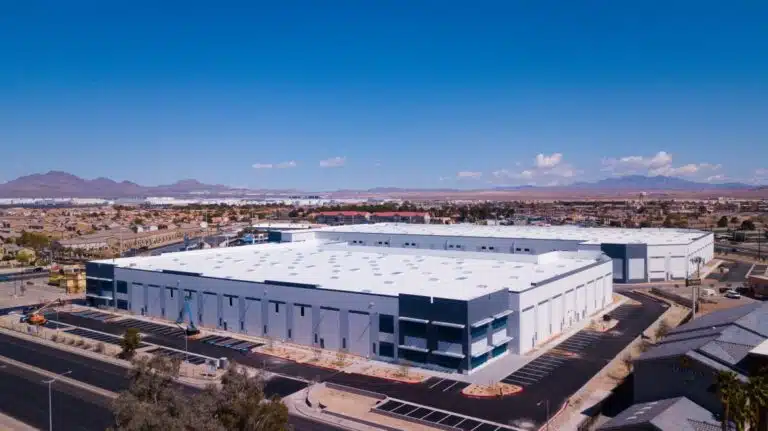

ALPLA will open a 13,000m² plastic-bottle plant in North Las Vegas in spring 2027, adding production capacity closer to food, beverage and other consumer-goods customers in the western United States.
The site at Craig Road Logistics Center will be ALPLA’s second manufacturing location in the western US. It will use extrusion blow moulding to produce rigid plastic bottles for domestic and international customers and is expected to create 36 jobs.
For grocery and FMCG procurement teams, the commercial importance is proximity. Bottles are bulky relative to their weight, so long transport distances can add cost, handling and supply risk before a pack reaches a filling line. A western production base can shorten replenishment routes for regional customers and give buyers another option when qualifying supply across several plants.
ALPLA said the Nevada location provides access to major transport corridors and regional distribution networks. The company now operates 19 sites across the United States, giving the new plant an established production and technical network behind it rather than leaving it as a standalone operation.
Tasos Pourloukakis, regional managing director of ALPLA North America, described the investment as “an important step in ALPLA’s long-term North American growth strategy”.
The plant will serve food and beverage, health and beauty, and home-care customers. That mix should help ALPLA spread demand across several packaging categories, although the company has not disclosed the plant’s annual bottle capacity, investment value, customer contracts or intended resin mix.
Those missing details will matter to buyers. A new factory only becomes commercially significant when its mould portfolio, line capacity, quality systems and material approvals match a customer’s actual pack specifications and launch timetable.
Extrusion blow moulding is commonly used to form hollow rigid containers by inflating heated plastic inside a mould. It can support bottles with handles and more complex shapes, making it relevant to products ranging from beverages and sauces to household and personal-care liquids.
Before moving volume, procurement and packaging teams will need to validate bottle weight, neck finish, closure compatibility, dimensional tolerances, leak performance, top-load strength and filling-line efficiency. Food and beverage customers will also need evidence that the plant’s hygiene, traceability and food-contact controls meet their own standards.
ALPLA is headquartered in Austria and is one of the large international groups shaping Austria’s packaging industry. Its broader capabilities cover bottles, preforms, caps, closures and recycling, which allows the business to compete for multi-component packaging programmes rather than bottle supply alone.
The Nevada addition also increases competitive pressure within the US packaging market, where regional capacity and delivery resilience are becoming more important alongside price, lightweighting and recycled-content targets.
For brands, a plant closer to western filling operations could reduce freight exposure and make production scheduling more responsive. The benefit will depend on whether ALPLA can match those logistical gains with dependable resin sourcing, efficient changeovers and consistent quality across customer-specific bottle formats.
The announcement does not say whether the facility will process recycled material on site or manufacture bottles with post-consumer resin. Buyers pursuing recycled-content commitments should therefore treat proximity and circularity as separate qualification questions rather than assuming that a new local plant automatically delivers both.
Retailers and FMCG suppliers should also examine contingency arrangements. A useful second-source strategy requires compatible tooling, agreed specifications and validated production at another location before a disruption occurs. ALPLA’s wider US network could support that resilience, but customers will need clear transfer protocols and lead-time commitments.
The next milestones will be equipment installation, customer qualification and the start of commercial output in spring 2027. The strongest evidence of the plant’s value will be whether it converts additional western capacity into shorter lead times, stable bottle supply and measurable logistics savings for food and beverage customers.
Editor’s note: This article is based on ALPLA’s company announcement published on 1 October 2026. Grocery Trade News added independent analysis of the capacity, production technology and implications for food and beverage packaging buyers.