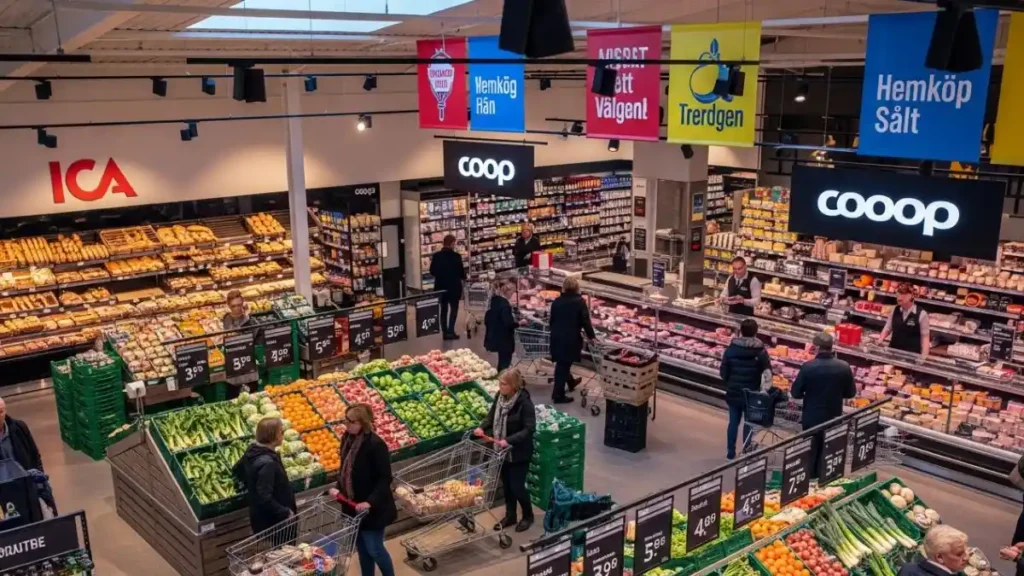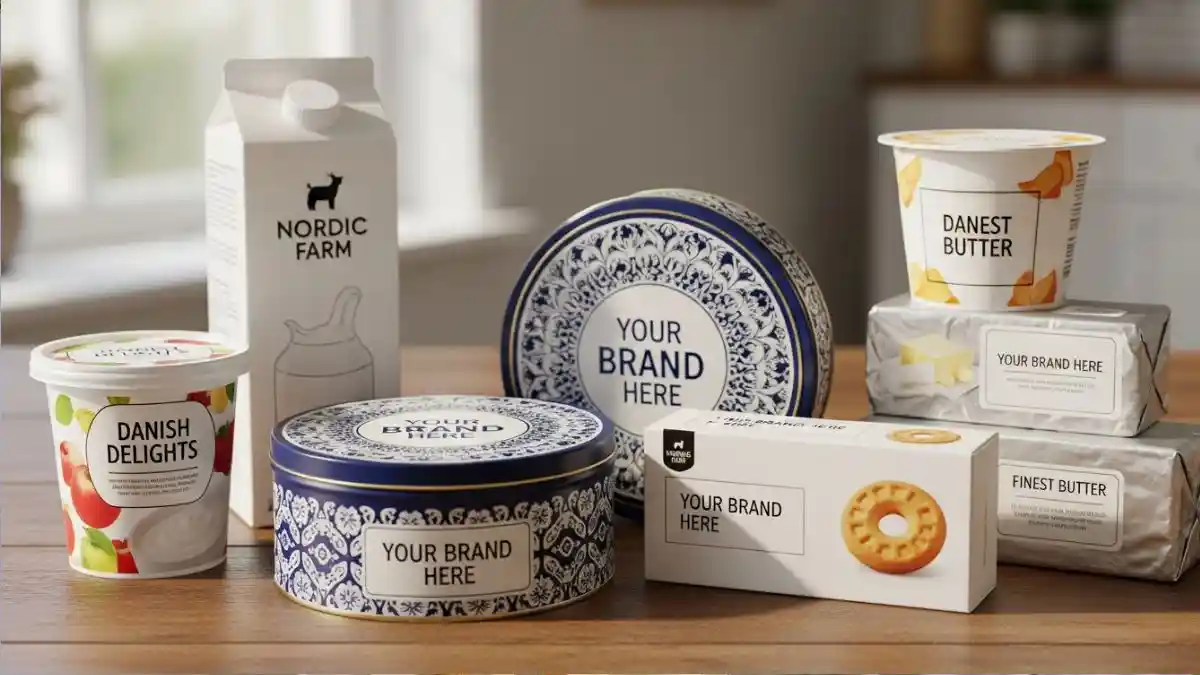

Denmark private label supply chain does not operate around “white-label only” factories. Instead, it is built on large branded food groups that run parallel private label production lines inside high-capacity, retailer-certified facilities. These manufacturers dominate because they already control raw material sourcing, operate automated plants, and meet the compliance standards demanded by Nordic and European retail buyers.
For supermarket groups, sourcing teams, and category managers, the real question is not brand visibility. It is manufacturing depth, scale reliability, and long-term partnership potential.
This ranking focuses on manufacturers with proven private label production capacity, not companies that operate exclusively as contract producers. Revenue scale, operational footprint, category strength, and retail programme suitability are the main criteria.
Manufacturer Overview
| Rank | Company | Revenue / Scale | Employees | Denmark Branches |
|---|---|---|---|---|
| 1 | Arla Foods | €13.8bn group revenue (2024) | ~6,100 FTEs (Arla Foods amba) | Multi-site dairy production network |
| 2 | Danish Crown | DKK 65.4bn revenue (FY 2024/25) | ~23,000 employees | Consolidated national processing network |
| 3 | Danpo (Scandi Standard) | DKK 2.586bn net revenue (2024) | ~1,070 employees | Dedicated poultry processing facilities |
| 4 | Lantmännen Schulstad A/S | DKK 1.136bn net revenue (2024) | ~559 employees | Avedøre and Pandrup bakeries |
| 5 | Kelsen Group A/S | DKK 1.027bn net revenue (2023/24) | ~298 employees | Two biscuit factories |
Categories and Retail Supply Role
| Company | Main Product Categories | Retail Partnership Role |
|---|---|---|
| Arla Foods | Dairy, cheese, butter, liquid milk, ingredients | Strategic high-volume supplier for branded and private label programmes |
| Danish Crown | Fresh meat, processed meat, ready meals | Core protein manufacturing partner for retail and foodservice |
| Danpo | Poultry, ready-to-cook chicken, value-added products | Primary poultry manufacturing partner for Nordic retail private labels |
| Lantmännen Schulstad | Bread, bakery, packaged baked goods | Industrial bakery supplier for retailer bakery programmes |
| Kelsen Group | Butter cookies, seasonal tins, biscuits | Premium private label biscuit manufacturing |
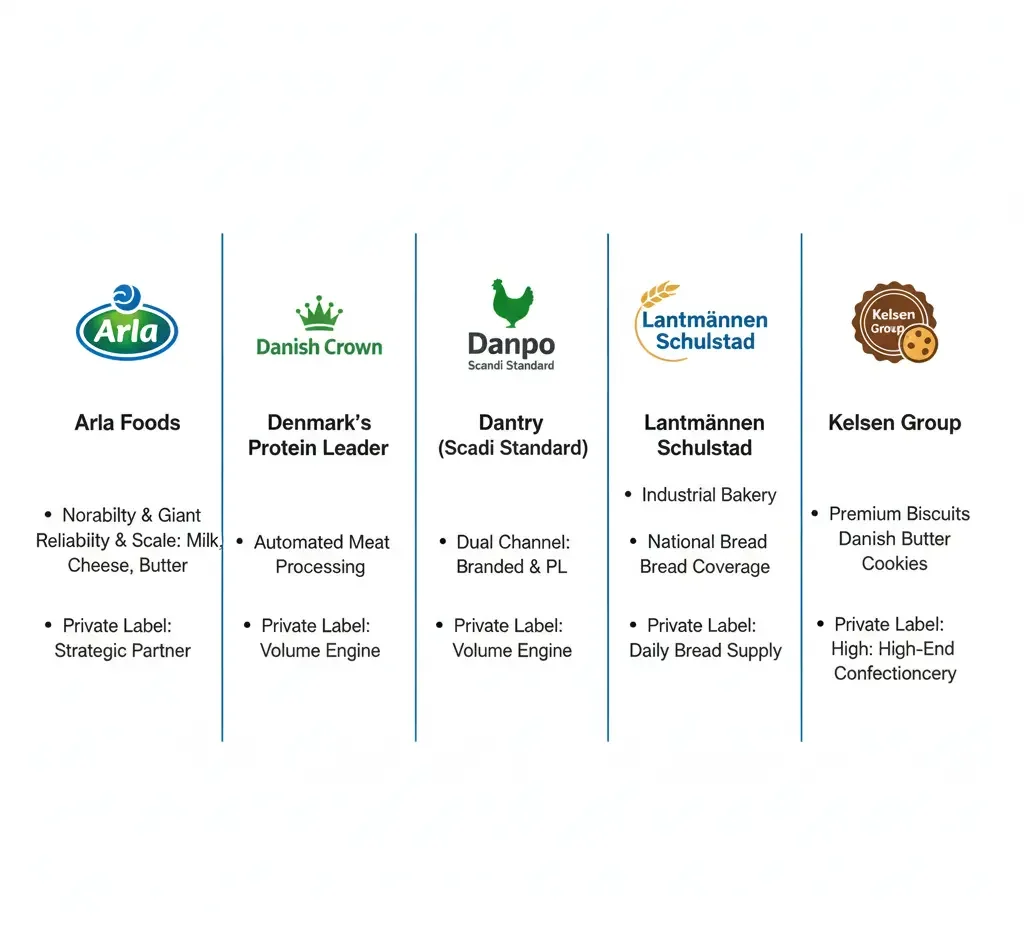
1) Arla Foods
Arla Foods is Denmark’s largest food manufacturer by revenue and the most structurally important dairy supplier in the Nordic retail system. While the majority of Arla’s turnover comes from its own consumer brands such as Arla and Lurpak, the cooperative also operates extensive private label production capacity across liquid milk, cheese, butter, and foodservice dairy formats.
For retailers, Arla’s private label value is not about low-cost production alone. It is about reliability at scale. Arla controls raw milk supply through its farmer-owner network, operates automated dairy plants, and manages cross-border logistics into multiple European retail markets. This allows retailers to build long-term private label programmes without relying on fragmented regional suppliers.
Arla’s Denmark business segment alone generates more than €1.2 billion in revenue, which shows the domestic production base remains commercially significant even inside a global cooperative structure. For private label buyers, this matters because domestic manufacturing gives faster lead times, stronger traceability control, and easier audit access.
Scale advantage: €13.8bn global revenue with large-volume dairy capacity
Private label role: Strategic manufacturing partner rather than pure contract supplier
2) Danish Crown
Danish Crown remains Denmark’s dominant protein manufacturer and one of Europe’s largest meat processors. The company’s revenue base of more than DKK 65 billion reflects its deep integration across slaughtering, processing, packaging, and export distribution.
Over the past few years, Danish Crown has gone through a major restructuring programme. Several older facilities have been closed or consolidated as part of a move toward fewer, larger, and more automated production hubs. For retail buyers, this shift is important. The footprint today is leaner, more centralised, and designed to deliver higher throughput efficiency and tighter quality control.
From a private label perspective, Danish Crown is not positioned as a branding partner. Instead, it functions as a volume engine. Supermarkets rely on the company for fresh meat supply, processed protein lines, and ready-to-cook formats that require strict food safety certification and consistent specification standards.
Retailers sourcing private label meat value Danish Crown’s ability to stabilise pricing across long-term contracts, manage animal welfare compliance, and supply both domestic and export-focused retail programmes.
Scale advantage: DKK 65.4bn revenue with national protein infrastructure
Private label role: High-volume protein manufacturing backbone
3) Danpo (Scandi Standard)
Danpo is Denmark’s most important poultry-focused manufacturer and part of the wider Scandi Standard group, which dominates chicken production across the Nordic region. With net revenue of DKK 2.586 billion, Danpo operates dedicated slaughtering, cutting, and further processing facilities inside Denmark.
What makes Danpo particularly relevant for private label buyers is its dual-channel structure. The company supplies branded poultry products while simultaneously producing retailer-owned private label chicken ranges. Major grocery groups such as Salling Group and Coop Denmark rely on Danpo to manufacture store-brand poultry lines covering fresh, frozen, marinated, and ready-to-cook categories.
This setup allows Danpo to run stable base-load production while customising specifications for different retail partners. From a procurement perspective, this reduces risk. Retailers gain access to established food safety systems, strong animal welfare controls, and flexible volume scaling during promotional or seasonal peaks.
Danpo’s integration into Scandi Standard also gives access to wider Nordic sourcing networks, which is increasingly important for retailers managing supply continuity across borders.
Scale advantage: DKK 2.586bn poultry manufacturing platform
Private label role: Primary chicken supplier for Nordic own-brand ranges
4) Lantmännen Schulstad A/S
Lantmännen Schulstad is Denmark’s largest industrial bakery manufacturer and a critical supplier of packaged bread and baked goods. With more than DKK 1.1 billion in net revenue and two major production sites in Avedøre and Pandrup, the company provides national coverage for retail bakery programmes.
Although Schulstad is highly visible as a branded bakery supplier, its operational structure is equally suited to private label production. Industrial bread manufacturing requires tight process control, consistent ingredient sourcing, and high-speed packaging lines. Schulstad already operates these systems at scale, making it a natural partner for retailers building own-brand bread assortments.
For supermarket buyers, Schulstad’s appeal lies in reliability. Bread is a daily traffic-driving category. Private label programmes depend on uninterrupted supply, short delivery windows, and consistent quality across hundreds of stores. Schulstad’s Denmark footprint supports exactly that requirement.
Scale advantage: National bakery manufacturing coverage
Private label role: Industrial bread supplier for retailer bakery ranges
5) Kelsen Group A/S
Kelsen Group represents Denmark’s premium private label manufacturing segment. Best known globally for Danish butter cookies, the company operates two biscuit factories and generates more than DKK 1 billion in annual revenue.
Since joining the Ferrero group, Kelsen has gained stronger international distribution access while maintaining production operations in Denmark. For retailers, this combination is attractive. It allows them to source premium-positioned private label biscuit ranges that can compete directly with branded gift tins, particularly during holiday and seasonal promotional periods.
Kelsen explicitly supplies private label cookies alongside its own branded production. This positions the company as a specialist manufacturing partner for retailers targeting higher-margin private label confectionery categories rather than entry-level price competition.
Scale advantage: Premium biscuit manufacturing with export reach
Private label role: High-end private label confectionery supplier
Why These Manufacturers Dominate Private Label Supply
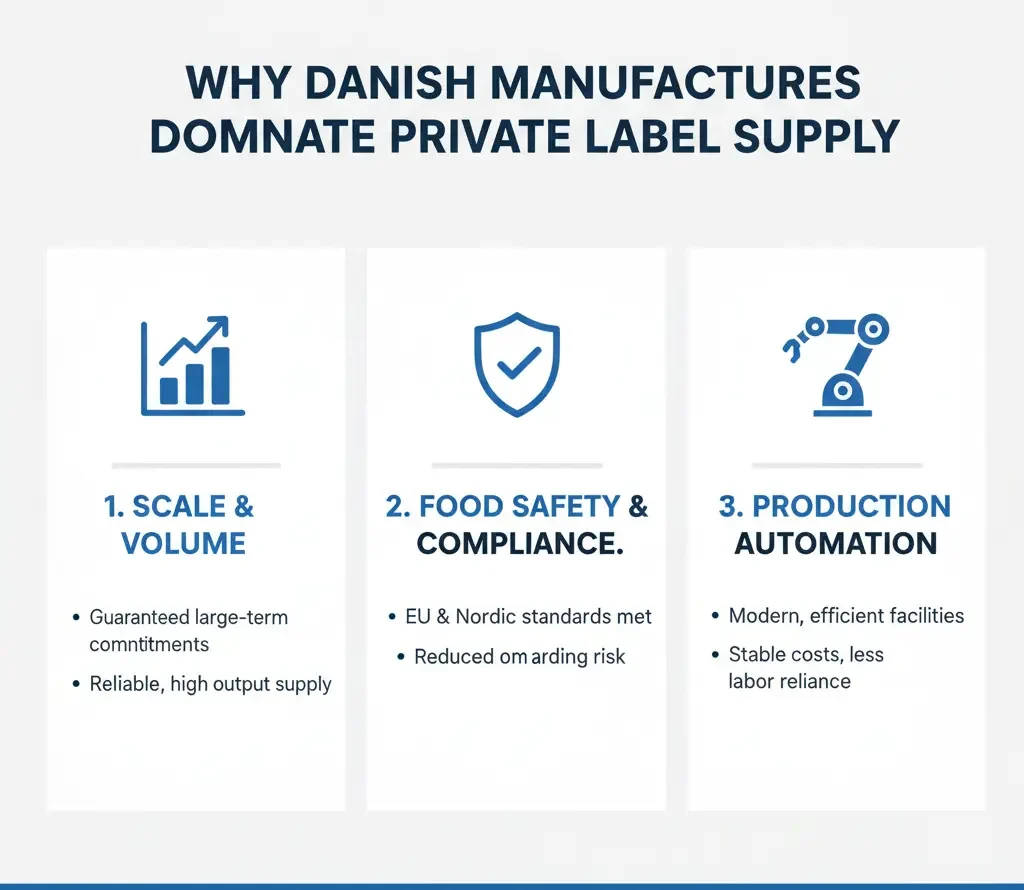
Denmark’s private label ecosystem is shaped by three structural realities.
First, scale matters more than branding. Retailers prioritise manufacturers that can guarantee long-term volume commitments, not companies that simply offer white-label packaging.
Second, food safety compliance is non-negotiable. Large manufacturers already operate under EU, Nordic, and retailer audit standards. This reduces onboarding risk for new private label programmes.
Third, production automation has become critical. Labour shortages and cost pressure mean retailers increasingly prefer partners with modernised facilities capable of high output with stable cost structures.
The five manufacturers listed here dominate because they already meet all three requirements.
What Retail Buyers Should Consider
When sourcing private label supply in Denmark, buyers should look beyond headline revenue numbers.
Important evaluation factors include:
Production line flexibility for retailer-specific specifications
Audit access and certification coverage
Capacity availability during promotional peaks
Cross-border logistics capability
Long-term pricing stability
Manufacturers such as Arla and Danish Crown operate at a strategic partnership level. Others like Danpo and Kelsen offer category-specialist advantages. Schulstad fills the essential daily volume bakery segment.
Each serves a different role inside modern supermarket private label strategies.
Final Take
Denmark’s private label supply is not built on small contract factories. It is driven by large industrial manufacturers that combine branded scale with private label production capability.
Arla and Danish Crown dominate through volume and infrastructure. Danpo controls the poultry category. Schulstad anchors bakery supply. Kelsen leads premium private label biscuits.
For supermarket buyers, these companies represent the backbone of Denmark’s private label manufacturing ecosystem — not just by revenue, but by operational depth, reliability, and long-term partnership value.