
Selling food products into major US supermarket chains has become far more complicated than simply meeting basic food safety rules.
American retailers are tightening supplier requirements across food safety, traceability, audit compliance, allergen management, sustainability reporting, and supply-chain transparency. For suppliers hoping to work with Walmart, Kroger, Costco, Albertsons, Publix, Target, Whole Foods Market, Aldi US, Trader Joe’s, or regional grocery chains, certification is now deeply tied to commercial access.
At the same time, the US food system operates differently from Europe.
Unlike the UK, where BRCGS dominates many supermarket supply chains, the American grocery industry is shaped far more heavily by FDA regulation, FSMA preventive controls, SQF certification programs, USDA oversight, and retailer-specific supplier audits.
That distinction matters.
Many suppliers entering the US market assume one certification automatically opens every retail door. In reality, supermarket expectations vary depending on:
- product category,
- manufacturing risk,
- retailer policies,
- export exposure,
- and whether products are branded or private label.
For some suppliers, HACCP and FDA registration may be enough to begin distribution. For others, especially private label manufacturers and national grocery suppliers, GFSI-recognized certification has effectively become mandatory.
The strongest suppliers in the US market increasingly combine regulatory compliance with third-party certification, retailer audit readiness, traceability investment, and category-specific approvals.
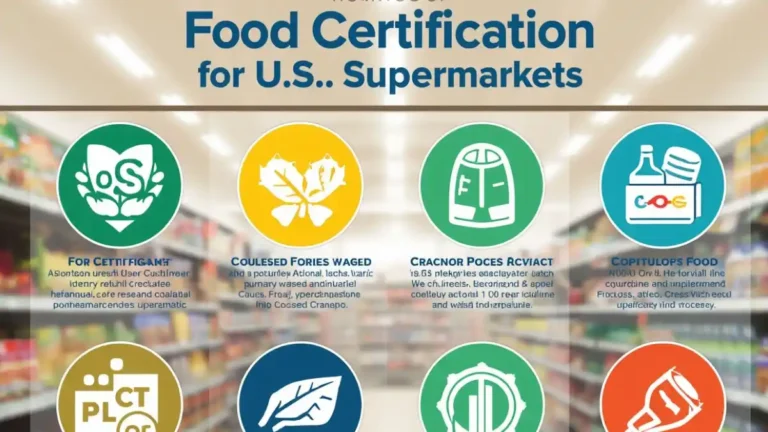
This article explains which food certifications grocery suppliers actually need to sell to US supermarkets, which certifications matter most by product category, and how the American supermarket compliance system is changing in 2026.
At a glance
- SQF is one of the strongest supermarket-recognized food safety certifications in the US.
- FDA FSMA compliance forms the legal foundation for most food suppliers.
- HACCP remains critical across meat, seafood, dairy, juice, and processed foods.
- USDA inspection is essential for meat, poultry, and some egg products.
- GFSI-recognized certification is increasingly expected by major retailers.
- Walmart, Costco, and other chains may require retailer-specific supplier programs.
- USDA Organic remains the dominant organic certification system in the US.
- Halal and Kosher certifications continue expanding across mainstream grocery retail.
- BRCGS and FSSC 22000 remain important for multinational and export-oriented suppliers.
- Certification alone does not guarantee supplier approval.
What certifications do US supermarkets actually require?
Most American supermarkets do not publicly publish one universal certification requirement covering every supplier category.
Instead, retailers typically expect suppliers to meet a combination of:
- FDA regulatory compliance,
- FSMA preventive control requirements,
- HACCP-based food safety systems,
- and third-party audited certification programs.
For large retail contracts, many supermarket chains strongly prefer suppliers holding certification under a GFSI-recognized scheme.
That usually includes:
- SQF,
- BRCGS,
- FSSC 22000,
- or IFS.
In practice, SQF holds particularly strong influence across the American grocery sector.
For many suppliers, the real question is not whether certification is legally required under federal law. The more important question is whether retailers will approve a supplier without recognized certification.
Increasingly, the answer is no.
Large supermarkets are trying to reduce supply-chain exposure at a time when recalls, contamination incidents, allergen failures, food fraud, and cybersecurity risks continue increasing across global food systems.
That pressure has made supplier verification far more aggressive than it was even five years ago.
Why the US supermarket system is different from Europe
The American food safety environment operates under a different structure than many European grocery markets.
In Europe, supermarket-led certification systems often dominate supplier approval.
In the United States, federal regulation plays a much larger role.
That means suppliers frequently face two separate layers:
- Government regulatory compliance
- Retailer commercial compliance
The first layer comes from agencies such as:
- the FDA,
- USDA,
- and state-level authorities.
The second layer comes from:
- Walmart,
- Costco,
- Kroger,
- Albertsons,
- Whole Foods,
- and other retailers.
This creates a more complex compliance environment.
A supplier may technically comply with US law while still failing to meet supermarket procurement standards.
Retailers increasingly expect suppliers to go beyond minimum legal requirements and demonstrate:
- audit readiness,
- traceability systems,
- food defense controls,
- allergen management,
- recall planning,
- and supplier verification systems.
For many manufacturers operating within the broader Food Safety Management ecosystem, certification has become part of long-term commercial credibility rather than simple regulatory compliance.
SQF: The strongest supermarket certification in the US
Safe Quality Food Institute operates one of the most influential food safety certification systems in the American grocery sector.
SQF certification is heavily recognized across US retail, foodservice, ingredient manufacturing, and food distribution systems.
Unlike some international standards that evolved from retailer consortiums, SQF became deeply integrated into North American food safety systems and supplier verification programs.
Many suppliers targeting large US retail contracts now view SQF as one of the most commercially valuable certifications in the market.
SQF is particularly common in:
- packaged grocery,
- frozen foods,
- snacks,
- bakery,
- beverage production,
- ingredient manufacturing,
- seafood,
- dairy,
- and food packaging.
One major reason SQF gained influence is its alignment with GFSI benchmarking requirements.
That allows retailers to use SQF as a trusted third-party verification system instead of relying entirely on internal audits.
The certification also includes structured levels covering:
- food safety fundamentals,
- HACCP integration,
- quality management,
- and operational verification systems.
Many large retailers now expect suppliers to maintain continuous audit readiness rather than preparing only for scheduled inspections.
That shift has increased the operational importance of SQF systems across the wider US FMCG supply chain.
Is SQF mandatory for Walmart suppliers?
Walmart does not publicly state that every supplier must hold SQF certification specifically.
However, Walmart strongly supports GFSI-recognized certification systems for many food categories.
In practice, suppliers frequently use:
- SQF,
- BRCGS,
- FSSC 22000,
- or other GFSI-recognized schemes.
SQF remains particularly common among suppliers working across large American retail distribution systems.
For higher-risk food categories, Walmart and other retailers may also require:
- supplier audits,
- traceability testing,
- recall exercises,
- facility inspections,
- and additional compliance verification.
The retailer’s scale makes supplier compliance especially important.
Because Walmart operates one of the world’s largest grocery procurement systems, failures inside supplier networks can create enormous financial and reputational exposure.
That is one reason certification expectations continue increasing across US retail supply chains.
FDA FSMA compliance: The real legal foundation
United States Food and Drug Administration and the Food Safety Modernization Act form the legal backbone behind much of the American food safety system.
FSMA fundamentally changed how food safety is regulated in the United States.
Instead of reacting mainly to contamination events after they occur, the law focuses heavily on prevention.
That includes:
- preventive controls,
- supplier verification,
- sanitation systems,
- allergen management,
- traceability,
- and risk-based monitoring.
Many food facilities supplying US supermarkets must comply with FSMA preventive control requirements even if they do not hold private certification.
This creates an important distinction.
FSMA compliance is often legally required.
Third-party certification is usually commercially required.
That difference confuses many suppliers entering the US market.
Retailers increasingly expect both.
For suppliers, FDA compliance failures can trigger:
- warning letters,
- import detention,
- recalls,
- retailer delisting,
- and reputational damage.
As a result, supermarket buyers increasingly examine regulatory history alongside certification status.
HACCP remains critical in the US food industry
Hazard Analysis and Critical Control Points remains one of the most important operational systems inside the American food industry.
Although HACCP originated decades ago, it continues shaping modern preventive food safety management across multiple categories.
HACCP systems identify and control risks involving:
- contamination,
- allergens,
- temperature abuse,
- pathogens,
- foreign materials,
- and process failures.
The system is especially important in:
- seafood,
- meat,
- poultry,
- dairy,
- juice,
- ready-to-eat foods,
- and refrigerated products.
Many supermarket buyers expect suppliers to demonstrate strong HACCP implementation even when the supplier already holds certification under SQF or another GFSI-recognized standard.
That is because HACCP forms the operational core behind many modern food safety frameworks.
Without strong HACCP systems, certification performance usually weakens quickly during real production conditions.
USDA inspection and certification requirements
United States Department of Agriculture plays a major role in American food supply chains, especially in meat and poultry production.
Unlike many packaged grocery categories regulated mainly through the FDA, meat and poultry operations often fall under USDA inspection systems.
That includes:
- slaughter operations,
- meat processing,
- poultry production,
- and some egg product categories.
USDA inspection is therefore essential for suppliers operating in these sectors.
Large supermarkets typically expect suppliers to maintain strong USDA compliance records alongside broader food safety certification systems.
For meat and poultry suppliers, supermarket approval often depends on:
- inspection history,
- pathogen control,
- traceability systems,
- cold-chain management,
- and recall readiness.
Retailers continue tightening scrutiny in this area because protein recalls can create major reputational and financial consequences.
USDA Organic certification in grocery retail
National Organic Program remains the dominant organic certification framework in the United States.
Organic grocery sales continue growing across many supermarket categories, including:
- fresh produce,
- dairy,
- packaged snacks,
- beverages,
- baby food,
- and frozen products.
For suppliers, USDA Organic certification supports access to premium retail positioning and higher-margin product segments.
However, organic compliance is operationally demanding.
Suppliers must maintain strict controls involving:
- ingredient sourcing,
- pesticide restrictions,
- segregation systems,
- sanitation,
- storage,
- labeling,
- and traceability documentation.
Retailers increasingly examine organic integrity closely because consumer trust remains central to the category’s commercial value.
Many supermarkets are also expanding private label organic ranges, creating additional opportunities for certified manufacturers.
BRCGS in the US market
BRCGS is less dominant in the United States than in the UK, but it still holds strong influence across several supplier categories.
BRCGS is particularly common among:
- multinational manufacturers,
- exporters,
- packaging suppliers,
- ingredient processors,
- and companies serving both European and American retail systems.
Many global suppliers operating across multiple regions maintain BRCGS certification because it supports broader international retail compatibility.
American retailers generally recognize BRCGS because it is benchmarked under GFSI standards.
However, SQF usually carries stronger day-to-day recognition inside domestic US grocery supply chains.
FSSC 22000 and ISO 22000 in US manufacturing
FSSC 22000 and ISO 22000 are particularly important among larger industrial manufacturers.
These systems are widely used in:
- beverage production,
- ingredients,
- food additives,
- multinational processing,
- and export manufacturing.
Compared with SQF, FSSC 22000 is often viewed as more internationally oriented.
That makes it attractive for companies managing global supply chains across multiple regulatory environments.
Many US suppliers exporting into Europe, Asia, and the Middle East use FSSC 22000 because of its broad international acceptance.
Halal certification in US supermarkets
Halal certification is becoming increasingly important across mainstream American grocery retail.
What was once considered a niche category is now expanding into:
- frozen foods,
- snacks,
- meat,
- poultry,
- ready meals,
- and convenience grocery.
Population growth and multicultural grocery demand are pushing more retailers to expand Halal shelf space.
Large supermarkets increasingly expect stronger traceability and certification verification from Halal suppliers.
That includes:
- ingredient validation,
- slaughter verification,
- segregation controls,
- and approved certification bodies.
For suppliers, Halal certification now represents both a compliance issue and a significant commercial growth opportunity.
Kosher certification and mainstream retail growth
Kosher certification continues holding strong influence across the US packaged food market.
Kosher-certified products extend far beyond traditional religious consumer segments.
Many retailers and consumers associate Kosher certification with:
- ingredient transparency,
- process discipline,
- and quality assurance.
Kosher certification is especially common in:
- confectionery,
- beverages,
- bakery,
- snacks,
- ingredients,
- and packaged grocery.
For export-oriented suppliers, Kosher certification can also support broader retail access in North America and international markets.
Retailer-specific supplier requirements are growing
One of the biggest shifts inside the US grocery industry is the rise of retailer-specific supplier compliance systems.
Certification alone is no longer enough.
Large supermarket chains increasingly apply additional requirements involving:
- ethical sourcing,
- ESG reporting,
- cybersecurity,
- packaging sustainability,
- traceability testing,
- social compliance,
- and environmental disclosures.
Costco, for example, is known for supplier addendums and additional audit expectations in certain categories.
Whole Foods Market places strong emphasis on ingredient transparency and category-specific quality standards.
Retailers are also increasing pressure around:
- food defense,
- supplier transparency,
- labor compliance,
- and climate-related reporting.
This is reshaping how suppliers invest in long-term operational systems.
Which certifications matter most by supplier type?
Different supplier categories face very different certification priorities.
Fresh produce suppliers
Most important:
- FDA compliance
- HACCP
- USDA Organic
- traceability systems
Meat and poultry suppliers
Most important:
- USDA inspection
- HACCP
- SQF
- Halal certification
Private label manufacturers
Most important:
- SQF
- GFSI-recognized certification
- retailer audits
- allergen management systems
Ingredient manufacturers
Most important:
- FSSC 22000
- ISO 22000
- Kosher certification
Export-oriented suppliers
Most important:
- BRCGS
- FSSC 22000
- dual-certification strategies
What happens next for US supermarket food certification?
American grocery compliance systems are becoming stricter and more data-driven.
Retailers are investing heavily in:
- digital traceability,
- AI-supported supplier monitoring,
- predictive recall systems,
- ESG reporting,
- and supply-chain transparency.
Food safety is also becoming more connected to broader operational risk management.
That includes:
- cybersecurity,
- climate risk,
- supplier concentration,
- logistics resilience,
- and packaging sustainability.
At the same time, retailer expectations continue rising across private label grocery production.
Suppliers without recognized certification may increasingly struggle to access national supermarket distribution over the next several years.
For many companies operating inside the US supermarket ecosystem, certification is no longer simply a technical audit requirement.
It is becoming part of long-term commercial survival inside one of the world’s most competitive grocery markets.
Editor’s Note: This article is based on publicly available information from FDA food safety guidance, FSMA regulatory frameworks, USDA compliance systems, GFSI-recognized certification standards, retailer supplier programs, and US grocery industry food safety practices as of 2026.