
The US private-label grocery market is moving fast in 2025. Prices stayed high longer than many shoppers expected, and the shift toward store brands has become more than a reaction to inflation. It’s now a habit, in some cases even a preference. That’s the part retailers are watching closely as US private label grocery 2025 becomes one of the most competitive years the category has ever seen.
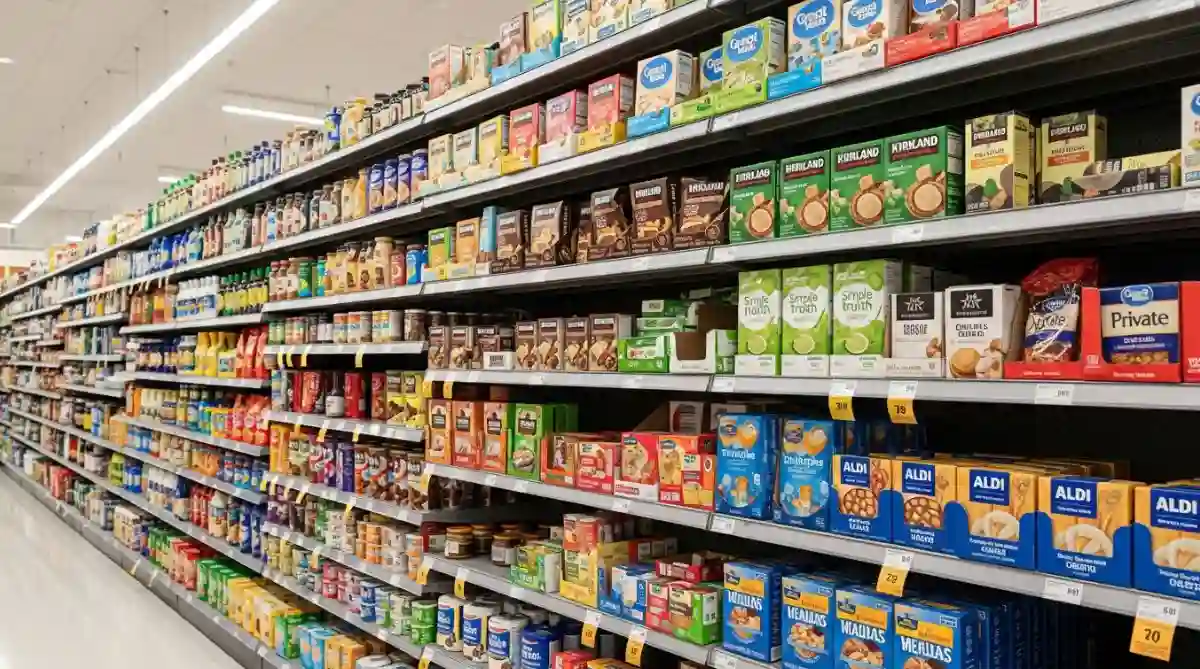
Across the country, baskets look a little different. More snacks with retailer names. More chilled meals from in-house brands. More household products where design feels as good as the nationals. It’s a quiet reshaping of the shelf, but it’s happening everywhere—from rural Walmart stores to busy Costco warehouses and ALDI’s lean network.
How Big Is Private Label In the US?
The US private-label market is now estimated at around $270–$280 billion in annual sales. Even the lower end of that range would put the US ahead of most global grocery markets in absolute PL value. What’s changing is not just the size, but the speed.
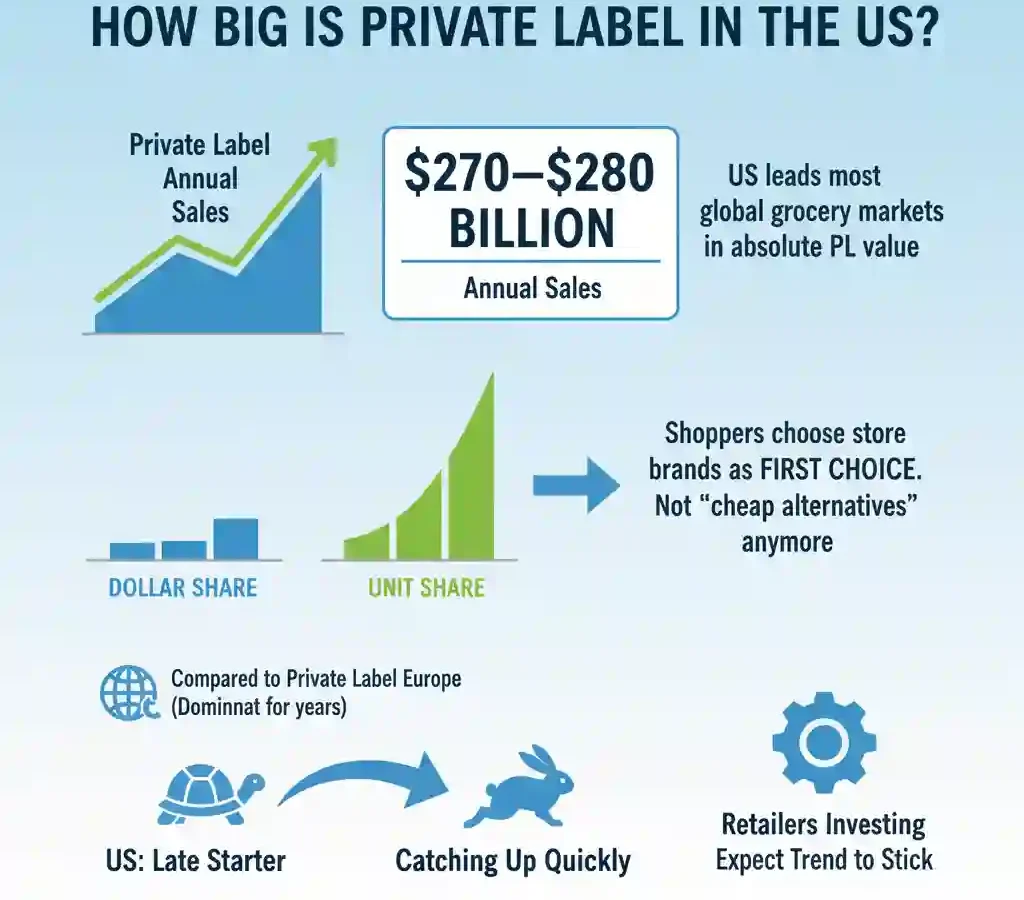
Dollar share continues rising. Unit share moves even faster. Shoppers who once treated store brands as a fallback are now buying them as first choice in several categories. Retailers say this gap between dollar and unit share tells the real story. Private label isn’t “cheap alternatives” anymore; it’s a stable part of the weekly shop.
Compared with other regions — such as Private Label Europe, where PL has been dominant for years — the US is a late starter. But it’s catching up quickly, and retailers are investing like they expect the trend to stick.
The Retailer Playbooks
Five retailers are shaping how private label looks, tastes, and behaves in the US today. Each has its own strategy, and each one influences how suppliers think about innovation, packaging, and price architecture.
Walmart – Great Value, Better Than Before
Great Value remains the largest private-label brand in the United States. Walmart uses it as the backbone of its price message, but the offer is shifting. More SKUs, better packaging, more consistency between stores.
What Walmart does better than anyone else is scale. Its reach into every demographic allows it to test new categories quickly. Once a product sticks—like frozen pizzas, enhanced waters, or household cleaners—it rolls out everywhere with a level of distribution most brands can only dream about.
Walmart also pays attention to shoppers who switched during inflation and didn’t switch back. That means more mid-tier and slightly premium lines sitting above everyday Great Value products, quietly pushing national brands to defend their territory.
Kroger – Simple Truth and a Full Wellness Play
Kroger has built one of the strongest “trust brands” in US retail with Simple Truth. Organic, clean label, plant-forward, and usually priced below national competitors. The line keeps expanding because shoppers treat it as a dependable wellness range rather than a private label in the old sense.
Kroger’s broader portfolio—Private Selection, Home Chef, and others—covers nearly every price tier. It makes Kroger a rare US retailer with a genuinely layered PL architecture. That’s useful in a market where shoppers mix value and premium items in the same basket.
The company’s confidence in its own brands is visible in-store. More space. Better merchandising. Stronger design. It signals a retailer that expects private label to be part of future loyalty equations, not just short-term price pressure.
Costco – Kirkland, the Retailer That Acts Like a Brand
Kirkland is an anomaly. In many households, it’s one of the most trusted names—sometimes even more trusted than the brands it competes with. Costco never tries to build huge assortments. Instead, it focuses on a few high-volume SKUs that it can produce at premium quality and competitive prices.
Shoppers don’t buy Kirkland because it’s cheaper. They buy it because it’s consistent. Olive oil, wine, baby wipes, ready meals, vitamins—categories where the brand acts almost like an authority. For a retailer-owned label, that’s unusual.
The model works because Costco members expect efficiency. Kirkland is the visual proof of that bargain: good products, enormous sizes, fair prices, and no overthinking.
ALDI US – Private Label as the Whole Store
ALDI operates differently. Its entire grocery model relies on private label, with most products sitting under its own brands. That gives ALDI a level of control over price and quality that traditional retailers can’t match.
In 2025, ALDI is expanding aggressively across the US. Every new store is another PL-heavy ecosystem entering a market where legacy retailers still depend heavily on A-brands. The message is simple: keep costs low, keep packaging tidy, and make the shopper’s experience straightforward.
Even categories like snacks, bakery, and chilled meals—areas once dominated by national brands—are now ALDI strengths. The retailer benefits when inflation is high, but it also holds its ground when prices cool. That says a lot about shopper habits.
Target – Design First, Value Second
Target approaches private label through design. Favorite Day, Good & Gather, Up&Up, Room Essentials—all feel visually polished, often better than national brands. It’s part of what Target shoppers expect: style without the premium price.
Target uses PL to support its brand identity rather than to lead on price. That gives its ranges room to explore flavours, packaging, and borderline-trendy formats. Snacks, frozen meals, home cleaning, and seasonal items move quickly because they look good and fit the store’s lifestyle message.
For national brands, Target’s strategy is a reminder: packaging and presentation matter as much as price.
Where US Private Label Is Growing Fastest
Growth in the US isn’t equal across all departments. Some categories are expanding faster than retailers planned, and they’re shaping the next phase of investment.
Snacks
Snacks have become one of the easiest entry points for private label. Shoppers trade down here without hesitation. Chips, trail mixes, crackers, sweet bakery items—they all move quickly because the price gaps are obvious and the quality gaps are shrinking.
Retailers have learned to offer both fun flavours and simple classics. It keeps younger shoppers close and gives households a stable option when name-brand promotions slow down.
Frozen Foods
Frozen food is experiencing a strong private-label wave. It’s no longer just vegetables and pizzas. Retailers now push into frozen meals, Asian-inspired recipes, breakfast sandwiches, and desserts.
The category is ideal for PL because it’s easy to scale once sourcing is set. National brands in frozen face a new reality: retailers now compete with them in nearly every segment except a few premium specialities.
You can also see inspiration coming from Europe. Chains noted how strong private label is in frozen across Germany private label trends, and some US ranges follow that same multi-tier approach.
Organic and Better-for-You
Organic used to be a niche price-sensitive segment for the US private-label sector. Not anymore. Simple Truth, 365, Target’s Good & Gather, ALDI’s Simply Nature, and others have shown that organic store brands can take meaningful share from traditional organics.
The shopper motivation is simple. They want clean ingredients, fewer additives, short labels—and they don’t want to pay double for it.
As wellness becomes more mainstream, organic private label could become the largest driver of category loyalty.
Household & Cleaning
This is a quiet growth engine. Household cleaners, detergents, wipes, paper goods—they’ve always been natural PL categories. But 2025 brings better packaging, stronger scent profiles, and formulas that feel closer to the big national players.
Retailers are also using promotions and bundled deals to shift households into higher volumes. For the first time in years, private-label household categories are growing not only because of price gaps but because of better product experiences.
Shopper Sentiment And Trust
The shift toward private label is no longer only an economic story. In 2025, US shoppers mix value and quality in a more nuanced way.
Inflation Pushed the Change, But Trust Keeps It Going
Inflation forced trial. That part is clear. When prices rose in 2023–2024, shoppers dipped into private label more than usual. But inflation easing didn’t bring them fully back to national brands.
Shoppers say PL is “good enough,” “same quality,” or sometimes “actually better.” When a shopper starts thinking like that, it’s unlikely they will return to old brands at full price.
Packaging Quality Matters More Than People Admit
One of the biggest mindset shifts is visual. Better design makes private label feel reliable. Shoppers trust what looks consistent. They trust clean colours. They trust packaging that resembles the brands they know—even if the price is lower.
Retailers have invested heavily in this area. It’s visible on shelves. Improved photography, brighter colours, clearer claims. Packaging is playing a bigger role in shopper perception than brand storytelling ever did.
Influence of Younger Shoppers
Younger shoppers grew up during the rise of tech-driven retail, discount chains, and a huge choice of store brands. They don’t carry the old stigma around PL. If anything, they see it as smart shopping.
Costco, ALDI, Trader Joe’s, Target—they’re all extremely popular with younger segments. That loyalty carries into their private-label choices.
What This Means For A-brands
For national brands, 2025 is a balancing act. The US grocery landscape is not collapsing into private label, but the pressure is real.
Shelf Space Is Never Guaranteed
Retailers now run tighter assortments. They monitor velocity more closely. If a national brand loses volume and a retailer’s own brand grows, the shelf may shift. That risk didn’t exist at the same scale ten years ago.
Some categories—snacks, frozen, pantry basics—are especially vulnerable. Once a retailer sees consistent private-label performance, it becomes harder for A-brands to win space back.
Premiumisation Is the New Defence Strategy
Big brands rely on marketing. Retailers rely on price. To protect share, national brands are moving further into premium segments where they can justify higher prices and unique flavours.
The strategy works, but it only covers part of the market. Many shoppers will still choose private label for basics. Premium lines cannot replace the volume that mid-tier brands are losing.
Innovation Windows Get Narrower
If a national brand hesitates, a retailer may build its own version. Faster cycles in development and sourcing mean store brands can follow trends without massive budgets.
Some suppliers, seeing this, now work directly with retailers to create private-label innovation instead of pitching to the national players. It’s a structural shift in the supply chain.
Retailer Comparison Table
A simple comparison of today’s PL strategies across the largest US retailers.
| Retailer | Key PL Brands | Positioning | Strengths | Growth Focus |
|---|---|---|---|---|
| Walmart | Great Value, Equate | Everyday value | Scale, distribution, affordability | Frozen, snacks, cleaning |
| Kroger | Simple Truth, Private Selection | Wellness + premium tiers | Organic trust, tiered architecture | Organic, snacks, ready meals |
| Costco | Kirkland | Quality first | Member loyalty, consistency | Household, beverages, supplements |
| ALDI US | Multiple PL ranges | Efficient pricing | Low overhead, controlled assortment | Bakery, snacks, chilled meals |
| Target | Good & Gather, Favorite Day, Up&Up | Design-led value | Packaging quality, lifestyle appeal | Frozen, snacks, seasonal |
Conclusion
Private label is now part of how US shoppers think about groceries. The days of “brand first, store brand second” are fading. In US private label grocery 2025, retailers push harder into categories once dominated by national players, and shoppers accept the shift as normal. What began as a price reaction is becoming a long-term behaviour.
Retailers saw the change early and built strategies to protect it. Walmart expanded its core lines. Kroger leaned into wellness. Costco strengthened Kirkland’s consistency. ALDI used simplicity to grow market after market. Target shaped its identity around design-led everyday products.
For suppliers, the message is clear: private label is not temporary. It’s structural. Any brand that wants to survive the next 10 years of grocery competition must understand how retailers think—and how shoppers now behave.
And as more lessons move across regions—from Private Label Europe to US supermarkets and cross-market comparisons with Germany private label—2025 may be the year the US locks in its new private-label era.