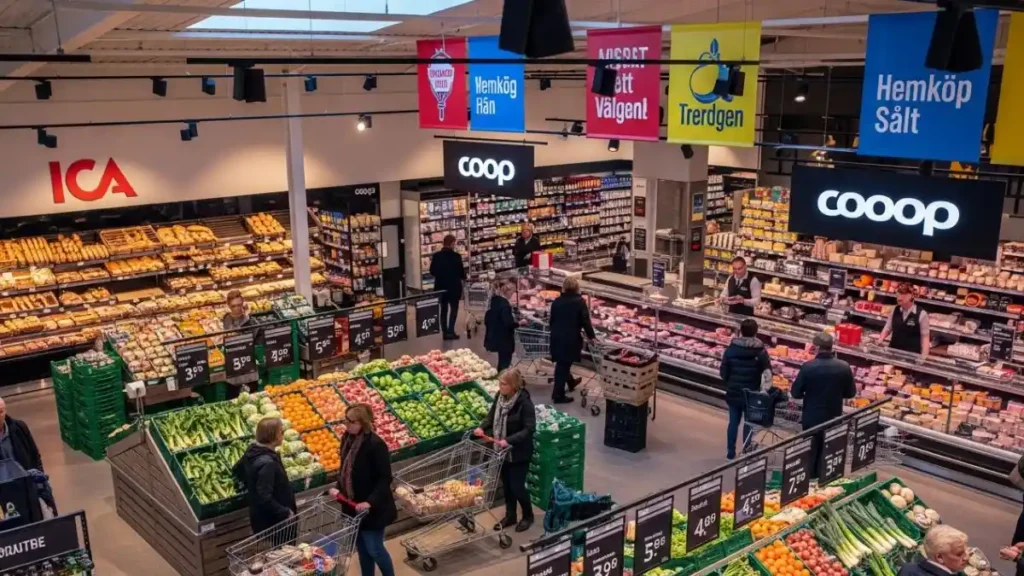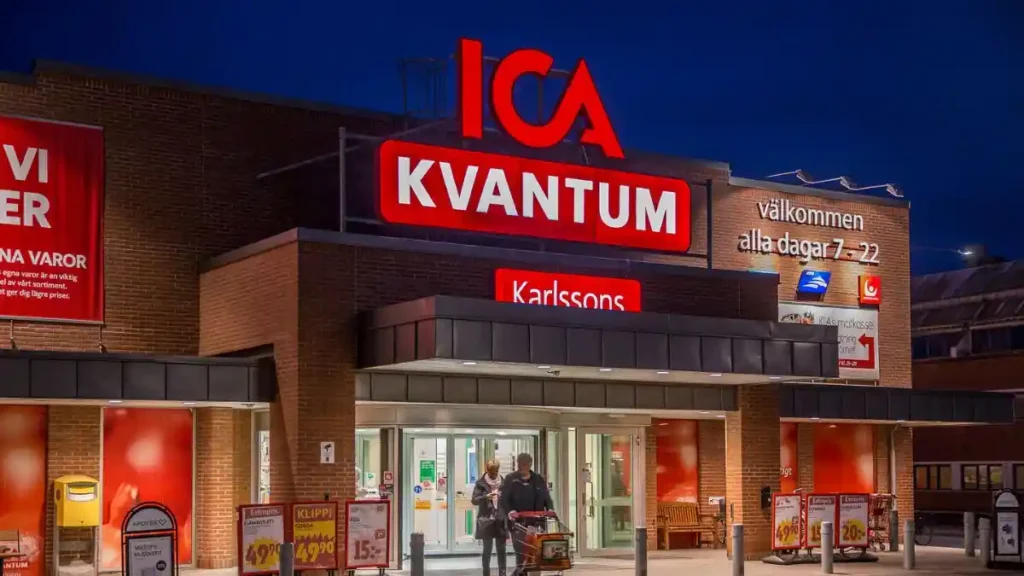
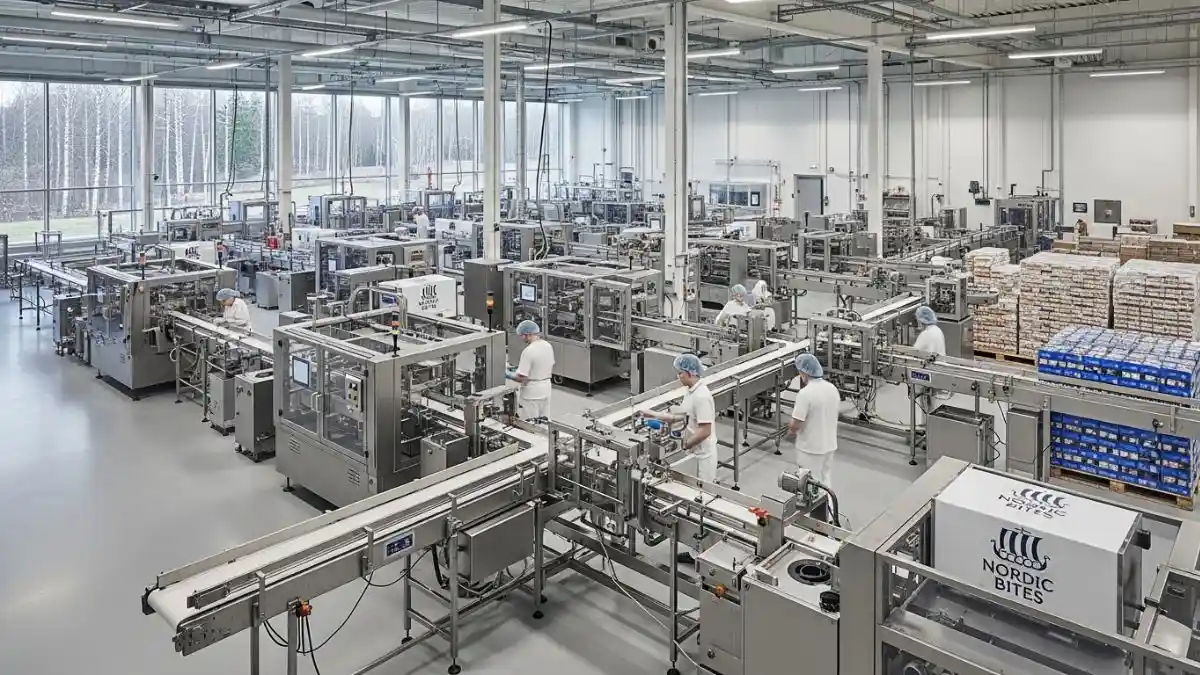

Sweden’s private label market has moved beyond price-led positioning. Over the past five years, own-brand products have become a central volume driver across ready meals, bakery, chilled protein, fresh convenience and ambient grocery. Retailers now treat private label as a structural pillar of category strategy rather than a secondary range.
This shift has concentrated production demand into a limited group of domestic manufacturers with national scale, automated facilities and advanced sustainability reporting capabilities. As of 2026, five suppliers dominate Sweden’s supermarket private label supply chain.
This report ranks the leading manufacturers by scale, production relevance and operational importance.
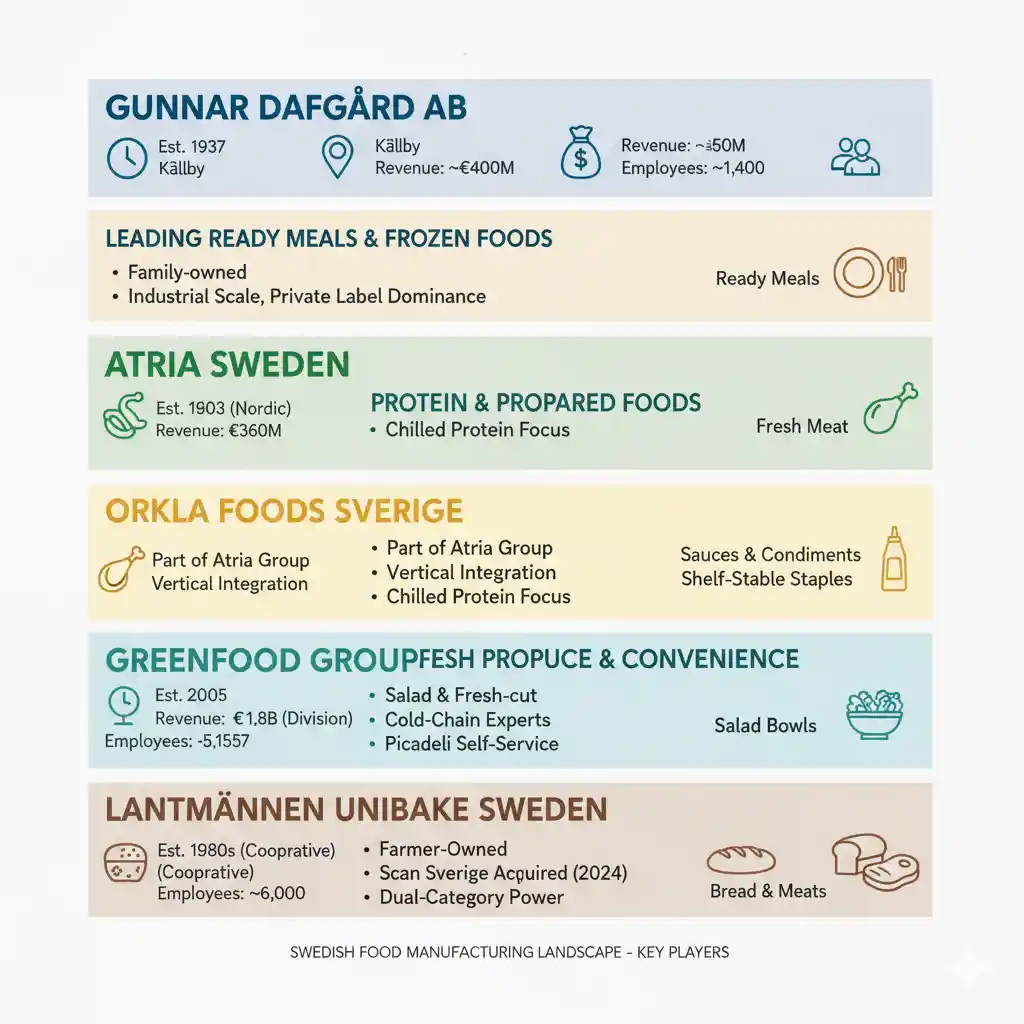
Ranking overview — Sweden private label manufacturers (2026)
| Rank | Manufacturer | FY Revenue (latest) | Employees | Core Private Label Categories |
|---|---|---|---|---|
| 1 | Gunnar Dafgård AB | ~SEK 4.5bn | ~1,400 | Ready meals, chilled food, frozen meals |
| 2 | Atria Sweden | €360.2m | 829 | Meat, poultry, prepared proteins |
| 3 | Orkla Foods Sverige | Division NOK 20.6bn | 5,157 | Sauces, ambient foods, meal bases |
| 4 | Greenfood Group | SEK 5.7bn | ~1,500 | Fresh-cut produce, salads, meal solutions |
| 5 | Lantmännen Unibake Sweden | Group €1.5bn+ | ~6,000 | Bakery, bake-off, chilled meat, charcuterie |
Revenue figures reflect the latest publicly available FY2024–FY2025 reporting. Currency conversion uses average annual exchange rates.
1) Gunnar Dafgård AB
Founded: 1937
Headquarters: Källby, Västra Götaland
FY revenue: ~SEK 4.5bn
Employees: ~1,400
Company background
Gunnar Dafgård AB began as a small family-owned food business in western Sweden. Over several decades, the company transformed into one of the country’s largest industrial producers of prepared food.
Family ownership has supported long-term capital investment and stable supermarket partnerships. Today, Dafgård operates one of Sweden’s most concentrated ready-meal manufacturing platforms.
Core product categories
Ready meals
Frozen meals
Chilled convenience food
Foodservice bulk formats
Market position and scale
Dafgård is the dominant private label producer in the ready-meal segment. Its centralized cooking and packaging operations in Källby allow high-volume national distribution with consistent product specifications.
This scale enables retailers to maintain wide chilled and frozen meal assortments without operating internal kitchens.
Operational relevance
Dafgård supports supermarket supply chains through:
High SKU rotation programs
Seasonal volume flexibility
Centralized production with national logistics reach
Its production model suits both full-service supermarket formats and discount retailers focused on standardized private label meal programs.
Strategic direction
Recent initiatives show continued focus on raw material sourcing efficiency, automation and climate-impact reduction. The company remains positioned as a long-term contract manufacturing partner for Sweden’s largest grocery groups.
2) Atria Sweden
Founded: Nordic group origins 1903
FY revenue: €360.2m
Employees: 829
Company background
Atria Sweden operates as part of the Nordic Atria Group. The Swedish business is focused on domestic protein production combined with value-added food processing.
Over recent years, Atria has expanded its prepared food capacity alongside traditional meat processing operations.
Core product categories
Fresh meat
Poultry
Cold cuts
Prepared protein meals
Market position and scale
Atria Sweden is one of the country’s most important private label suppliers in chilled protein categories. Its vertically integrated processing model allows control over sourcing, portioning and packaging.
This scale gives supermarkets stable supply across fresh and processed protein segments.
Operational relevance
Atria’s manufacturing platform supports:
Year-round protein availability
Centralized quality control
Large-volume retail promotions
It also plays an increasing role in retailer meal programs that combine chilled proteins with ready-to-cook components.
Strategic direction
The acquisition of Gooh strengthened Atria’s presence in chilled ready meals. This aligns with retailer demand for higher-margin prepared protein ranges under private label brands.
3) Orkla Foods Sverige
Founded: Orkla Group roots 1654
Sweden footprint: Seven production locations
Division revenue: NOK 20.6bn
Employees: 5,157
Company background
Orkla Foods Sverige is part of one of the Nordic region’s largest food manufacturing groups. While Orkla is widely known for consumer brands, its industrial infrastructure also supports private label production across multiple categories.
The Swedish operation includes several regional factories supplying both retail and foodservice channels.
Core product categories
Sauces and condiments
Shelf-stable meal bases
Ambient grocery products
Institutional food ingredients
Market position and scale
During Orkla’s portfolio restructuring phase through 2025, the Swedish private label focus sharpened toward high-volume ambient categories. This includes ketchup, sauces and center-of-store staples where price stability and scale efficiency are critical.
Orkla now dominates Sweden’s private label production in shelf-stable grocery segments.
Operational relevance
Orkla’s multi-site manufacturing network supports:
National supermarket distribution
Regional logistics optimization
High-throughput ambient production
This footprint reduces transport distance and improves replenishment speed.
Strategic direction
Orkla continues investing in industrial efficiency and foodservice production capacity. The group is positioning its Swedish operations as a core supplier for large retail contract volumes.
4) Greenfood Group
Founded: 2005
FY revenue: SEK 5.7bn
Employees: ~1,500
Company background
Greenfood Group was created to consolidate Sweden’s fresh produce processing and convenience food supply chain. The group operates across fresh produce distribution, salad manufacturing and ready-to-eat food solutions.
It also owns Picadeli, one of Europe’s largest self-service salad concepts.
Core product categories
Fresh-cut vegetables
Salad bowls
Ready-to-eat components
Healthy convenience meals
Market position and scale
Greenfood is Sweden’s dominant supplier of private label fresh convenience products. Its processing scale and cold-chain infrastructure allow supermarkets to offer fresh ranges without operating in-store cutting facilities.
The company’s “Greenhouse” production model has become a benchmark for industrial fresh food processing.
Operational relevance
Greenfood plays a central role in:
Short shelf-life logistics
High-frequency store replenishment
Cold-chain category management
Its integrated supply chain reduces food waste and improves shelf availability.
Strategic direction
Expansion of ready-to-eat and meal solution categories reflects continued demand growth for fresh convenience food across Swedish retail formats.
5) Lantmännen Unibake Sweden
Founded: Cooperative roots 1880s
Group revenue: €1.5bn+
Employees: ~6,000
Company background
Lantmännen Unibake Sweden operates within the farmer-owned Lantmännen cooperative structure. Historically known as Sweden’s largest bakery supplier, the group expanded its private label relevance significantly in 2024 through the acquisition of Scan Sverige (formerly HKScan Sweden).
This acquisition repositioned Lantmännen from a bakery-focused producer into a multi-category private label manufacturing platform.
Core product categories
Fresh bread
Bake-off bakery products
Burger buns
Chilled meat
Charcuterie and processed protein
Market position and scale
Lantmännen now operates across two of Sweden’s highest-volume private label categories: bakery and chilled protein. This dual-category footprint makes the group one of the most strategically important supply partners for national supermarket chains.
The combined production platform allows retailers to consolidate supplier relationships and logistics flows.
Operational relevance
Lantmännen supports supermarket operations through:
National bakery production
Centralized meat processing
In-store bake-off programs
High-volume chilled protein supply
This integration strengthens retailer margin control and private label consistency.
Strategic direction
The SEK 700m investment in the new Örebro bread production facility remains a key capacity expansion project. As of 2026, equipment installation is underway, including automated end-of-line robotics. Full operational output is expected in 2027.
Market structure impact
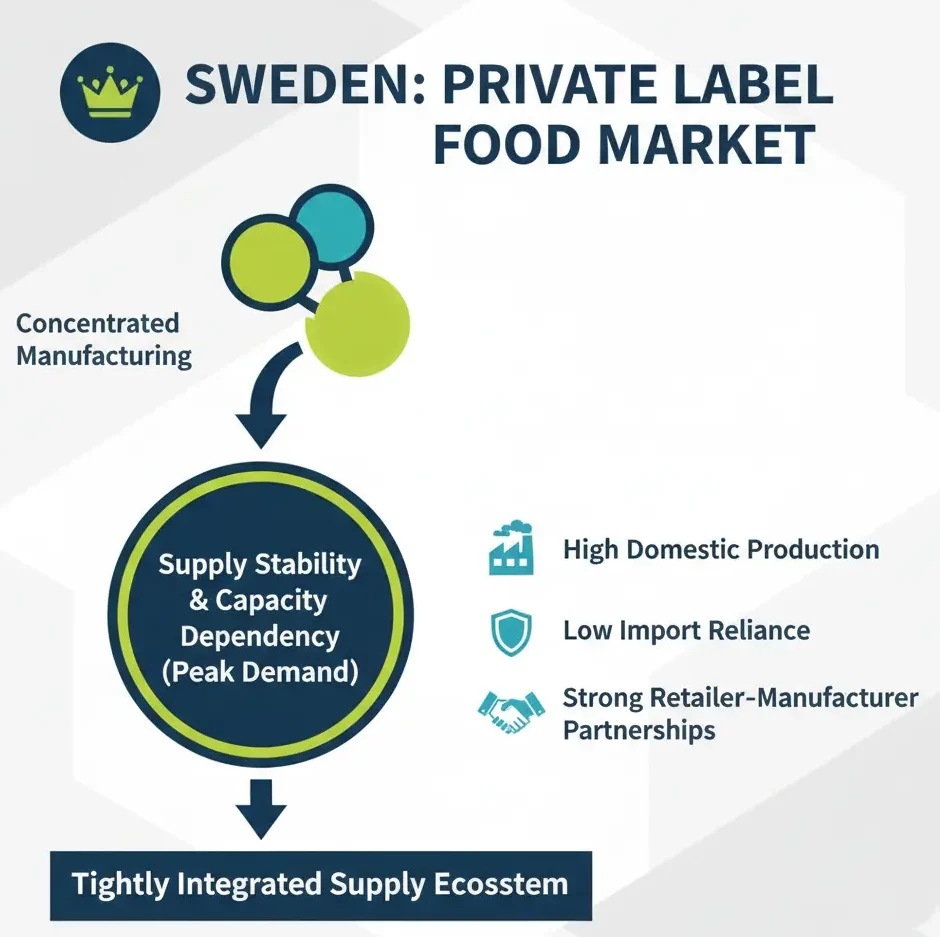
Sweden’s private label manufacturing market is highly concentrated. A limited number of producers control most national volume across food categories.
This structure delivers supply stability but also creates capacity dependency during peak demand periods such as holiday seasons and national promotions.
Key structural characteristics include:
High domestic production share
Low reliance on imported private label food
Strong long-term retailer-manufacturer partnerships
The result is a tightly integrated supply ecosystem.
Category dominance trends
Private label growth remains strongest in three segments.
Ready meals
Chilled and frozen meals continue gaining shelf space. Dafgård and Atria dominate production capacity in this category.
Fresh convenience
Salads, fresh-cut produce and ready-to-eat components are expanding rapidly. Greenfood leads this segment with industrial-scale fresh processing.
Bakery and bake-off
Retailers continue investing in in-store bakery concepts. Lantmännen Unibake’s industrial baking and new capacity investments support this expansion.
Ambient grocery categories remain stable volume drivers, supported by Orkla’s large-scale production network.
Industry direction: Sustainability data becomes decisive
By 2026, Swedish private label contracts are increasingly shaped by “Hållbarhetsdata” requirements. Retailers now require product-level carbon footprint reporting as part of ESG disclosure frameworks.
Manufacturers that can deliver verified lifecycle data are winning long-term supply agreements. The five producers in this ranking have invested heavily in traceability systems, emissions reporting tools and packaging footprint transparency.
Sustainability reporting capability has shifted from compliance requirement to competitive advantage.
Structural outlook
Several long-term changes continue reshaping Sweden’s private label manufacturing sector:
Increased automation in packaging and end-of-line operations
Greater contract manufacturing integration with branded production lines
Regional production hubs replacing single-site dependency
Expanded cold-chain infrastructure for fresh categories
These trends favor large producers with capital investment capacity and national footprints.
Conclusion
Private label manufacturing in Sweden is entering a consolidation phase driven by automation investment, sustainability reporting demands and retailer volume concentration. The five producers ranked in this report control much of the country’s food private label output across key categories.
Capacity expansion in bakery, ready meals and fresh convenience will remain the main growth focus through 2026 and beyond. As supermarkets continue expanding own-brand portfolios, supplier partnerships will become increasingly strategic components of retail operations.
Editor’s Note: This article is based exclusively on publicly available company financial reports, annual disclosures and corporate announcements. Revenue figures reflect FY2024–FY2025 reporting where available. Currency conversions use average annual exchange rates. No unpublished data or estimates were used.