
Austria is one of Europe’s most influential supermarket refrigeration markets. It does not have the continent’s largest grocery sector. It stands out because it combines advanced engineering with practical retail innovation.
The country is home to internationally recognised refrigeration manufacturers. Its supermarket chains keep investing in natural refrigerants, energy-efficient stores and lower-carbon food retail infrastructure.
Retailers including SPAR Austria, BILLA, HOFER, Lidl Austria and MPREIS are modernising their stores. For them, refrigeration is no longer simply about keeping food cold. It is a strategic investment in sustainability, operating efficiency and long-term food safety. The leading companies supply everything from plug-in cabinets to complete CO₂ refrigeration systems and nationwide technical services.
At a Glance
| Rank | Company | FY Revenue | Strategic Role |
|---|---|---|---|
| 1 | AHT Cooling Systems | Private | Plug-in supermarket refrigeration |
| 2 | HAUSER (an Epta company) | Private | Centralised supermarket refrigeration systems |
| 3 | Carrier Commercial Refrigeration Austria (Haier) | Private | Integrated supermarket refrigeration solutions |
| 4 | Arneg Austria | Private | Display cabinets and retail refrigeration |
| 5 | Equans Kältetechnik Austria | Private | Installation, maintenance and lifecycle services |
Methodology
This ranking evaluates each company’s contribution to Austria’s supermarket refrigeration sector. It does not rank by global company size.
We assessed each company on:
- Supermarket refrigeration expertise
- Equipment manufacturing and engineering capability
- Installation experience and lifecycle service
- Natural refrigerant technology
- Operational support
- Public activity in Austria’s grocery retail market
Component suppliers, such as compressor and controls manufacturers, play an essential role. They are assessed separately in the supporting ecosystem section. They are not ranked alongside companies that deliver complete supermarket refrigeration solutions.
Why Austria Matters
Austria occupies a unique position in the European refrigeration industry. Many countries mainly buy refrigeration technology. Austria is also a significant producer of it.
Several internationally recognised refrigeration manufacturers have their roots in Austria. They supply supermarket operators across Europe and beyond.
The grocery market is equally demanding. National retailers compete with international discount chains. This creates constant pressure to improve store efficiency, reduce energy use and meet stricter environmental rules.
Two refrigeration approaches side by side
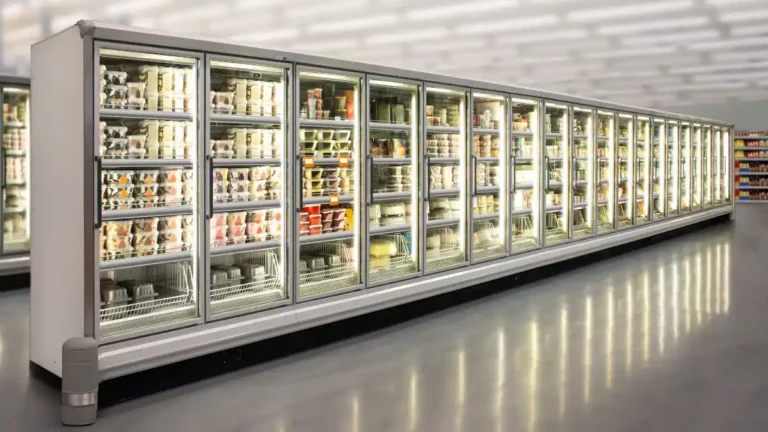
Natural refrigerants are central to this transition. Austrian supermarkets increasingly combine transcritical CO₂ refrigeration with heat recovery. These systems recycle waste heat for store heating and hot water.
Plug-in propane (R290) cabinets are also gaining popularity, particularly in discount retail. Their advantages are flexibility, lower installation costs and faster store rollouts.
- Traditional supermarkets keep investing in sophisticated central refrigeration systems.
- Discount retailers increasingly adopt self-contained plug-in units that are simpler to install and run.
That balance makes Austria one of Europe’s most technically interesting supermarket refrigeration markets.
1. AHT Cooling Systems
- Founded: 1983
- Headquarters: Rottenmann, Styria, Austria
- Ownership: Part of Daikin Industries since 2019
- FY Revenue: Private
AHT Cooling Systems has grown from an Austrian refrigeration manufacturer into one of the world’s leading suppliers of plug-in refrigeration for food retail. From Rottenmann, it develops and manufactures chilled and frozen display cabinets.
These cabinets are used by supermarkets, convenience stores and discount retailers. Its markets include Europe, North America and other international regions.
How the plug-in model works
Traditional suppliers rely on large central machine rooms. AHT specialises in self-contained plug-in units using natural refrigerants, particularly propane (R290). Each cabinet contains its own refrigeration circuit.
Retailers can therefore install equipment with minimal on-site engineering. This reduces construction time and maintenance complexity.
Why it matters to supermarket buyers
The approach is particularly attractive to discount grocery operators. Fast-expanding retailers need refrigeration that can be installed quickly, moved if required and commissioned without extensive pipework. Plug-in technology also gives more flexibility when refurbishing stores or changing layouts.
Austria has become an important testing ground for these systems. As supermarkets pursue lower energy use and emissions, AHT keeps investing in cabinet efficiency, intelligent temperature management and environmentally friendly refrigerants.
Since joining Daikin Industries, AHT has gained wider global research capabilities. It has kept its specialist focus on food retail. Its equipment is now used in thousands of supermarkets worldwide.
2. HAUSER (an Epta company)
- Founded: 1946
- Headquarters: Linz, Austria
- Ownership: Part of Epta Group since 2026
- FY Revenue: Private
HAUSER has long been recognised as one of Austria’s leading supermarket refrigeration specialists. From Linz, it supplies food retailers across Europe with refrigerated display cabinets, cold rooms, refrigeration systems, digital monitoring and lifecycle service.
Its strength is delivering complete supermarket projects rather than single pieces of equipment. HAUSER supports retailers from early planning through installation, commissioning and long-term maintenance.
HAUSER has traditionally focused on central systems for medium and large supermarkets. These often combine display cabinets with remote CO₂ refrigeration, advanced controls and heat recovery.
The Epta acquisition
Italian refrigeration group Epta completed its acquisition of HAUSER in February 2026. The combined organisation has annual revenues exceeding €2 billion. HAUSER keeps its engineering expertise and manufacturing capabilities in Austria.
For Austrian retailers, the deal brings broader international resources while keeping decades of local technical knowledge. It also strengthens Epta’s position in Central Europe.
Why it matters to supermarket buyers
As supermarkets keep investing in sustainable store formats, HAUSER remains one of Austria’s most influential refrigeration companies. It now combines domestic engineering expertise with the international reach of the Epta Group.
3. Carrier Commercial Refrigeration Austria (Haier)
- Founded: Legacy Carrier Commercial Refrigeration business
- Headquarters: Austria operations
- Ownership: Haier Smart Home
- FY Revenue: Private
Carrier Commercial Refrigeration has a long-standing presence in Austria’s food retail sector. It supplies refrigeration systems for supermarkets, hypermarkets and food distribution facilities.
Haier Smart Home completed its acquisition of the business in October 2024. Ownership changed, but Carrier still supports European customers through its established portfolio, engineering expertise and service network.
What Carrier supplies
Carrier’s supermarket offering includes refrigerated display cabinets, freezer systems, machine packs and natural refrigerant technologies. These help retailers cut energy use while meeting European environmental rules.
Austrian grocers increasingly want systems that combine efficiency with lower carbon emissions. Carrier has responded by expanding its focus on CO₂ refrigeration and integrated energy-efficient solutions.
Why it matters to supermarket buyers
Carrier’s experience extends beyond stores to distribution centres and logistics. Reliable refrigeration there is essential for food quality across the supply chain.
Carrier does not compete on equipment alone. It also brings decades of engineering knowledge, lifecycle support and project management experience. These keep it a recognised supplier in Austria’s competitive market.
4. Arneg Austria
- Founded: 1963
- Headquarters: Austrian operations (Arneg Group headquartered in Italy)
- FY Revenue: Private
Arneg is one of Europe’s leading manufacturers of refrigerated display equipment, with a strong presence in Austria’s supermarket sector. It supplies refrigerated multidecks, freezer islands, service counters, cold rooms and complete refrigeration concepts.
Arneg is headquartered in Italy. It has invested heavily in Austria and Central Europe through local sales, engineering support and project management. Its equipment is used in supermarkets, convenience stores and specialist food retailers.
Solutions for different store formats
One of Arneg’s strengths is customising refrigeration for different retail formats. Large supermarkets need long refrigerated display lines. Neighbourhood stores need compact systems that make the most of limited floor space.
Why it matters to supermarket buyers
Environmental performance has become increasingly important. Arneg keeps developing systems compatible with natural refrigerants. It is also improving cabinet insulation, lighting efficiency and energy use.
These improvements help retailers lower electricity costs without compromising food quality or customer experience. Arneg also works closely with refrigeration engineers, contractors and retail designers throughout each project.
5. Equans Kältetechnik Austria
- Founded: Operates under the Equans brand following the integration of Axima’s technical activities
- Headquarters: Austria operations
- FY Revenue: Private
Equans Kältetechnik Austria represents a different side of the supermarket refrigeration industry. Manufacturers design and build the equipment. Equans installs, maintains and supports the systems supermarkets depend on every day.
Its expertise covers commercial refrigeration, industrial cooling, building automation, HVAC and energy management. This makes it one of Austria’s leading multi-technical engineering companies.
Why it matters to supermarket buyers
For supermarket operators, installation quality matters as much as equipment selection. Refrigeration systems need careful commissioning, ongoing servicing and rapid fault response. This minimises downtime and protects temperature-sensitive products.
Equans supports retailers throughout this lifecycle, long after a new store opens. Its experience also extends to food manufacturing, logistics and distribution.
Supermarkets increasingly link refrigeration with heat recovery, building management systems and digital monitoring. Engineering contractors have therefore become strategic partners rather than simply installers. That shift has strengthened Equans’ role in Austria’s refrigeration sector.
Austria’s Supporting Refrigeration Ecosystem
Behind Austria’s leading suppliers sits an important network of technology providers. Their products are built into supermarket refrigeration systems throughout the country.
- BITZER Austria supplies compressors used in commercial refrigeration across Europe. Its technology is at the heart of many CO₂ systems in supermarkets, food distribution centres and cold storage facilities.
- Danfoss Austria provides electronic controls, expansion valves, sensors and monitoring technologies. These help operators optimise performance, improve food safety and reduce energy use. Digital controls also let retailers monitor equipment remotely and spot issues before failures occur.
- SCM Frigo, supported through the Beijer Ref distribution network, specialises in factory-built transcritical CO₂ refrigeration packs. Shoppers rarely see these systems, but they power many modern supermarket installations.
Austria also benefits from specialist refrigeration contractors and engineering companies. They support retailers through installation, servicing and emergency maintenance.
Industry Outlook
Austria’s supermarket refrigeration market keeps evolving. Retailers must balance environmental targets with rising operating costs and changing consumer expectations.
Natural refrigerants are firmly established in new supermarket developments. Existing stores keep upgrading older systems to improve efficiency, reduce electricity use and comply with European environmental regulations.
Digitalisation is expected to accelerate in the coming years. Cloud-based monitoring, predictive maintenance and intelligent energy management help retailers detect faults earlier and reduce maintenance costs.
Austria’s domestic manufacturing base puts it in a strong position for future innovation. Austrian companies export advanced refrigeration technology worldwide, using the home grocery market as a reference for new developments. Supermarkets increasingly treat cooling as part of wider building energy strategies.
Frequently Asked Questions
Which supermarket refrigeration companies lead in Austria?
The five leading companies are AHT Cooling Systems, HAUSER (an Epta company), Carrier Commercial Refrigeration Austria (Haier), Arneg Austria and Equans Kältetechnik Austria. The ranking reflects strategic influence, not market share.
What refrigerants do Austrian supermarkets use?
Natural refrigerants dominate new developments. Traditional supermarkets favour transcritical CO₂ systems with heat recovery. Discount retailers increasingly use plug-in propane (R290) cabinets.
Who owns HAUSER?
Italian refrigeration group Epta completed its acquisition of HAUSER in February 2026. HAUSER keeps its engineering and manufacturing in Austria.
What Happens Next?
Austria’s supermarket refrigeration sector is expected to continue investing in natural refrigerants, intelligent controls and integrated energy management over the coming years.
Across the Austria retail technology sector, refrigeration is becoming increasingly connected with digital building management, predictive maintenance and energy optimisation. For the Austria supermarket industry, future investment is likely to prioritise operating efficiency, lower emissions and improved lifecycle performance.
Across the wider Austria FMCG sector, modern refrigeration will continue supporting food quality, supply-chain resilience and long-term sustainability as retailers modernise stores and distribution networks.
Editor’s Note: This report evaluates companies according to their strategic contribution to Austria’s supermarket refrigeration market. The assessment considers equipment manufacturing, engineering expertise, installation capability, natural refrigerant technologies, lifecycle support and publicly available market information.
The ranking reflects overall strategic influence within Austria’s supermarket refrigeration sector. It should not be interpreted as a measure of market share or exclusive retailer procurement relationships, as purchasing decisions vary between retailers and individual projects.