
The supermarket sector in Switzerland has entered a new phase in 2025. Long regarded as one of Europe’s most stable and predictable grocery markets, Switzerland is now seeing visible shifts in leadership, pricing strategy, and operational focus. The most notable change is at the very top: Coop has overtaken Migros to become the largest player in Swiss food and near-food retail by market share.
Together, Coop and Migros still dominate supermarkets in Switzerland, accounting for roughly 70% of total grocery sales. But the balance between the two has changed. Coop’s rise has been driven by stronger execution in convenience formats, alcohol categories, and private label, while Migros is undergoing a deep restructuring to defend its core food business amid intensifying price pressure.
Around this duopoly, discount chains such as Denner, Lidl, and Aldi Suisse are playing an increasingly influential role, not through sheer scale but through growth rates that are forcing permanent changes in pricing behaviour. For suppliers and buyers, Switzerland remains a high-barrier market, but one where clarity, discipline, and long-term alignment are rewarded.
Market structure: high concentration, shifting leadership
Swiss grocery retail remains one of the most concentrated markets in Europe. Two cooperative groups control nationwide distribution, pricing frameworks, and category standards. In 2025, however, Coop now leads the market, holding an estimated low-40% share of food and near-food sales, while Migros has slipped to just under 38%.
This reversal reflects structural rather than cyclical change. Coop has benefited from a format mix that better matches today’s shopping behaviour, particularly urban convenience and impulse missions. Migros, while still deeply embedded in Swiss daily life, has been slower to adapt its large-store model to rising price sensitivity and changing trip patterns.
Below the top tier, discounters and regional operators continue to shape the competitive environment. Their combined market share remains well below that of Coop or Migros, but their influence on price discipline across supermarkets in Switzerland is now structural.
Decision-making power is highly centralised. Listings are controlled, assortments are curated, and supplier relationships are typically long-term. This makes Switzerland difficult to enter, but predictable once established.
Coop: Switzerland’s grocery market leader in 2025
Coop’s position as the largest grocery retailer in Switzerland is the result of steady execution rather than aggressive expansion. While its supermarket and hypermarket network remains the backbone of the business, the real growth engine in recent years has been convenience.
Coop Pronto has emerged as the fastest-growing retail format in Switzerland, reporting growth of around 16% in recent periods. Located in urban centres, transport hubs, and commuter corridors, Pronto stores capture high-frequency shopping occasions that traditional supermarkets struggle to serve efficiently.
Unlike Migros, Coop sells alcohol and tobacco across its core formats, materially increasing basket value and profitability. This advantage has become more important as consumers trade down on certain categories while maintaining spend on convenience and impulse items.
Coop’s private-label architecture is one of the most developed in Europe. Value, mainstream, organic, and premium tiers are clearly segmented, allowing Coop to compete across income groups without brand dilution. This strength places Coop at the centre of Private Label in Switzerland, particularly in fresh food, dairy, and ambient grocery.
Operationally, Coop continues to invest heavily in automation, supply chain optimisation, and retail technology. Self-checkout, loyalty integration, and inventory optimisation are now standard rather than experimental, helping Coop protect margins in a high-cost retail environment.
For suppliers, Coop expects full regulatory compliance, reliable volumes, and clear category logic. Products that support margin stability, sustainability objectives, or convenience-led consumption tend to gain attention fastest.
Migros: restructuring, consolidation, and strategic reset
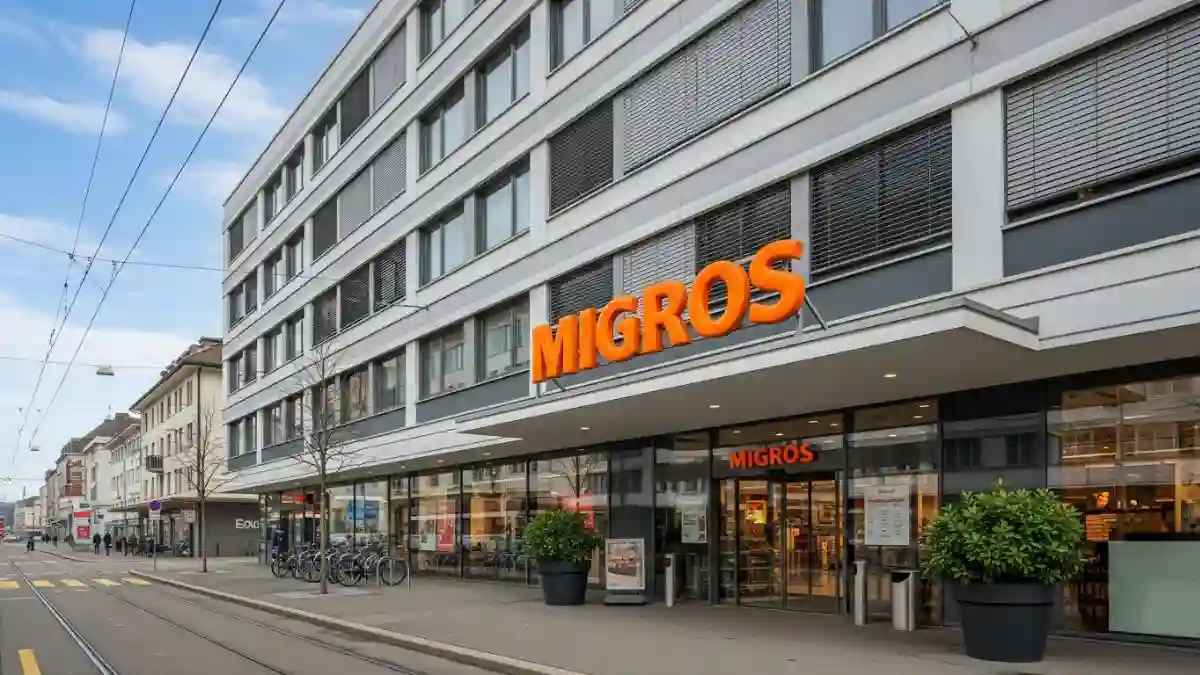
Migros remains one of the most recognisable brands among supermarkets in Switzerland, but its 2025 position is defined by transformation rather than dominance. After years of diversification into non-food retail and services, Migros is executing a broad strategic reset focused on efficiency and food retail competitiveness.
Over 2024–2025, Migros has divested or announced exits from several non-food businesses, including electronics, home furnishings, sports retail, and travel. What was once presented as diversification is now openly acknowledged as a source of operational complexity and cost.
This restructuring is paired with aggressive price action. Migros has committed to large-scale price reductions across hundreds of everyday products, responding directly to pressure from Coop and hard discounters.
At the same time, Migros is confronting a long-standing internal taboo: the structure of its ten regional cooperatives. Internal discussions have begun around consolidation into fewer, larger regional units to streamline decision-making and reduce duplication. While no final model has been confirmed, the fact that consolidation is openly discussed signals how seriously Migros views the competitive threat.
Migros continues to rely on its manufacturing arm and private-label strength, remaining a cornerstone of the Switzerland FMCG Market 2025, particularly in fresh food, dairy, and processed staples.
Although its core stores remain alcohol-free, Migros increasingly competes in alcohol and convenience through Migrolino and its ownership of Denner. These channels now play a critical role in defending market share and neutralising what was once a key brand distinction.
For suppliers, Migros in 2025 is more selective than in the past. Partners are expected to support cost discipline, operational efficiency, and consistent execution during this transition period.
Discounters and regional players: pressure from below
Discounters play a disproportionate role in shaping competitive behaviour across supermarkets in Switzerland. Lidl and Aldi Suisse, while smaller in absolute market share, are central to the ongoing price war.
Both chains continue to expand cautiously, adapting their assortments to Swiss expectations around quality, fresh food, and local sourcing. Lidl’s long-term ambition to reach around 300 stores illustrates how seriously discounters view Switzerland as a growth market.
Their impact is felt less through promotional noise and more through permanent price pressure, forcing larger retailers to make structural rather than tactical adjustments.
Denner, owned by Migros, occupies a hybrid position. Its dense store network, strong alcohol offer, and urban focus make it a key pressure valve in the system. Volg, by contrast, serves rural communities where large supermarkets are impractical, prioritising accessibility and local supply over expansion.
Snapshot of key supermarket chains in Switzerland
| Chain | Core formats | Positioning | Approximate footprint |
|---|---|---|---|
| Coop | Supermarkets, hypermarkets, Pronto, wholesale | Mainstream to organic-led | 1,000+ stores |
| Migros | Supermarkets, hypermarkets, online | Mainstream, cooperative | 1,000+ stores |
| Denner | Discount, convenience | Value-focused | 800+ stores |
| Aldi Suisse | Discount supermarkets | Value with quality focus | 200+ stores |
| Lidl | Discount supermarkets | Value, limited assortment | 150+ stores |
| Volg | Rural convenience supermarkets | Local and regional | 600+ stores |
Performance trends: pricing pressure and margin defence
Volume growth across supermarkets in Switzerland remains modest, but competition has intensified sharply. Inflation over recent years has made even high-income consumers more price-aware, increasing demand for value ranges and private label.
Retailers have responded by simplifying assortments, reducing complexity, and committing to visible price reductions on staple products. Margin protection now depends more on operational efficiency and scale than on headline price increases.
At the same time, opportunities remain in premium, health-focused, and functional categories, provided value is clearly communicated and justified.
E-commerce and omnichannel: steady, disciplined growth
Online grocery remains a smaller share of total sales than in markets like the UK, but growth is steady. Migros Online and Coop’s digital platforms continue to expand at mid-single to low-double-digit rates.
Swiss consumers prioritise reliability, order accuracy, and planned delivery over speed. Click-and-collect and scheduled home delivery perform better than rapid-delivery models.
E-commerce is treated as an extension of physical retail rather than a standalone channel. For suppliers, strong digital content, accurate product data, and consistent availability are essential, but online presence does not replace in-store performance.
What Swiss supermarkets expect from suppliers
Entry into supermarkets in Switzerland requires precision. Compliance with labelling, origin, and quality standards is mandatory, and claims around sustainability or health must be fully substantiated.
In 2025, sustainability expectations go beyond “green” positioning. Swiss retailers increasingly require traceability data, including ingredient origin, supplier-level transparency, and auditable documentation, to comply with evolving Swiss and EU regulatory frameworks.
Supply reliability and long-term planning matter more than speed to market. Buyers favour partners who can deliver consistent volumes and operate with minimal disruption.
Private label remains one of the most realistic entry routes, particularly for manufacturers able to meet strict cost and quality benchmarks. Branded suppliers must demonstrate clear differentiation and measurable category value.
Language, packaging, and cultural discipline
Switzerland’s multilingual environment requires careful planning. Packaging clarity, regulatory accuracy, and recyclability are closely scrutinised. Over-packaging and vague claims are poorly received.
Relationships develop slowly but tend to be stable once established. Swiss buyers favour partners who understand local expectations and operate with discipline rather than urgency.
Outlook for 2025 and beyond
The Swiss grocery market in 2025 is no longer static. Leadership has shifted, price competition has hardened, and long-standing structures are being questioned.
Coop’s convenience-led growth, Migros’ restructuring and potential cooperative consolidation, and sustained discounter pressure will define the next phase of supermarkets in Switzerland.
For suppliers and buyers, Switzerland remains a market of precision over volume. Those who understand its evolving dynamics will find opportunity. Those who don’t will struggle to gain a foothold.
In a European retail landscape marked by volatility, Swiss grocery retail still stands out for its order and predictability. In 2025, that predictability is being reshaped — but not replaced.