
Bulgaria’s supermarket market has shifted in 2026, with Lidl overtaking Kaufland to become the country’s top retailer by revenue. This ranking of the top 10 supermarkets in Bulgaria uses a RevNow approach, combining estimated revenue ranges with store scale, growth trends, and real market influence. Discounters now lead the market, traditional hypermarkets are stabilising, and local chains like Fantastico Group continue to compete through strong regional performance.
At a glance: Top 10 supermarkets in Bulgaria (RevNow 2026)
| Rank | Retailer | Format | Estimated Revenue (BGN) |
|---|---|---|---|
| 1 | Lidl | Discounter | 2.6 – 3.0 billion |
| 2 | Kaufland | Hypermarket | 2.5 – 2.9 billion |
| 3 | Billa | Supermarket | 1.2 – 1.5 billion |
| 4 | Metro Cash & Carry | Wholesale | 1.1 – 1.4 billion |
| 5 | Fantastico Group | Supermarket | 0.9 – 1.1 billion |
| 6 | T Market | Proximity | 0.6 – 0.8 billion |
| 7 | CBA Bulgaria | Franchise | 0.5 – 0.7 billion |
| 8 | ProMarket | Convenience | 0.4 – 0.6 billion |
| 9 | KAM Market | Hard discount | 0.3 – 0.5 billion |
| 10 | Coop Bulgaria | Cooperative | 0.3 – 0.5 billion |
1. Lidl
Founded: 1930 (Germany)
What they are known for: Private label dominance and aggressive pricing
Lidl is now the largest supermarket operator in Bulgaria by revenue. The shift happened in 2024 and has held through 2026.
The model is simple but effective. Limited assortment, strong private labels, and tight cost control. This allows Lidl to offer consistent pricing that Bulgarian consumers trust, especially during inflation cycles.
Expansion has also played a role. Lidl continues to add stores at a steady pace, focusing on accessibility and efficiency rather than size.
In today’s market, Lidl sets the benchmark for value perception.
2. Kaufland
Founded: 1968 (Germany)
What they are known for: Large-format stores and wide product range
Kaufland held the number one position for over 13 years. It now sits at number two, but remains one of the most powerful retailers in the country.
Its strength is scale. Large stores allow for deep assortment across food and non-food categories. This makes Kaufland a destination for bulk shopping.
However, the hypermarket model grows slower than discount. Fewer new store openings and higher operating costs have slightly reduced its growth pace compared to Lidl.
Still, Kaufland remains critical for suppliers due to its volume and category breadth.
3. Billa
Founded: 1953 (Austria)
What they are known for: Strong urban supermarket network
Billa is firmly positioned as Bulgaria’s leading supermarket chain in urban areas.
The company operates more than 160 stores and continues to invest in modernization and store upgrades. Its focus is convenience, location, and a balanced mix of branded and private label products.
Billa’s role in the market is clear. It sits between discount and hypermarket — offering accessibility with a broader assortment than discounters.
This makes it a preferred option for regular weekly shopping.
4. Metro Cash & Carry
Founded: 1964 (Germany)
What they are known for: B2B supply and HoReCa dominance
Metro is not a traditional supermarket, but its revenue places it among the top food retail players in Bulgaria.
Its core business is wholesale. It supplies restaurants, hotels, and small retailers across the country. This gives Metro a strong position in the food supply chain, not just consumer retail.
Even as consumer shopping shifts, Metro remains essential due to its role in bulk distribution and professional sourcing.
5. Fantastico Group
Founded: 1991 (Bulgaria)
What they are known for: Premium supermarkets and high store productivity
Fantastico is the strongest domestic supermarket chain in Bulgaria.
It operates mainly in Sofia, with a limited number of stores compared to international players. But what stands out is performance. Revenue per store is among the highest in the market.
The chain focuses on quality, fresh food, and a more premium shopping experience. This positioning allows it to compete without needing nationwide scale.
Fantastico shows that local players can still win — if they focus on the right segment.
6. T Market
Founded: 2005 (Bulgaria operations)
What they are known for: Neighborhood discount supermarkets
T Market is one of the most widely distributed supermarket chains in Bulgaria.
Owned by Lithuania’s Maxima Group, it focuses on proximity retail. Stores are located in residential areas, offering affordable pricing and easy access.
Its strength lies in coverage. While individual stores are smaller, the network allows T Market to reach a large share of the population.
This makes it a key player in everyday shopping.
7. CBA Bulgaria
Founded: 2003 (network formation)
What they are known for: Franchise-based supermarket network
CBA operates through a network model rather than a centralized chain.
This structure allows independent retailers to operate under a shared brand, giving them buying power and distribution advantages.
The result is scale through aggregation. CBA stores vary in size and format, but collectively they form a significant part of Bulgaria’s grocery landscape.
It is a good example of how fragmentation can still compete with large international chains.
8. ProMarket
Founded: 2005 (approx.)
What they are known for: Urban convenience supermarkets
ProMarket focuses on city-based retail, especially in Sofia.
The chain operates smaller supermarkets designed for quick shopping trips. Location and accessibility are the main drivers.
While it does not match the scale of larger players, it remains relevant due to its urban footprint and convenience-driven model.
9. KAM Market
Founded: 1990 (Bulgaria)
What they are known for: Hard discount model and low pricing
KAM Market represents the fastest-growing discount segment in Bulgaria.
The model is simple. Minimal store design, limited assortment, and very low prices. This approach works especially well outside major cities.
Growth has been steady, and the chain continues to expand its footprint.
As price sensitivity remains high, hard discounters like KAM are gaining importance.
10. Coop Bulgaria
Founded: 1895 (cooperative roots)
What they are known for: Regional and rural retail coverage
Coop Bulgaria operates a cooperative retail network across smaller towns and rural areas.
While it does not compete directly with large chains in major cities, it plays an important role in ensuring food access across the country.
Its strength is reach, not scale. The network supports local communities and maintains presence where larger retailers often do not operate.
Why this ranking matters
The Bulgarian supermarket sector is now clearly shaped by three forces.
First, discount retail is leading growth. Lidl’s rise to number one confirms that price and private label are driving consumer decisions.
Second, format differences are becoming more important. Hypermarkets like Kaufland still dominate in scale, but smaller and more flexible formats are expanding faster.
Third, the market remains mixed. International chains control the top positions, but local players like Fantastico and cooperative networks still hold strong positions in specific regions.
For suppliers and buyers, this means one thing. Success depends on understanding format strategy, not just market share.
What happens next
The next phase of growth will be shaped by three developments.
Private label will continue to expand, especially in discount and mid-tier supermarkets.
Store formats will become more localized, with more focus on proximity and efficiency.
And operational changes, including pricing systems and store technology upgrades, will continue as Bulgaria moves closer to Euro adoption.
The structure is already clear.
Now the competition is about execution.
Conclusion
Bulgaria’s supermarket market is no longer defined by one format or one leader. The shift reflects deeper changes across the industry, especially in Bulgaria’s private label development, where discounters continue to gain ground through pricing and control over assortment.
At the same time, investment in Bulgaria’s retail tech is reshaping store operations, from pricing systems to in-store efficiency, as retailers prepare for the next phase of competition and regulatory changes.
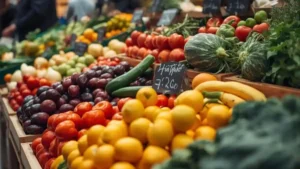
Fresh categories are also becoming more strategic. Growth in Bulgaria’s fresh produce segment is pushing supermarkets to improve sourcing, quality, and supply chain speed, particularly in urban markets.
The structure is now clear. Discounters lead, formats are adapting, and the next phase will be defined by how well each retailer connects pricing, technology, and fresh supply into one consistent offer.
Editor’s Note: This article is based on publicly available company data, industry reports, and market analysis covering 2024–2026. Some privately held companies do not disclose full financial results. Rankings reflect estimated revenue scale combined with store network size and market influence under RevNow methodology.