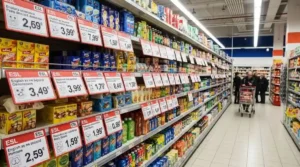

Armenia’s supermarket sector is still small compared with larger European grocery markets, but private label activity is becoming more visible as modern retail networks expand their control over sourcing, pricing, and packaged grocery distribution.
The biggest shift is happening inside urban supermarket chains. Retailers are no longer relying only on imported global brands or local suppliers. Some are slowly building their own store-brand strategies to improve pricing flexibility and strengthen customer loyalty in a market where inflation pressure and purchasing power remain sensitive.
Private label penetration in Armenia is still limited compared with Western Europe, where supermarket-owned brands often dominate shelf space. But retailers such as Carrefour Armenia, Yerevan City, SAS Supermarkets, Nor Zovq, and Parma Supermarket are increasingly shaping how packaged grocery retail operates across the country.
For suppliers, distributors, and FMCG manufacturers, Armenia’s grocery market is becoming more structured, more competitive, and more operationally disciplined.
At a Glance
| Rank | Company | Strategic Role | Core Strength |
|---|---|---|---|
| 1 | Carrefour Armenia | International retail operator | European private label imports |
| 2 | Yerevan City | Mass-market grocery leader | High-volume value retail |
| 3 | SAS Supermarkets | Premium supermarket chain | Imported premium assortment |
| 4 | Nor Zovq | Urban neighborhood retailer | Price-focused convenience retail |
| 5 | Parma Supermarket | Boutique grocery operator | Curated bakery and prepared foods |
1. Carrefour Armenia
Founded in Armenia: 2015
Headquarters: Yerevan, Armenia
Parent Brand: Carrefour
Carrefour entered Armenia in March 2015 with the opening of its first hypermarket inside Yerevan Mall. The arrival of the French retailer marked a major turning point for organized grocery retail in the country.
Unlike many local supermarket operators, Carrefour Armenia built its reputation around direct imported assortment and recognizable European retail standards. That included Carrefour-branded private-label products across grocery, household, frozen, dairy, and packaged food categories.
The retailer originally operated through a franchise agreement linked to UAE-based Majid Al Futtaim before local operational responsibilities shifted toward Food Depot LLC.
Inside Armenia’s retail market, Carrefour’s biggest advantage remains its access to international sourcing infrastructure. That allows the chain to offer European private-label ranges at pricing levels that compete directly with branded imports already present in the market.
Carrefour also introduced stronger shelf organization, modern merchandising practices, and broader packaged-food variety compared with many traditional local operators during its early expansion phase.
The company remains one of the most visible private-label grocery operators in Armenia, especially for consumers looking for imported European packaged foods.
2. Yerevan City
Founded: Expanded rapidly during the 2000s
Headquarters: Yerevan, Armenia
Ownership Structure: Alex Holding
Yerevan City is one of Armenia’s largest supermarket operators by footprint and grocery sales volume.
The chain became dominant through aggressive urban expansion, large-format supermarket operations, extended operating hours, and a strong focus on everyday grocery affordability.
Its business model differs sharply from Carrefour’s international retail positioning. Yerevan City focuses heavily on high-turnover grocery staples, packaged basics, and operational scale inside Armenia’s domestic retail economy.
Private-label activity inside the chain is mostly concentrated around economy-focused categories rather than premium retail branding. Products linked to value grocery retail, including flour, grains, oils, sugar, and packaged essentials, fit naturally within its pricing strategy.
The retailer’s importance to Armenia’s FMCG market goes far beyond private label alone.
Because of its scale, Yerevan City influences supplier negotiations, inventory movement, retail pricing pressure, and grocery distribution volumes across multiple consumer categories.
For local manufacturers, securing shelf placement inside the network remains commercially important due to the chain’s extensive urban presence.
3. SAS Supermarkets
Founded: 1997
Headquarters: Yerevan, Armenia
Ownership: SAS Group
SAS Supermarkets operates in a different part of Armenia’s grocery market.
Rather than competing primarily on discount pricing, the retailer has positioned itself around premium grocery retail, imported assortments, prepared foods, and upscale urban supermarket environments.
The chain is especially known for bakery operations, confectionery sections, ready-to-eat food counters, and imported packaged grocery products that target middle- and higher-income shoppers.
While SAS is not a traditional large-scale private-label retailer in the Western European sense, the company still plays an important role in Armenia’s evolving supermarket structure.
Its retail strategy shows how Armenian consumers are gradually becoming more comfortable with specialized grocery formats, curated food offerings, and premium supermarket experiences.
SAS also demonstrates how modern grocery retail in Armenia is becoming more segmented.
Some chains compete aggressively on price and volume. Others compete on environment, assortment quality, prepared foods, and imported specialty products.
That distinction is becoming increasingly important as Armenia’s urban retail market matures.
4. Nor Zovq
Founded: Late 1990s to early 2000s
Headquarters: Yerevan, Armenia
Nor Zovq expanded rapidly through neighborhood-focused grocery retail formats across Yerevan and surrounding urban areas.
Instead of operating massive hypermarkets, the company built its presence around compact supermarket footprints positioned close to residential districts and daily shopping traffic.
That operational structure gave the retailer a strong position in convenience-driven grocery purchasing.
Nor Zovq is widely associated with competitively priced everyday products, fresh produce access, packaged grocery essentials, and fast-moving consumer goods aimed at value-conscious shoppers.
The chain’s retail model also reflects a broader trend inside Armenia’s grocery sector.
Large-scale destination hypermarkets are important, but urban convenience retail continues gaining relevance because of traffic density, consumer accessibility, and faster purchase cycles.
For suppliers and FMCG distributors, neighborhood retail networks like Nor Zovq remain important for maintaining product visibility and consistent turnover inside local markets.
5. Parma Supermarket
Founded: 1997
Headquarters: Yerevan, Armenia
Parma Supermarket operates on a smaller scale than Armenia’s largest grocery chains, but the company has maintained a distinct position inside the urban supermarket segment.
The retailer is known for cleaner boutique-style store layouts, bakery operations, pastry production, prepared foods, and curated imported grocery assortments.
Its supermarket format targets consumers looking for a more controlled shopping environment compared with high-volume discount grocery operations.
Parma’s strength is not based on scale alone.
Instead, the chain competes through presentation, product curation, ready-to-eat foods, and customer experience.
That reflects another important development in Armenia’s grocery sector: supermarket differentiation.
As competition increases, retailers are increasingly separating themselves through operational identity rather than simply expanding store counts.
Some focus on premium imports. Others prioritize discount pricing, convenience retail, prepared foods, or European grocery positioning.
That diversification is gradually reshaping Armenia’s modern retail structure.
Industry Outlook
Private label growth in Armenia will likely remain gradual rather than explosive.
The market still depends heavily on imported international brands and established local food manufacturers. Consumer familiarity with traditional packaged brands also remains strong.
However, several conditions are beginning to support wider private-label development:
- Rising grocery price sensitivity
- Better supermarket supply-chain organization
- Larger modern retail footprints
- More centralized purchasing systems
- Increased imported packaged-food competition
Retailers are also under pressure to protect margins while maintaining affordable pricing.
Private label gives supermarket operators greater control over pricing structure, promotional flexibility, and category management, especially in packaged grocery and household essentials.
That trend is already influencing wider Armenia FMCG operations, Armenia supermarket procurement strategies, Armenia packaging demand, and Armenia fresh produce distribution planning.
What Happens Next
The next phase of Armenia’s grocery market will likely focus less on aggressive store-count expansion and more on operational efficiency.
Retailers are increasingly investing in sourcing control, inventory management, neighborhood convenience formats, and packaged grocery distribution stability.
That shift is expected to influence wider Armenia FMCG supply chains, Armenia supermarket logistics, Armenia packaging operations, and Armenia fresh produce retail planning over the next several years.
Private label activity is also becoming more relevant inside Armenia supermarket operations as retailers look for stronger pricing flexibility and better margin protection in competitive grocery categories.
For packaging suppliers and FMCG manufacturers, that could create additional opportunities in locally packed goods, imported packaged foods, and retailer-controlled grocery sourcing programs.
Private label will probably remain concentrated in value-focused grocery categories first before expanding into premium or specialized food segments.
For international suppliers and regional FMCG exporters, Armenia remains a relatively small market by volume.
But its supermarket infrastructure is becoming more commercially organized, more competitive, and more operationally modern each year.
Editor’s Note: This report is based on publicly available company information, retail market observations, supermarket operational positioning, and regional grocery industry analysis related to Armenia’s modern retail sector.