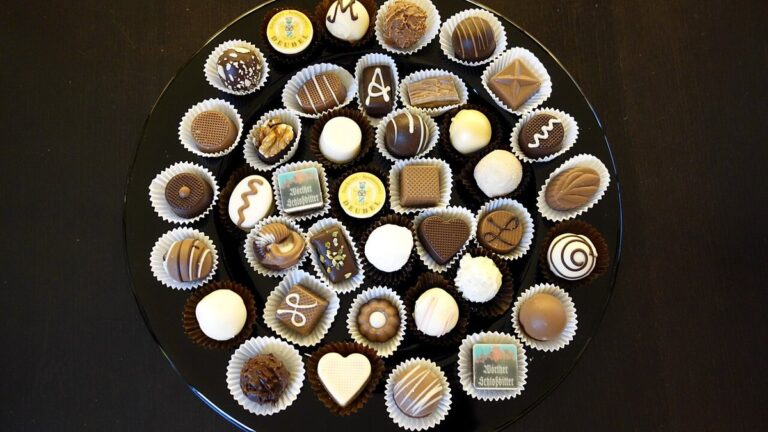

Boxed chocolate pralines. Photo by Blechmodelle via Wikimedia Commons, CC0. Cropped.
Ten confectionery packaging suppliers in Hungary cover chocolate boxes, sweet wrappers, praline trays and printed pouches. Sz.Variáns, Keskeny and Center Print make boxes. Sipospack and PandanPack convert flexible film. Pro-Form makes shaped trays for bonbons and desserts. Marzek Kner, Kartonpack, JAVIPA and STARFOL Plusz cover other printing, carton and materials supply needs.
Two developments show where suppliers are investing. In Debrecen, Sz.Variáns announced a HUF 660 million factory investment in January 2026. Near Budapest, press maker Windmöller & Hölscher reported a new flexographic press investment at Sipospack in 2025. The projects serve different ends of the confectionery aisle: decorated gift boxes and flexible packs.
Confectionery packaging suppliers in Hungary: comparison
| Company | Location | Buyer-fit category | Key qualification |
|---|---|---|---|
| 1. Sz.Variáns | Debrecen and Budapest sales contact | Custom luxury boxes, praline and cake cartons | Stühmer chocolate project proof, not film manufacturer |
| 2. Marzek Kner Packaging | Békéscsaba | Confectionery labels, folding cartons, flexible packaging | Confirm exact Hungarian production stage |
| 3. Keskeny Print House | Budapest, Rákospalotai határút | Chocolate boxes, cookie cartons and pastry displays | Chocolate and cookie carton samples |
| 4. Pro-Form | Ecser, with additional warehouse in Lepsény | Praline trays and thermoformed dessert inserts | PET dessert-insert suitability |
| 5. Kartonpack | Debrecen, Galamb Street | Printed food-grade folding cartons and outer sleeves | Direct-contact carton evidence |
| 6. JAVIPA Printing | Békéscsaba, Kazinczy Street | Printed folding cartons and aluminium packaging | Chocolate-specific print approval |
| 7. STARFOL Plusz | Ikervár headquarters and Szigetszentmiklós warehouse | Bakery and confectionery films, trays and materials supply | Distributor vs original manufacturer |
| 8. Sipospack | Sóskút | Printed rollstock and premade pouches | HUF 4.00bn reported revenue and 43 employees (2025, CompanyWall) |
| 9. PandanPack | Hungary | Custom films, laminated webs, pouches and bags | HUF 2.97bn reported revenue (2025, CompanyWall) |
| 10. Center Print | Hungary | Printed bonbon, chocolate and biscuit cartons | Custom offset cartons and up to six-point gluing |
The table groups specialist converters, carton makers and materials distributors. For small quantities of standard cake or sweet boxes, Budapest’s Écsy is a separate wholesale option. Custom printed packaging starts with a specification and a production sample.
Original chocolate packaging or just a general box?
A confectionery pack often combines primary contact material, secondary retail presentation and tertiary transport protection. Primary material touches unwrapped chocolate or sweets, or forms a sealed barrier. Secondary packaging includes printed cartons, gift sleeves and protective trays. Tertiary packaging keeps case quantities safe during transport. A standard carton may be appropriate outside a sealed inner film but not for direct contact with fatty chocolate.
Before asking for a quote, decide which component is needed. A single chocolate assortment can include several packaging suppliers: flexible film for individual pieces, PET or paperboard inserts for positioning, a rigid premium box for display, and an outer corrugated shipper. Packaging quality is judged on the finished system. A box that looks attractive in a showroom can still fail a vibration, humidity or pallet-stacking test.
1. Sz.Variáns: packaging formats
Company scale. The Debrecen business traces its origins to 1994. Sz.VARIÁNS Kft. was registered in 1998. CompanyWall lists HUF 1.879 billion in 2025 revenue and 74 employees. The Budapest contact serves sales enquiries.
Sz.Variáns started in 1994, according to its own history, making gifts from decorated paper before expanding into specialised printed boxes. Its current product catalogue explicitly includes praline packaging, cake and pastry boxes, folding cartons and premium rigid packs. It says production is based in Debrecen, with an additional Budapest contact. This is a strong match for seasonal confectionery sets, not proof that the company makes every direct-contact candy film.
The firm says the Stühmer Pillanat confectionery packaging it designed won a 2026 WorldStar award in the Food category. In January 2026 it announced a HUF 660m investment expanding its manufacturing capability, including a new Heidelberg UV printing press. That is an investment amount, not annual revenue. Buyers should ask for samples resembling their own gift box, the die-cut and surface-finish specifications, structural tests, material declarations and artwork-tooling costs.
For a chocolate collection, send the proposed piece count, tray layout, net product weight and storage conditions. Ask who supplies any food-contact insert, whether the high-gloss coating is compatible with the chosen recycling route, and what happens if the print design changes before Christmas. The company reports a separate net sales figure for 2024.
Sz.Variáns says the January 2026 Debrecen project put a five-colour Heidelberg UV press with a coating unit into service. The HUF 660 million project is separate from the annual accounts. The press adds a finishing option for seasonal gift cartons and premium confectionery sleeves.
2. Marzek Kner Packaging: packaging formats
Company scale. The Békéscsaba company was registered in 2000. Its local operations include the Kner and FlexiLog divisions. CompanyWall lists 457 employees. Labels & Labeling reported about €80 million in turnover and more than 700 people for the wider Marzek group in January 2025.
Marzek Kner Packaging Kft. identifies its Hungarian address at Baross u. 9–21, 5600 Békéscsaba, with a local flexible-packaging and label operation. The company’s confectionery page explicitly targets chocolates, wafers and sweets with folding cartons, labels, flexible materials and decorative finishes. Its wider Marzek group also operates sites outside Hungary, so buyers must distinguish the Békéscsaba work from production elsewhere in the group.
The company lists laser cutting, quality printing, luxury finishes and virtual prototyping among relevant packaging options. It has announced more than €13m invested across its wider business in machinery during a recent two-year period. That investment covers machinery across the wider group.
A brand switching printers should ask where the specific printed roll or carton is converted, whether artwork plates must be recreated, and which food-contact documentation applies. For wrap labels on individual sweets, confirm roll direction, material stiffness, adhesive and line compatibility. Its broad group capabilities should not be assumed to apply identically to every local plant.
Hungary’s government reported the opening of a HUF 5.5 billion capacity expansion in Békéscsaba in January 2026. It said the project secured about 480 jobs. ABT Hungária reported that more than half of the local company’s production was exported. The project’s jobs figure and the company directory’s workforce count come from different sources.
3. Keskeny Print House: packaging formats
Company scale. Keskeny és Társai 2001 Kft. operates from Rákospalotai határút in Budapest. The Magyar Grafika 2026 industry directory lists HUF 20.70 billion in 2025 net sales and 558 employees in 2026.
Keskeny & Co. 2001 Ltd. operates in Budapest and its official product selector explicitly names chocolate boxes, cookie boxes, food trays, giftware and point-of-sale packaging. Its company website describes custom packaging design, print finishing, prototyping and luxury-box development. It is relevant to a confectioner who needs an outer pack or branded display tray rather than primary sealed film.
The company has discussed a 2026 environmental and packaging-design programme, including a public article on responsible material selection and new EU packaging rules. These are company claims that explain its development direction, not independent certification of any finished chocolate box. Ask for current FSC or other documented claims only for the exact material the supplier proposes.
A buyer should provide a physical confectionery sample, a complete box drawing and the intended handling environment. Test whether the carton opens cleanly on shelf, carries a readable barcode and protects a fragile product during a mixed retail pallet shipment. Company sales and workforce figures appear in the comparison below.
Keskeny’s plant overview describes 12,500 square metres of production space and storage for 3,000 pallets. It lists hot and cold foil, UV coating and embossing among the finishing operations it handles in-house. The workforce figure above comes from the 2026 industry directory.
4. Pro-Form: packaging formats
Company scale. The Ecser company was registered in 1992 and lists an additional warehouse in Lepsény. CompanyWall reports HUF 8.706 billion in 2025 revenue and lists 203 employees.
Pro-Form Ltd. describes more than 30 years of Hungarian thermoplastic conversion experience. Its official dessert-and-box-inlays page explicitly covers bonbon moulds, chocolate trays, dessert containers and multi-cavity inserts, typically using food-grade PET in stated thicknesses from about 0.2 to 0.4 mm. Its head office and showroom are at Ady Endre utca 2 in Ecser, with a Lepsény warehouse separately listed.
In a January 2024 update, Pro-Form described its completed 2023 investment programme: two higher-capacity forming machines, warehouse improvements and an automated handling upgrade. These details establish manufacturing activity in Hungary, but they are historical development evidence, not proof of its current capacity for an individual customer’s bespoke design.
For a premium assortment, specify whether chocolates are sold directly in the formed insert, behind an inner wrap or separately in cups. Require a material declaration and migration evidence appropriate to the actual contact, plus dimensions, compartment tolerances, drop tests and proof of recycled-content claims if requested.
The company’s technology programme added two automated press-forming machines for packaging including chocolate trays, dessert pads and blisters. Pro-Form identifies PET, polypropylene and high-impact polystyrene among the materials used across its product range. Its contact directory distinguishes the Ecser production address from its Lepsény warehouse.
5. Kartonpack: packaging formats
Company scale. The company traces its roots to a Debrecen cooperative set up in 1952. The Magyar Grafika directory gives HUF 3.166 billion in 2025 net sales and 94 employees in 2026. Debrecen is the operating location profiled here.
Kartonpack’s predecessor began in 1952 as a bookbinding and box-making cooperative in Debrecen. Its official site describes modern offset-printed folding cartons, cutting, gluing and decorative effects. Pharmaceutical packaging remains a major business line, but the company has a separate food-packaging offering discussing grease resistance, taste and odour neutrality and migration requirements.
The company’s food page says that materials are selected with strength, moisture, temperature and food-contact considerations in mind. That is a relevant supplier claim, not a guarantee that every cardboard construction can touch unwrapped confectionery. Its experience with pharmaceutical compliance does not automatically constitute approval for high-fat chocolate packaging.
A buyer sourcing biscuit sleeves or chocolate outer cartons should identify whether the supplied product is a direct-contact material or a printed exterior pack around a separate approved inner wrapper. Confirm paperboard specification, ink application, grease-resistance testing and the packaging design’s recyclability.
Kartonpack identifies Debrecen as its manufacturing base in its sustainability reporting. Its food-packaging materials describe folding cartons and paper packaging designed for product protection and retail display. The company lists ISO 9001, ISO 14001 and FSC certification.
6. JAVIPA Printing: packaging formats
Company scale. JAVIPA Kft. was established in 1990 and operates on Kazinczy utca in Békéscsaba. CompanyWall reports HUF 7.739 billion in 2025 revenue and lists 208 employees.
JAVIPA was established in 1990 and operates from Békéscsaba. Its website states more than 200 employees and a 12,000-square-metre manufacturing area. Its product range includes folding cartons, labels, printed aluminium foil and printed roll-fed packaging. It added flexographic capability in 2006 and says part of its flexo production has operated in a cleanroom-compliant hall since 2014.
JAVIPA publishes specific 2025 production volumes: 352m boxes, 325m leaflets, 176m labels and 200 tonnes of printed aluminium foil. These numbers are not 2025 revenue and they are not proof that the volumes were produced for confectionery. Its website says the food category accounts for about 15% of its market portfolio, while pharmaceuticals account for 75%; verify the definition of these percentages before treating them as turnover by segment.
The confectionery opportunity is mainly a prospective print and carton enquiry, subject to product confirmation. A chocolate manufacturer should ask for evidence of a comparable confectionery contract and migration controls for the actual inks, foil or carton. Do not confuse the company’s blister-packaging credentials with approval of a food-contact chocolate foil unless the complete material structure is documented.
JAVIPA added flexographic printing in 2006 and has run roll-fed work in a hall designed to meet cleanroom requirements since 2014. Roll-fed lines make foils and self-adhesive labels. A carton order and a foil order use different production stages.
7. STARFOL Plusz: packaging formats
Company scale. STARFOL PLUSZ Kft. was registered in 2005 in Ikervár. It lists a second warehouse in Szigetszentmiklós. CompanyWall reports HUF 1.869 billion in 2025 revenue and lists 15 employees.
STARFOL Plusz Kft. explicitly markets packaging to the bakery and confectionery industry. Its category page lists printed flow-pack films, pouches, sealable trays, dessert inserts, cake boxes and paper baking moulds. The company gives a headquarters and warehouse in Ikervár and another warehouse in Szigetszentmiklós. Crucially, its overview says it distributes packaging products; that is not evidence every structure is manufactured at either Hungarian warehouse.
STARFOL describes HD flexographic or gravure printed film options, with up to eleven print colours for selected constructions, and a range of paper and plastics materials. Buyers should ask who actually extrudes, prints or converts the specified film. A distributor can offer valuable range breadth and lead-time advantages, but origin transparency and documentation remain essential.
For a confectionery factory with several packing lines, this may be a useful route for a mixed basket of wraps, trays and secondary packaging. Request original manufacturer documents, food-contact declarations and samples of the exact films and coatings. Verify current stocking arrangements and minimum order.
STARFOL lists its headquarters and warehouse at Gróf Batthyány Lajos utca 91 in Ikervár and its second warehouse at Leshegy utca 8 in Szigetszentmiklós. These are stock and distribution locations. Ask for the converting site when assessing a specific food-contact material.
8. Sipospack | Printed rollstock and premade pouches
Company scale. The Sóskút firm was registered in 1996. CompanyWall reports HUF 3.995 billion in 2025 revenue and lists 43 employees.
Sipospack has a dedicated confectionery range covering laminated rollstock and premade pouches. The family-run business was registered in 1996 and operates in Sóskút Industrial Park, near Budapest. Press maker Windmöller & Hölscher reported in October 2025 that Sipospack was investing in an ALPHAFLEX flexographic press.
A reel of printed film goes onto the confectioner’s own packing line. A premade pouch comes to the factory already shaped and is filled and sealed later. When comparing the two, send the fill weight, bag dimensions and expected output per shift. Ask Sipospack to confirm suitable structures for the required moisture and aroma barrier, and compare the seal on a commercial run.
CompanyWall reports HUF 3.995 billion in revenue and HUF 91.2 million net profit for 2025. The figures cover the registered company across its activities.
In November 2025 Sipospack reported that its eight-colour Windmöller & Hölscher ALPHAFLEX press was running at full capacity. The press is 1,300 mm wide and uses four-zone register control. That specification concerns the press. Finished film widths depend on the print layout and cutting requirements.
9. PandanPack | Custom films, laminated webs, pouches and bags
Company scale. Pandan Kft. was registered in 1992. Its official contact page gives Zrínyi út 37/A in Balogunyom. CompanyWall reports HUF 2.968 billion in 2025 revenue and lists 55 employees.
Hungarian-owned Pandan has worked in flexible packaging for more than four decades. It offers flexographic printing, solvent-free lamination and custom pouches and bags. Its published capabilities also include laminates made from two or three layers, which can combine a printable surface, a barrier and a sealant.
For a chocolate bar wrapper, send the line model, reel width and roll direction before approving artwork. Ask for a material sample and run it at the planned packing speed. For loose sweets in a retail pouch, compare seal strength, shelf presentation and the ability to reseal the pack after opening.
CompanyWall lists 2025 revenue of HUF 2.968 billion for Pandan Kft. Its own company profile describes in-house production and development.
Pandan lists 31 October 2026 as the planned completion date for two supported projects. It reports adding a hall and forklift corridor, investing in electronic inspection for lamination and buying a Windmöller & Hölscher ALPHAFLEX press. It also lists solar and IT upgrades as part of the programme.
10. Center Print | Printed bonbon, chocolate and biscuit cartons
Company scale. Center-Print Nyomda Kft. was founded in 1992. Its headquarters are at Füredi út 76 in Debrecen, and its directory entry lists a second address on Nyugati utca. The Dun & Bradstreet profile shown by Táblázat lists 35 employees and HUF 857.0 million in revenue. The public profile gives no financial year for that figure.
Center Print Nyomda lists bonbon, chocolate and biscuit boxes on its packaging page. It offers offset printing, surface finishes and up to six-point gluing for suitable box shapes. That gives confectioners another factory option alongside Sz.Variáns and Keskeny for folding cartons and printed outer packs.
Ask how the box will arrive and how many steps staff need to erect it. A flat carton can reduce storage volume, but the savings can disappear if assembly is slow. A sample filled with the actual product lets the warehouse test stacking and lets the retailer check how the box looks and opens on shelf.
For unwrapped sweets, ask for the full proposed construction. The board, ink, adhesive and any inner barrier all matter when assessing the finished pack.
Center-Print’s company history describes its move to a 4,000-square-metre site on Füredi út. It lists a Heidelberg Speedmaster XL75PC offset press, bag-making equipment and bindery upgrades among investments at the site.
EU packaging rules affecting Hungarian confectionery in 2026
The EU Packaging and Packaging Waste Regulation, EU 2025/40, began general application on 12 August 2026, with important later dates for some individual requirements. Buyers must not incorrectly say that all 2030 recyclability targets are already mandatory in November 2026. An EU compliance review should assess the current rule for the material, the food-contact layers, the destination market and the relevant transition dates.
Food-contact rules also need attention. Regulation (EC) 1935/2004 is part of the general framework, while specific materials, including certain plastics, fall under more detailed requirements. For direct-contact chocolate films or inserts, request the actual declaration of compliance and supporting migration testing for the intended temperature, duration and food type. A supplier’s statement that its company is ISO-certified is not the same as approval for a specific chocolate contact layer.
When an outer carton carries foil stamping, UV varnish or other decorative effects, confirm where printing takes place and whether any component can transfer to food. An approved inner pack may change the analysis, but it must be real and validated. Do not assume that low-migration inks alone establish overall package compliance, since adhesives, coatings, recycled fibres and contact times can also matter.
A buyer’s specification for wrapped sweets and chocolates
| Pack type | Information to send the supplier | What to test |
|---|---|---|
| Printed bar wrapper | Machine type, reel width, sealing temperature, barrier and printed design | Heat seals, registration marks, aroma transfer, shelf life |
| Praline insert | Piece dimensions, cavity count, food-contact status, finish | Product release, drop resistance, migration, fit |
| Premium gift box | Net weight, gift set structure, inserts, decoration, pallet limits | Compression, moisture, opening, barcode, recycle route |
| Pastry or cake box | Food contact, grease, temperature, portion size, handling | Board strength, migration, stain resistance, closure |
| Retail display or transport case | Case count, store shelf width, outer dimensions, shipping route | Stacking, retail opening, replenishment and damage |
Suppliers should receive a written brief. It helps the buyer compare actual solutions rather than brochures. The relevant drawings, target annual order, first production date and planned destination should be included. Ask whether the printer, converter and original material producer are the same entity. If not, clarify accountability for quality defects before signing the contract.
How to compare a Hungarian packaging quotation
- Define whether the contact surface must meet direct-contact food regulations.
- Confirm the registered legal supplier and the location of printing or conversion.
- Request samples of the exact proposed material, finish and packaging construction.
- Check moisture, oxygen, odour and grease requirements for the finished food.
- Confirm minimum print runs, tooling charges, plate or die ownership and storage of finished packaging.
- Ask for a clear unit price with delivery terms, VAT basis, production waste and payment conditions.
- Test the packaging on the real line at the desired throughput and sealing temperature.
- Review regulatory declarations, print proofs, traceability and supplier change controls.
- Calculate full cost, including slow-moving inventory after seasonal changes or recipe updates.
- Approve a pilot, document defects and record a named technical owner for reorders.
For Christmas gift assortments, artwork, finishing and tool availability can set the calendar. A supplier may need to purchase specialist papers months in advance, or a custom formed tray may require investment in moulds. Ask whether a layout change can be made late in the season. Do not mistake a nominal ten-day printing quote for a complete supply timeline if samples, compliance review and manufacturing allocation are still pending.
How to compare supplier turnover and staffing
These figures describe each business across its activities. Confectionery-only market share requires sales for the same packaging category, geography and year across suppliers. Use the figures as a measure of company scale.
JAVIPA states it has more than 200 staff, but its published 2025 volumes of boxes, leaflets and foil include pharmaceutical and other industries. They are not an employee census or chocolate-specific sales. Sz.Variáns’s HUF 660m factory investment in 2026 is capital spending, not company revenue. Pro-Form’s 2023 machinery upgrade is historical investment evidence, a change to the equipment available at the plant. Counting a warehouse as a manufacturing site would also distort comparisons.
Public company registries or customer-supplied audited statements can help assess creditworthiness, but the exact legal entity and financial year matter. A manufacturing subsidiary may produce the packaging while a sales company invoices it. The same wider group may operate in Austria and Hungary. Never use global group sales as proof of Hungarian confectionery revenue.
Hungarian confectionery packaging sits within a wider Hungarian packaging industry that also makes corrugated cases, labels and beverage cartons. Nearby Slovak confectionery packaging suppliers and Czech packaging converters add options for regional production and distribution.
Who leads Hungary’s confectionery retail market?
Euromonitor’s 2026 estimates give Mondelez Hungária and Ferrero Magyarország 18% each of Hungarian chocolate confectionery retail value. In sugar confectionery, it puts Haribo at 23% and Mondelez at 11%. These percentages measure retail confectionery sales. Packaging suppliers are compared above using their own financial, staffing and manufacturing figures.
Frequently asked questions
Which Hungarian supplier has made award-winning confectionery boxes?
Sz.Variáns published a 2026 WorldStar award for packaging made for the Stühmer chocolate brand. Keskeny explicitly lists chocolate and cookie cartons. Marzek Kner’s primary site lists confectionery folding cartons and labels. Ask for current references for the exact style and volume needed.
Who makes plastic inserts for chocolates in Hungary?
Pro-Form in Ecser publishes direct evidence of pressure-formed bonbon, dessert and chocolate trays. The correct material, migration tests, cavity dimensions and food-contact conditions still require approval for the particular confectionery product.
Who can supply flow-pack film for sweets?
Sipospack offers confectionery rollstock and premade pouches. PandanPack makes custom flexible films and bags. STARFOL Plusz distributes bakery and confectionery flow-pack film. Marzek Kner lists flexible packaging and labels; ask the converting site which grades meet the intended food-contact requirements.
Are all these businesses manufacturers?
No. STARFOL explicitly describes itself as a packaging distributor. Some groups also have factories outside Hungary. Always identify the original manufacturing company and local conversion step, not just the office or warehouse address.
Are these Hungary’s ten largest confectionery packaging firms?
No. They are ten researched supplier options with different product strengths. Comparable confectionery-only revenues and market shares are not public for the entire shortlist.
Where Hungarian confectionery packaging is heading
The investments at Sz.Variáns and Sipospack give a snapshot of two different manufacturing priorities. Premium carton makers can compete on print and finish, while flexible-packaging plants can compete on the range of packs they can run. The next production decision for many confectioners will come down to how a new pack seals, travels and performs through its full shelf life.
Reporting sources: Company product pages, Magyar Grafika’s 2026 industry directory, CompanyWall’s 2025 company profiles, Labels & Labeling’s January 2025 Marzek profile and Windmöller & Hölscher’s October 2025 Sipospack report.