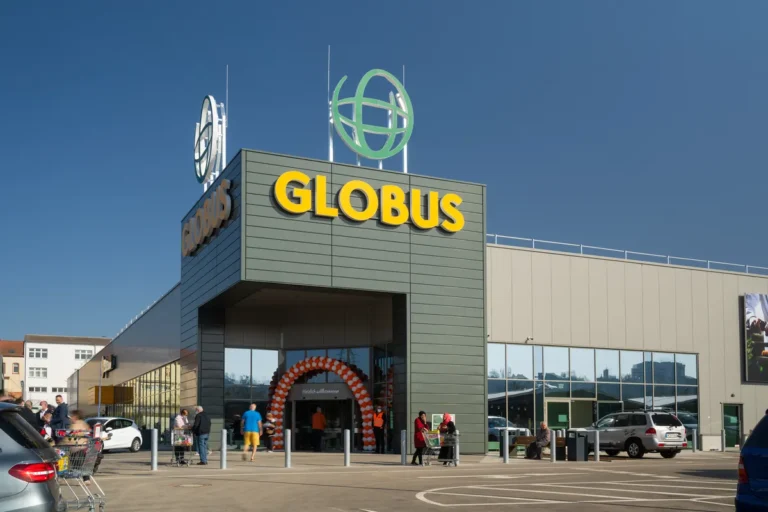

Globus increased operating profit by 1.9% to €195.1 million in its 2025/26 financial year, while comparable gross sales rose 1.4% to €8 billion.
The family-owned retailer announced the results on 4 November. They cover the year from 1 July 2025 to 30 June 2026. Growth excluding the petrol-station business was 0.4%, showing how modest the underlying sales increase remained.
The comparison needs care. Globus separated its Russian food stores in the preceding financial year. Its stated growth rates use an adjusted, comparable basis that excludes Russia. Comparing the new total directly with an older headline group figure would give a misleading picture.
For food suppliers, the hypermarket division is the more relevant measure. Its comparable gross merchandise sales increased 1.5% to €6 billion. The wider group also operates DIY stores, so its €8 billion total is not supermarket-only revenue.
Globus competes in the German grocery market through large stores, regional sourcing and substantial food production on site. Bakeries, butchery counters and restaurants give the business a different proposition from a tightly ranged discount format.
That model creates several types of supply relationship. A finished retail product, a bakery ingredient and an item for a restaurant kitchen can involve different specifications, pack sizes and order patterns. Manufacturers need to identify which channel a proposed agreement actually covers.
Regional availability also matters. A product suitable for a local range is not automatically a national listing. Suppliers should confirm the participating locations before committing production capacity or calculating promotional volumes.
The latest results arrive alongside changes to the physical estate. Globus closed its Hamburg hypermarket in September. It is preparing a new development in Trier, where planning permission was obtained at the end of 2025.
The company is also preparing another hypermarket in Brno. That reinforces its position among supermarkets in Czechia, where its business combines large stores with smaller formats and online ordering.
The Czech operation currently includes four Globus Fresh stores and four Globus Bistros. These formats extend the reach of its food-production capabilities beyond a conventional weekly hypermarket visit.
Online demand is another part of that development. Globus reported growth of more than 50% in both Czech online sales and orders since the start of the year. It also said the expanded delivery offer reached an additional 140,000 residents around Prague and Ostrava.
Online growth changes the practical requirements for a listing. Product descriptions, images, substitution rules and stock availability need to work alongside the physical shelf. Fresh-food suppliers also need an agreed approach to picking quality and remaining shelf life.
Buying arrangements are developing at the same time. Globus participates through RTG International in the Concordis buying alliance. That adds an international negotiation layer for branded suppliers while the retailer continues to emphasise local production and regional relationships.
For procurement teams, the results point to steady comparable growth rather than a rapid acceleration. The distinction between group sales, food-store sales and online growth is essential when estimating a specific category’s opportunity.
Attention now turns to the Trier and Brno developments and whether the Czech digital business can sustain its momentum. Suppliers approaching the retailer should match proposals to the relevant format, buying team and delivery network.
Editor’s Note: Based on Globus’s 4 November 2026 announcement, cross-checked against German trade and regional reporting. Sales are gross figures; growth uses the company’s comparable basis excluding Russia.