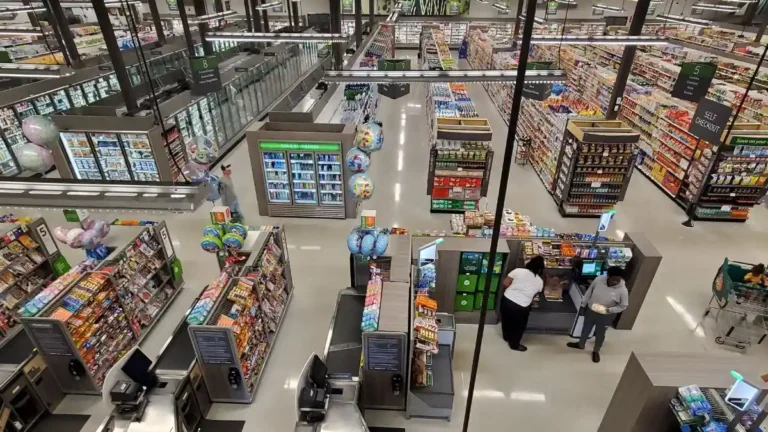

Singapore’s supermarket sector is one of the most competitive and tightly controlled grocery markets in Asia.
Despite the country’s small physical size, grocery retail power is concentrated in the hands of a limited number of operators. These chains control shelf access, import flows, private label development and last-mile delivery infrastructure. For suppliers, exporters and FMCG brands, understanding who holds influence matters more than simple store counts.
Influence in Singapore is shaped by store footprint, neighbourhood coverage, private label penetration, omnichannel reach and purchasing power. It is not just about size. It is about control over consumer access.
This analysis looks at the supermarket groups that currently hold the strongest positions in Singapore’s grocery market, based on retail coverage, format dominance, supplier leverage and long-term strategic positioning heading into 2026.
Singapore Supermarket Influence Ranking (2026)
| Rank | Retailer | Influence Level | Store Footprint | Core Positioning |
|---|---|---|---|---|
| 1 | FairPrice Group | Very High | Nationwide network | Mass market + public trust |
| 2 | Sheng Siong Group | High | Island-wide neighbourhood coverage | Value-led retail |
| 3 | Cold Storage (DFI Retail) | High | Urban and premium districts | Premium + imported goods |
| 4 | Giant Singapore | Medium-High | Hypermarket + suburban | Price-focused bulk retail |
| 5 | Prime Supermarket | Medium | Heartland communities | Local convenience grocery |
| 6 | CS Fresh | Medium | Affluent districts | Premium fresh food focus |
| 7 | Don Don Donki | Medium | High-traffic locations | Japanese specialty retail |
| 8 | U Stars Supermarket | Medium | Residential zones | Discount neighbourhood format |
| 9 | Scarlett Supermarket | Medium | Central shopping areas | Imported snack specialist |
| 10 | Hao Mart | Medium | Dense convenience network | Small-format grocery access |
How Market Influence Was Assessed
Singapore’s grocery market is not built around pure volume leadership.
Influence is shaped by several structural factors:
- Shelf access power
- Import sourcing control
- Store density and proximity to households
- Private label scale
- Digital grocery integration
- Supplier contract leverage
This ranking reflects how each retailer shapes purchasing decisions, supply chain access and category development across the market.
Company Profiles
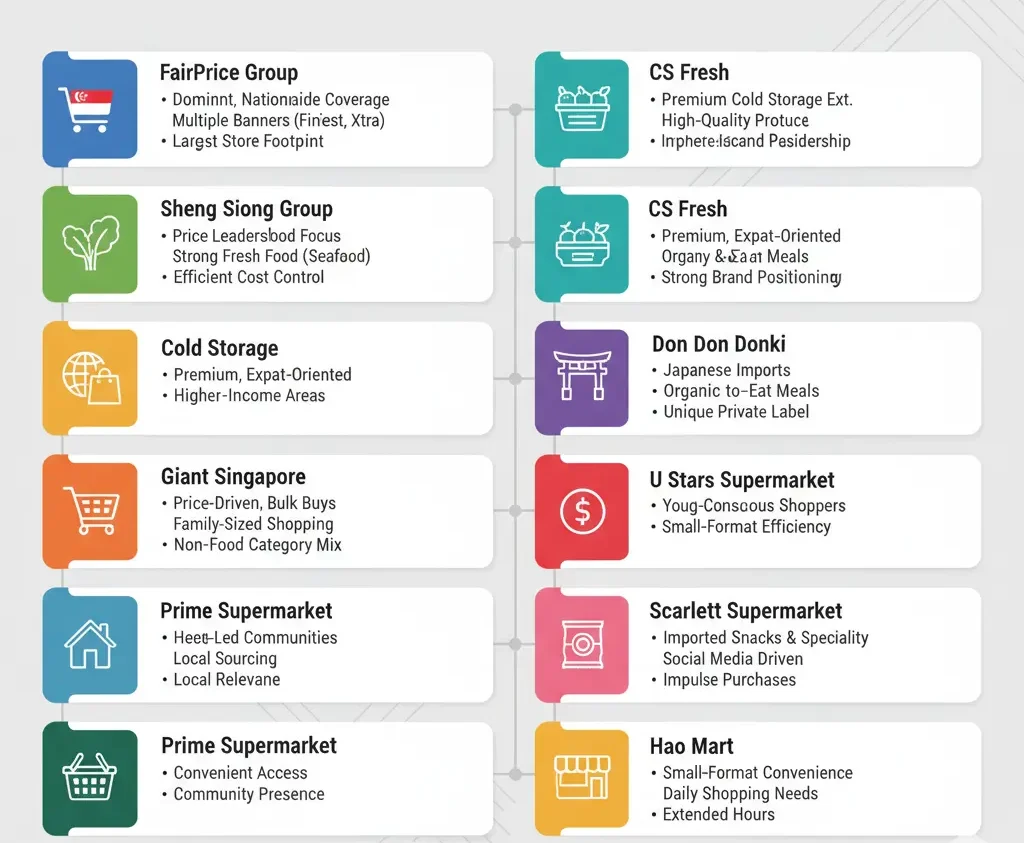
1. FairPrice Group
FairPrice is the dominant force in Singapore’s grocery market.
It operates under multiple banners including FairPrice Finest, FairPrice Xtra and neighbourhood FairPrice stores. With nationwide coverage and deep government-linked roots, the group holds unmatched trust and accessibility among consumers.
Its influence comes from:
- Largest store footprint in the country
- Strong private label portfolio
- Integrated supply chain operations
- Deep community presence
FairPrice also plays a strategic role in price stabilisation and food security policy objectives, giving it structural importance beyond commercial retail.
For suppliers, FairPrice is often the primary gateway into mass-market distribution.
2. Sheng Siong Group
Sheng Siong has built its position through aggressive neighbourhood expansion and price leadership.
The chain focuses on value-oriented consumers while maintaining strong fresh food departments, particularly in seafood and produce.
Its competitive advantages include:
- High-density residential locations
- Strong fresh category turnover
- Efficient cost control
- Local sourcing relationships
Sheng Siong’s operational efficiency allows it to maintain margin discipline while competing directly with FairPrice in mass-market segments.
3. Cold Storage (DFI Retail)
Cold Storage occupies the premium and expatriate-oriented segment of the market.
The chain focuses on imported products, specialty food categories and higher-income neighbourhoods. It plays a major role in premium brand distribution across Singapore.
Its influence is driven by:
- Imported FMCG shelf dominance
- Strong brand positioning
- Urban store locations
- Premium private label development
Cold Storage remains a preferred partner for international suppliers entering the Singapore market.
4. Giant Singapore
Giant operates across hypermarket and supermarket formats.
It competes primarily on price, bulk purchasing and family-sized shopping trips. While store numbers have been rationalised in recent years, its hypermarket footprint still attracts high-volume shoppers.
Key strengths include:
- Bulk purchasing power
- Price-sensitive consumer reach
- Large basket size transactions
- Strong non-food category mix
Giant remains important for suppliers targeting value-driven consumers.
5. Prime Supermarket
Prime Supermarket has built steady growth by focusing on heartland communities.
Its stores are embedded in residential neighbourhoods, offering convenient access to daily groceries.
Its positioning includes:
- Local sourcing partnerships
- Competitive pricing
- High convenience factor
- Strong community presence
Prime plays a stabilising role in neighbourhood retail competition.
6. CS Fresh
CS Fresh operates as a premium extension of the Cold Storage portfolio.
The chain targets affluent shoppers seeking higher-quality produce, organic ranges and imported specialty foods.
Its influence is smaller in scale but strong in margin contribution.
Key features include:
- Premium assortment strategy
- High fresh food standards
- Imported category leadership
- Strong brand perception
CS Fresh helps shape premium food trends in Singapore.
7. Don Don Donki
Don Don Donki has rapidly expanded its footprint through Japanese-themed retail experiences.
The chain specialises in Japanese imports, ready-to-eat meals and private label products sourced directly from Japan.
Its market influence comes from:
- Strong brand differentiation
- Youth and expatriate appeal
- High foot traffic locations
- Unique private label assortment
Don Don Donki has successfully created a niche retail ecosystem within Singapore.
8. U Stars Supermarket
U Stars focuses on price-led neighbourhood retail.
It targets cost-conscious shoppers and competes directly with Sheng Siong in selected residential areas.
Key strengths include:
- Competitive pricing strategy
- Small-format efficiency
- Local supplier partnerships
- Fast inventory turnover
While not dominant nationally, U Stars maintains strong local relevance.
9. Scarlett Supermarket
Scarlett has carved out a niche as an imported snack and specialty product retailer.
Its stores are popular with younger consumers and tourists seeking international confectionery and novelty food items.
Its influence lies in:
- Import trend leadership
- Social media-driven demand
- Fast-moving specialty categories
Scarlett plays a unique role in shaping impulse purchase behaviour.
10. Hao Mart
Hao Mart operates a dense network of small-format convenience grocery stores.
Its strength lies in proximity retail, serving daily shopping needs in residential zones.
Key advantages include:
- High store density
- Fast-moving essentials
- Extended operating hours
- Convenience-driven purchasing
Hao Mart supports last-mile grocery access across the city.
Retailer-Controlled Sourcing Is Reshaping Supply Chains
One of the most important shifts in Singapore’s supermarket sector is the growing role of retailer-controlled sourcing.
Large chains increasingly manage supply through:
- Direct importer relationships
- Exclusive supplier programs
- Private label development
- Long-term category contracts
This reduces reliance on traditional distributors and gives retailers greater control over pricing and assortment.
For suppliers, this means shelf access is increasingly tied to strategic partnerships rather than transactional buying.
Singapore Supermarket Format Breakdown
| Format | Leading Chains | Shopper Profile |
|---|---|---|
| Hypermarket | Giant, FairPrice Xtra | Bulk buyers, families |
| Neighbourhood | Sheng Siong, Prime, Hao Mart | Daily grocery shoppers |
| Premium | Cold Storage, CS Fresh | High-income households |
| Specialty | Don Don Donki, Scarlett | Imported and niche product buyers |
Structural Features of Singapore’s Grocery Market
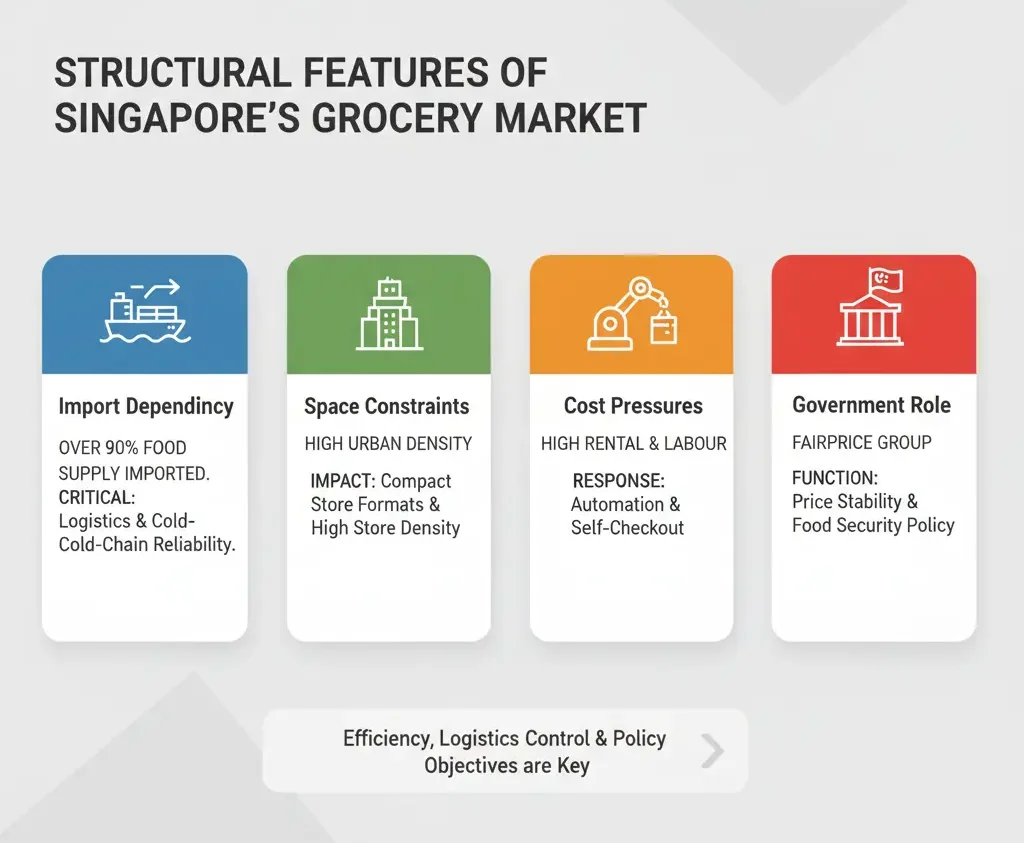
Singapore’s supermarket structure is shaped by unique national conditions.
The country imports more than 90 percent of its food supply. This makes import logistics and cold-chain reliability critical.
Space constraints push retailers toward compact formats and high store density.
High rental and labour costs drive automation investment and self-checkout adoption.
Government-linked retail participation, particularly through FairPrice, adds a public policy dimension to food retail.
These factors create a market where efficiency and logistics control matter as much as pricing.
Digital Grocery and Omnichannel Expansion
Online grocery continues to expand across Singapore.
Most major chains now operate:
- Click-and-collect services
- Home delivery platforms
- App-based loyalty programs
- Dynamic pricing tools
FairPrice and Sheng Siong lead in mass-market digital adoption, while premium chains focus on curated online assortments.
Omnichannel capability is becoming a standard requirement rather than a competitive advantage.
What Suppliers Should Watch in 2026
Suppliers targeting Singapore’s supermarket market should monitor several trends.
Private label expansion is accelerating across major chains.
Margin pressure is increasing as retailers demand better pricing terms.
Sustainability requirements are tightening, particularly for packaging and sourcing transparency.
Cross-border sourcing is shifting toward regional ASEAN suppliers for cost optimisation.
Retailers are also consolidating supplier lists, favouring long-term strategic partners.
Companies that align with retailer sourcing strategies will gain stronger shelf access.
Competition Is Moving Beyond Price
Singapore’s supermarket competition is no longer based on price alone.
Retailers now compete on:
- Convenience
- Fresh food quality
- Digital experience
- Store location density
- Private label differentiation
This creates multiple layers of competition across different consumer segments.
Conclusion
Singapore’s supermarket market is not fragmented.
It is tightly structured around a small group of retailers that control consumer access, supply chains and product visibility. The companies shaping this landscape are defined less by store numbers and more by purchasing power, logistics integration and private label development.
For international suppliers, FMCG brands and exporters, understanding this structure is essential for building successful market entry strategies and long-term retail partnerships.
Singapore remains one of Asia’s most sophisticated and strategically important grocery retail markets.
Editor’s Note: Market influence levels are based on retail footprint, supplier access power, store coverage, and projected 2026 retail positioning. Figures reflect market structure rather than audited financial data.