
Denmark’s grocery market is one of the most concentrated in Europe. The top three retailers control close to 90% of national food sales. For suppliers, this concentration matters more than store count. Market share defines listing access, pricing leverage, private label exposure, and long-term contract volume.
Since 2023, the market has shifted sharply. Aldi exited. REMA 1000 absorbed much of that footprint. Coop restructured ownership. Salling Group defended domestic leadership while expanding into the Baltic region.
For FMCG brands, food manufacturers, packaging suppliers, and private label producers, Denmark now operates as a high-volume, low-margin, centralised buying market.
Which supermarket group has the largest market share in Denmark? with courent information Salling Group remains the largest retail group, while REMA 1000 is now the biggest single supermarket chain.
Denmark Supermarket Market Overview (2025/26)
| Rank | Company | Market Share | Revenue | Employees | Branches |
|---|---|---|---|---|---|
| 1 | Salling Group | ~35% | €10bn+ | 68,000+ | 1,700+ |
| 2 | Coop Danmark | ~28% | €7.3–7.7bn | 38,000+ | 900+ |
| 3 | REMA 1000 Denmark | ~24% | €7.0–7.5bn | 17,000+ | 500+ |
| 4 | Lidl Denmark | ~8% | €2.1bn | 6,500+ | 145+ |
| 5 | Dagrofa Group | ~4% | €3.1bn | 14,000+ | 500+ |
| 6 | Meny (Dagrofa banner) | ~2% | €1.6bn | 6,000+ | 120+ |
| 7 | Spar Denmark | ~1.5% | €1.2bn | 3,000+ | 130+ |
| 8 | Min Købmand | ~1% | Regional | — | 300+ |
| 9 | nemlig.com | ~1–1.5% | €350–450m | 2,000+ | National delivery |
| 10 | Løvbjerg Supermarkets | <1% | Regional | — | 17 |
Company Profile
1. Salling Group
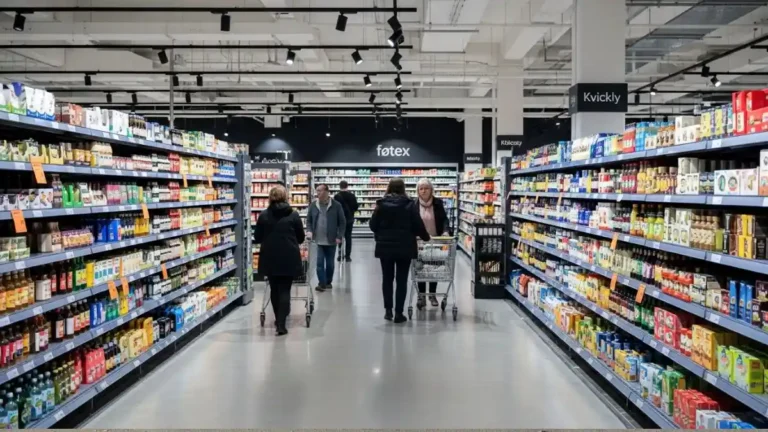
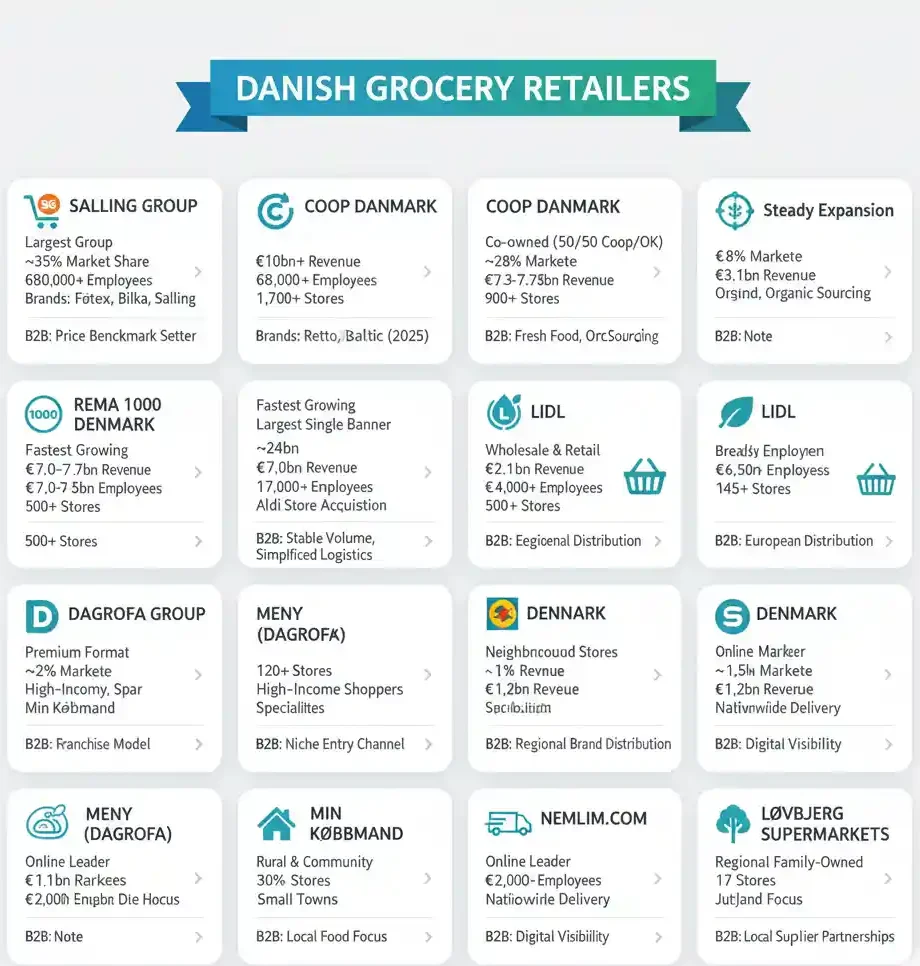
Salling Group is Denmark’s largest grocery retailer at group level. It operates Netto (discount), Føtex (supermarket), Bilka (hypermarket), and Salling department stores. Market share: ~35%. Revenue: €10bn+. Employees: 68,000+. Branches: 1,700+ across Denmark and Europe. Private label plays a central role, especially in Netto and Føtex, where dairy, frozen food, household goods, and bakery categories are dominated by in-house brands. In 2025, Salling completed the €1.3bn acquisition of Rimi Baltic, giving the group direct scale in Estonia, Latvia, and Lithuania.
B2B note: Salling sets national price benchmarks. A single Netto listing can determine nationwide volume performance.
2. Coop Danmark
Coop Danmark operates SuperBrugsen, Kvickly, Dagli’Brugsen, and Coop 365discount. It exited Irma and restructured into a leaner model. Market share: ~28%. Revenue: €7.3–7.7bn. Employees: 38,000+. Branches: 900+. The business is now a 50/50 joint venture between Coop amba and OK amba. Private label remains strong in organic, sustainability-focused, and everyday grocery categories.
B2B note: Coop remains a key player in fresh food sourcing and private label organics, especially for Danish producers.
3. REMA 1000 Denmark
REMA 1000 is Denmark’s fastest-growing discount chain and now the largest single supermarket banner by market share, ahead of Netto. It operates a decentralised franchise model. Market share: ~24%. Revenue: €7.0–7.5bn. Employees: 17,000+. Branches: 500+. Growth accelerated after acquiring most former Aldi store locations. Private label penetration exceeds 50% across many categories.
B2B note: REMA is highly selective but stable. Suppliers who secure national contracts benefit from predictable volume and simplified logistics.
4. Lidl Denmark
Lidl continues steady national expansion with compact discount formats. Market share: ~8%. Revenue: €2.1bn. Employees: 6,500+. Branches: 145+. Lidl’s assortment is dominated by private label, supported by selected Danish suppliers in fresh produce, bakery, and meat categories.
B2B note: Lidl offers suppliers access to European distribution through its centralised sourcing network.
5. Dagrofa Group
Dagrofa operates wholesale and retail grocery operations. It owns Meny, Spar, and Min Købmand while supplying independent retailers and foodservice customers. Market share: ~4%. Revenue: €3.1bn. Employees: 14,000+. Branches: 500+. Private label presence continues expanding across Spar and convenience formats.
B2B note: Dagrofa provides strong regional distribution access for mid-scale suppliers.
6. Meny (Dagrofa Premium Format)
Meny targets high-income urban shoppers and premium grocery segments. Market share: ~2%. Branches: 120+. The chain focuses on fresh food, imported specialties, and premium private label ranges.
B2B note: Meny is a preferred entry channel for niche brands and high-quality producers.
7. Spar Denmark
Spar operates neighbourhood supermarkets and convenience-oriented stores. Market share: ~1.5%. Revenue: €1.2bn. Branches: 130+. Private label supports everyday grocery needs but does not dominate assortments.
B2B note: Spar remains important for regional brand distribution outside major urban areas.
8. Min Købmand
Min Købmand focuses on rural and community-based convenience retail. Market share: ~1%. Branches: 300+. It serves commuter locations and small towns where large chains have limited coverage.
B2B note: Local food suppliers and regional producers benefit most from this channel.
9. nemlig.com (Online Grocery Leader)
nemlig.com is Denmark’s largest pure-play online supermarket. Market share: ~1–1.5%. Revenue: €350–450m. Employees: 2,000+. Coverage: nationwide home delivery. Online grocery demand remains stable among urban households and premium shoppers.
B2B note: Digital shelves provide higher visibility for premium and convenience-focused products.
10. Løvbjerg Supermarkets
Løvbjerg is a regional family-owned supermarket chain operating mainly in Jutland. Market share: <1%. Branches: 17. The chain maintains strong local loyalty.
B2B note: Regional supplier partnerships remain central to its assortment strategy.
Revenue Growth and Private Label Share
| Company | Revenue | YoY Growth | Private Label Share |
|---|---|---|---|
| Salling Group | €10bn+ | +4–5% | 35–40% |
| Coop Danmark | €7.3–7.7bn | +1–2% | 30–35% |
| REMA 1000 | €7.0–7.5bn | +6–8% | 50%+ |
| Lidl Denmark | €2.1bn | +5% | 60%+ |
| Dagrofa Group | €3.1bn | +3% | 25–30% |
Supplier Impact: Why Market Share Now Matters More Than Ever
Denmark’s grocery market is now dominated by a small number of national buying teams. Centralised purchasing decisions reduce negotiation diversity but increase contract scale.
For suppliers, winning a single national listing can secure distribution across hundreds of stores. Losing one major retailer contract can immediately remove access to millions of weekly shoppers.
This environment favours manufacturers with:
High production scale
Reliable logistics performance
Stable year-round supply capacity
Automated warehousing integration
Smaller producers increasingly rely on private label manufacturing or regional distribution partnerships to remain competitive.
Discount Expansion Is Reshaping Category Economics
Discount formats now drive most grocery growth.
REMA 1000, Netto, Lidl, and Coop 365discount continue expanding store networks. These formats operate with reduced assortments, high stock turnover, and simplified supply chains.
For suppliers, this creates pressure:
Fewer SKUs per category
Higher volume per listed product
Lower price tolerance
Greater reliance on private label
Mid-tier branded products face the most risk. Premium brands maintain space in Føtex, Meny, and Kvickly, while entry-level categories increasingly move toward retailer brands.
Premium Private Label Is Replacing Mid-Tier Brands
Private label growth is no longer limited to budget products.
Salling Group is expanding premium ranges such as organic and specialty private labels. Coop continues investing in sustainability-focused lines. Lidl and REMA improve product quality to compete directly with established brands.
This creates a “mid-tier squeeze” for suppliers. Brands positioned between budget and premium segments are losing shelf space as retailers capture margin through high-quality private label alternatives.
Logistics and ESG Pressure Are Rising
Retailers now demand more from suppliers beyond price.
Two major challenges dominate 2025–2026 negotiations:
Labour shortages. Denmark faces truck driver and warehouse staffing shortages. Retailers increasingly require suppliers to handle more inbound logistics responsibility.
Scope 3 emissions reporting. Retailers demand CO₂-per-unit data. Suppliers unable to provide verified sustainability reporting risk losing shelf access regardless of price competitiveness.
FAQ
Which supermarket group has the largest market share in Denmark?
Salling Group leads at group level, while REMA 1000 leads at individual chain level.
Which retailer expanded fastest after Aldi exited Denmark?
REMA 1000 gained the largest share of former Aldi locations.
Why does market concentration matter for suppliers?
Because a small number of buying teams control most national grocery contracts.
What Happens Next in 2026
Denmark’s supermarket competition will intensify.
- Discount formats will continue expanding.
- Private label penetration will increase further.
- Retail consolidation will strengthen buyer power.
Retailers will push harder on cost efficiency, sustainability compliance, packaging reduction, and supply chain automation.
For suppliers, long-term success will depend on scale, reliability, and strategic partnerships.
Denmark will remain one of Northern Europe’s most commercially demanding grocery markets — but also one of the most stable for high-volume manufacturers.
Conclusion
Denmark’s supermarket market is entering a new phase of consolidation and competitive pressure. Market share is becoming more concentrated, buying power is shifting toward fewer national players, and private label continues to reshape category economics.
For suppliers operating across Denmark FMCG, the message is clear. Scale, logistics performance, and pricing discipline now matter more than brand legacy. Retailers are tightening listings and focusing on fewer, higher-volume partners.
At the same time, changes in Denmark packaging requirements and sustainability reporting are raising entry barriers. Suppliers unable to adapt to packaging efficiency targets and Scope 3 emissions reporting risk losing shelf access, regardless of price competitiveness.
Private label expansion is also accelerating. Across Denmark private label programs, retailers are moving beyond budget ranges into premium and organic alternatives. This is squeezing mid-tier brands and shifting margin control further toward supermarket groups.
Looking ahead to 2026, discount growth, automation investment, and supply chain centralisation will continue shaping the Danish grocery market. For manufacturers and suppliers, long-term success will depend on operational efficiency, strategic partnerships, and the ability to adapt quickly to retailer-led change.
Editor’s Note: Market share and revenue figures are based on publicly available company disclosures and industry estimates at the time of publication. All figures are rounded.