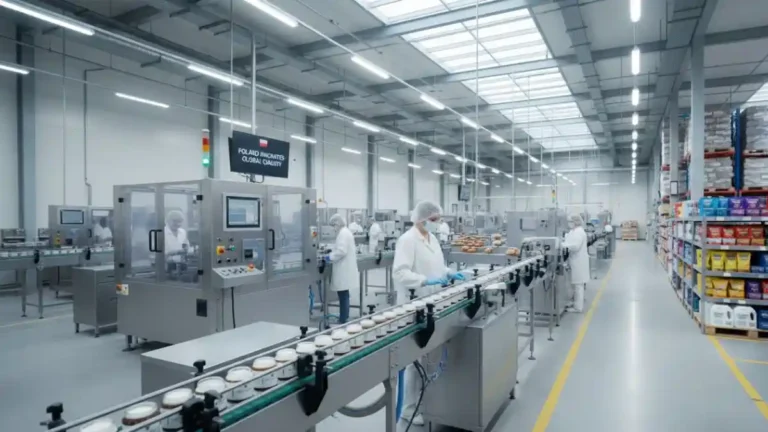

Poland is one of Europe’s largest private label production hubs, led by Maspex Group, Mlekovita and Mlekpol.
Dairy, meat and ambient grocery manufacturers dominate revenue scale. They supply supermarket chains across Poland and the wider European Union.
The ranking below reflects the largest private label manufacturers operating production facilities in Poland. It is based on the latest publicly available annual revenue figures for FY2024.
Companies included manufacture food and selected FMCG categories under retailer-owned brands for domestic and export markets.
Private label manufacturing refers to products made by a producer and sold under a retailer’s brand name rather than the manufacturer’s own brand.
In Poland, this includes dairy products, processed meat, ready meals, beverages, confectionery and vegetable preserves. These are supplied to both national and cross-border retail networks.
Over the past decade, Poland’s role in European supermarket supply chains has expanded steadily.
Competitive production costs, EU single-market access and continued investment in processing automation have strengthened its position. In 2026, it is a strategic sourcing base for retailer brands.
Who are the largest private label manufacturers in Poland by revenue?
The largest private label manufacturers in Poland by revenue are Maspex Group, Mlekovita, Mlekpol, Animex Foods and Cedrob Group. They are followed by Colian Holding, FoodCare, Pamapol, FoodWell and Dawtona.
Maspex Group leads the list with diversified beverage and ambient food production across multiple plants in Poland and Central Europe.
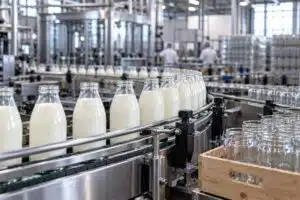
Mlekovita and Mlekpol dominate dairy private label supply. They produce UHT milk, cheese, butter and other dairy products both for domestic retailers and export markets.
Animex Foods, operating as part of the WH Group supply network, and Cedrob Group are major contributors in processed meat and poultry. They supply chilled and prepared products under retailer brands to chains such as Biedronka, Lidl and Carrefour.
The remaining companies contribute significant volume in confectionery, functional beverages, ready meals and vegetable preserves. This reflects the breadth of private label categories produced in Poland for supermarket supply in 2026.
Private Label Manufacturers in Poland by Revenue (2026)
| Rank | Company Name | Annual Revenue (PLN) | Fiscal Year | Employees | Key Private Label Products |
|---|---|---|---|---|---|
| 1 | Maspex Group | approx. 15–16 billion | FY2024 | 9,000+ | Beverages, ready meals, sauces |
| 2 | Mlekovita | approx. 10 billion | FY2024 | 5,000+ | Milk, cheese, dairy powders |
| 3 | Mlekpol | approx. 9–10 billion | FY2024 | 4,000+ | UHT milk, butter, dairy |
| 4 | Animex Foods | approx. 8–9 billion | FY2024 | 10,000+ | Processed meat, chilled poultry |
| 5 | Cedrob Group | approx. 7–8 billion | FY2024 | 7,000+ | Poultry, prepared meat |
| 6 | Colian Holding | approx. 1.7–1.8 billion | FY2024 | 2,000+ | Confectionery, snacks |
| 7 | FoodCare | approx. 1.5–1.7 billion | FY2024 | 1,000+ | Beverages, functional drinks |
| 8 | Pamapol | approx. 1.0–1.2 billion | FY2024 | 1,500+ | Ready meals, canned foods |
| 9 | FoodWell (Bakalland) | approx. 1.0 billion | FY2024 | 1,000+ | Nuts, dried fruit, snack mixes |
| 10 | Dawtona | approx. 0.9–1.0 billion | FY2024 | 1,000+ | Tomato products, vegetable preserves |
Revenue figures reflect the latest publicly available financial disclosures for FY2024.
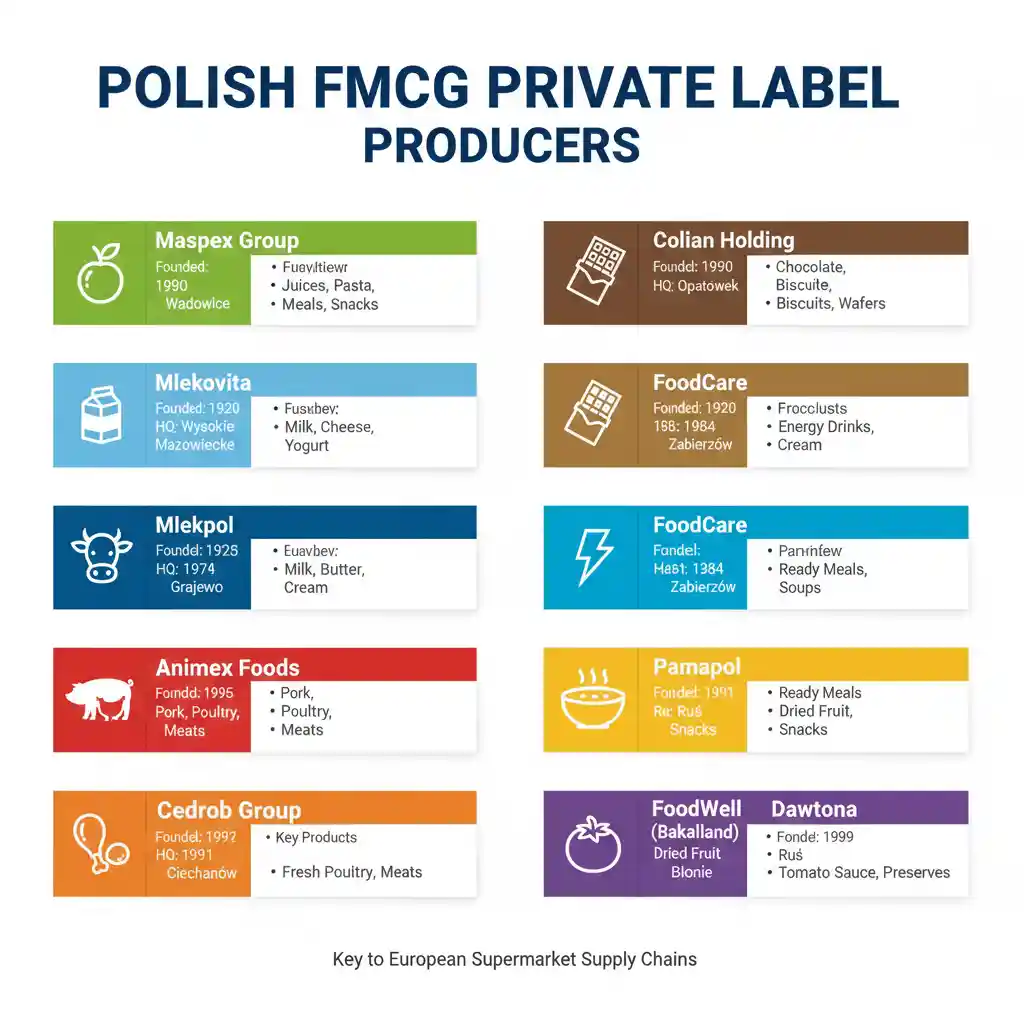
Maspex Group
- Founded: 1990
- Headquarters: Wadowice
Maspex is one of Central Europe’s largest FMCG producers. It is known for branded products, but it also manufactures significant volumes for retailer-owned brands across multiple categories.
Key Private Label Products:
- Fruit juices and beverages
- Pasta and sauces
- Instant meals
- Ready-to-eat products
Why it matters to supermarket buyers
Maspex operates many production facilities in Poland and across Central Europe.
This gives it the scale required to support large private label tenders from both domestic supermarket groups and EU retailers.
Its diversified category portfolio allows flexibility in responding to changing retailer specifications and ongoing margin pressure.
In 2026, energy efficiency and packaging optimisation have become increasingly relevant in private label negotiations. They influence cost structures and contract competitiveness.
Mlekovita
- Founded: 1928
- Headquarters: Wysokie Mazowieckie
Mlekovita is one of Poland’s largest dairy cooperatives and a significant exporter.
Key Private Label Products:
- UHT milk
- Hard and semi-hard cheese
- Milk powders
- Yogurt
The company operates an extensive processing network across Poland. Production capacity is aligned closely to export markets within the European Union.
Dairy continues to be one of the highest private label penetration categories in European supermarkets. This reinforces the company’s structural importance within retailer supply chains.
Mlekpol
- Founded: 1979
- Headquarters: Grajewo
Mlekpol is a leading dairy cooperative with vertically integrated milk sourcing.
Key Private Label Products:
- UHT milk
- Butter
- Cream
- Dairy desserts
Its production scale and cooperative ownership structure support long-term retail supply stability. They provide consistent raw milk sourcing and predictable volume delivery for supermarket private label contracts.
Animex Foods
- Founded: 1995 (current structure)
- Headquarters: Warsaw
Animex Foods operates as a subsidiary of WH Group, the Hong Kong-based parent company of Smithfield Foods. It manages large-scale meat processing operations in Poland.
Key Private Label Products:
- Processed pork
- Chilled poultry
- Ready meat products
Private label meat production remains essential in value-driven supermarket segments. Consistent volume, cost efficiency and reliable processing capacity are critical to maintaining competitive pricing and shelf availability.
Cedrob Group
- Founded: 1991
- Headquarters: Ciechanów
Cedrob is a vertically integrated poultry producer.
Key Private Label Products:
- Fresh poultry
- Processed poultry
- Prepared meat
The company maintains strong domestic distribution across Poland. It also supplies export markets within the European Union, supporting steady production volumes and cross-border retail alignment.
Colian Holding
- Founded: 1990
- Headquarters: Opatówek
Colian operates in confectionery and snack production, including retailer brand contracts.
Key Private Label Products:
- Chocolate
- Biscuits
- Wafer products
Confectionery private label production remains comparatively margin-stable. This is especially true when set against more volatile protein categories such as meat and dairy.
It provides retailers with consistent pricing structures and predictable sourcing costs.
FoodCare
- Founded: 1984
- Headquarters: Zabierzów
FoodCare produces beverages and functional drinks.
Key Private Label Products:
- Energy drinks
- Vitamin beverages
- Ready-to-drink products
Private label beverage diversification supports retailer portfolio strategies. It expands assortment depth across value and functional segments while maintaining cost flexibility and scalable production capacity.
Pamapol
- Founded: 1991
- Headquarters: Ruś
Key Private Label Products:
- Ready meals
- Canned vegetables
- Soups
Ambient grocery production provides longer shelf life and greater export flexibility. Retailers can manage inventory more efficiently. They can also support cross-border distribution without the constraints of chilled logistics.
FoodWell (Bakalland)
FoodWell Group includes Bakalland, a recognised snack and nut processor.
Key Private Label Products:
- Nuts
- Dried fruit
- Snack bars
Health-oriented snacking continues to expand within retailer private label portfolios. This reflects steady consumer demand for nuts, dried fruit and functional snack formats.
These formats combine higher margins with scalable, shelf-stable production.
Dawtona
- Founded: 1989
- Headquarters: Błonie
Key Private Label Products:
- Tomato concentrates
- Sauces
- Vegetable preserves
Vegetable processing aligns closely with supermarket value-tier segments and structured export contracts. It supports steady demand for shelf-stable products such as tomato concentrates and preserved vegetables across domestic and EU markets.
Why are European supermarkets increasing sourcing from Poland in 2026?
Poland offers production cost advantages compared with Western Europe. Modern processing facilities, automation and scale support competitive pricing.
EU regulatory alignment simplifies cross-border distribution. Proximity to Germany, Scandinavia and Central Europe reduces logistics complexity.
Dairy and meat production capacity provides consistent volume supply for private label expansion.
How retailers evaluate Polish private label manufacturers
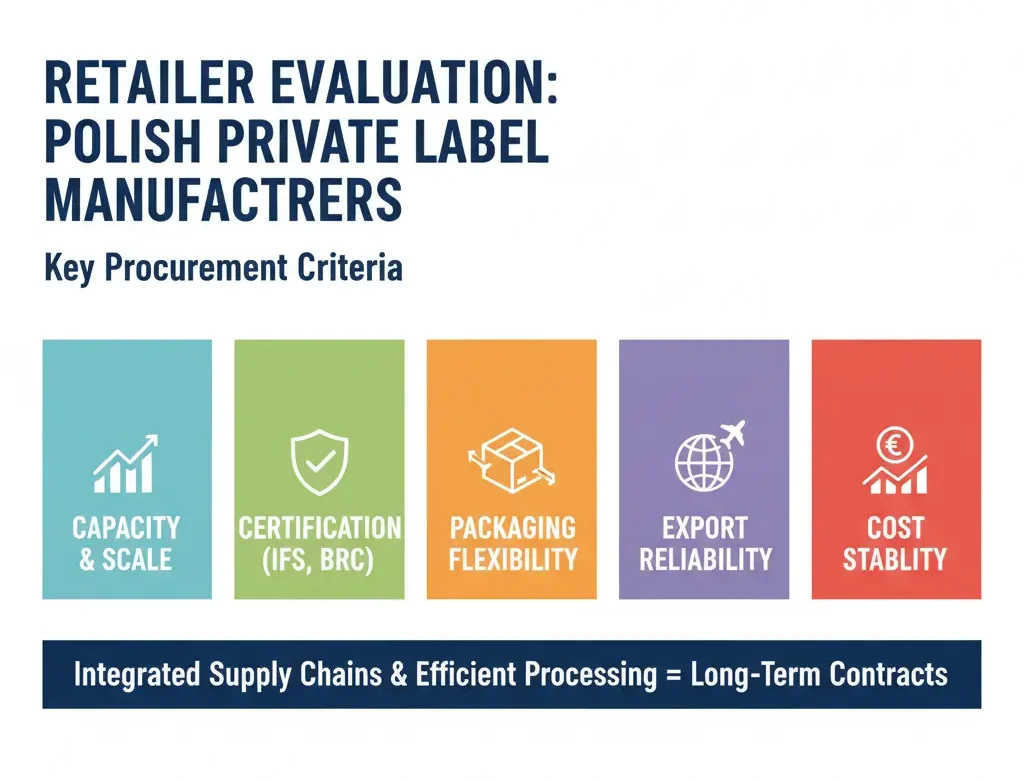
Retail procurement decisions increasingly focus on:
- Production capacity and scalability
- Certification standards (IFS, BRC)
- Packaging flexibility
- Export logistics reliability
- Cost stability amid energy fluctuations
Manufacturers with integrated supply chains and efficient processing infrastructure tend to secure longer-term contracts.
Category concentration and margin dynamics
Dairy and meat remain structurally dominant due to household penetration and repeat purchase frequency.
Ready meals and ambient foods provide export-friendly formats with longer shelf stability.
In 2026, sustainable packaging compliance and energy-cost efficiency are emerging as key differentiators in private label tender evaluations. This is particularly true in dairy and convenience segments.
Structural outlook for 2026
Retailer consolidation continues shaping supplier selection. Scale-based producers are positioned to absorb price pressure more effectively.
Export alignment remains essential as domestic supermarket competition intensifies.
Operational efficiency, automation and packaging optimisation are expected to influence competitive positioning in the coming year.
Ranking methodology
This ranking includes companies operating production facilities in Poland that manufacture private label products for supermarkets.
Revenue figures reflect latest publicly available FY2024 disclosures. Both Polish-owned and multinational-owned entities are included where substantial Polish production exists.
Revenues are presented in PLN based on company financial reporting.
Frequently Asked Questions
Which is the largest private label manufacturer in Poland?
Maspex Group leads the ranking with approx. 15–16 billion PLN in FY2024 revenue. It produces beverages, ready meals and sauces.
Which Polish companies dominate dairy private label supply?
Mlekovita and Mlekpol dominate dairy private label supply. They produce UHT milk, cheese, butter and other dairy products for domestic retailers and export markets.
What do retailers look for in Polish private label manufacturers?
Retailers focus on production capacity and scalability, certification standards (IFS, BRC), packaging flexibility, export logistics reliability and cost stability amid energy fluctuations.
Conclusion
Poland’s largest private label manufacturers in 2026 are defined by revenue scale, export intensity and production depth. Dairy, meat and ambient food categories remain structurally dominant within retailer-brand supply chains. This reflects the purchasing priorities of major Poland supermarket groups and broader EU retail networks.
Competition is intensifying across Poland FMCG markets and wider European grocery retail. As a result, production efficiency, packaging compliance and energy management are becoming decisive factors in supplier resilience.
Manufacturers that combine scale with operational discipline are likely to remain central to supermarket private label strategies in the years ahead.
Editor’s Note: All information is based on publicly available financial reports and corporate disclosures for FY2024–FY2025. Revenue figures are reported in PLN according to company filings.