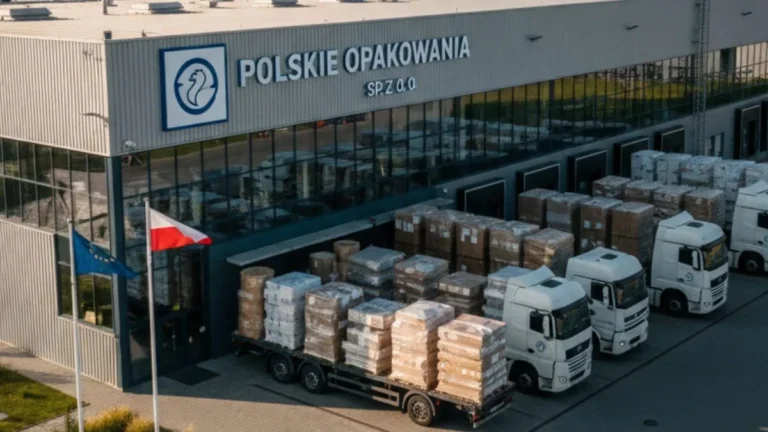

Poland has become a central manufacturing base for European packaging. It supplies corrugated cases, cartonboard formats, flexible films, and beverage cans into supermarket and FMCG supply chains across the region.
The country’s role extends beyond domestic demand. Polish plants support export-driven food production, private label growth, and cross-border retail logistics.
Many of the largest packaging operators active in Poland are international groups with headquarters outside the country.
However, their Polish production facilities, converting networks, and board mills play a decisive role within the national packaging system. Market influence is determined by operational footprint and supply chain integration rather than ownership structure.
In this environment, scale alone does not define leadership. Market power is shaped by material integration, production depth, technical capability, and the ability to maintain service during peak demand cycles.
This ranking reflects market power rather than annual turnover.
It assesses the leading packaging companies operating in Poland, whether domestically owned or internationally headquartered. The assessment rests on structural strength within the national packaging system, including operational depth, supply chain leverage, and relevance to Poland supermarket and Poland FMCG distribution networks.
What “market power” means in Polish packaging
Market power is the ability to shape supply conditions for customers and competitors. It comes from scale, capacity access, and material integration, such as paper and board supply.
Technical barriers also count, including food-safe films and can and closure quality systems. So do network coverage and the ability to hold service when demand spikes.
What gives a packaging company market power
In practice, the companies with the most market power are the ones that can do at least one of the following consistently:
- Control upstream material supply (containerboard/cartonboard) that converters depend on
- Run multi-plant converting networks that protect service levels
- Serve the highest-risk, highest-volume supermarket categories (food, beverage, chilled, fresh, e-commerce)
- Absorb complexity (short runs, many SKUs, high print demands) without quality drift
- Invest through cycles and still deliver on time
Market Power Ranking Table
Scoring is qualitative, on a simple 1–5 scale, based on visible footprint and category leverage in Poland.
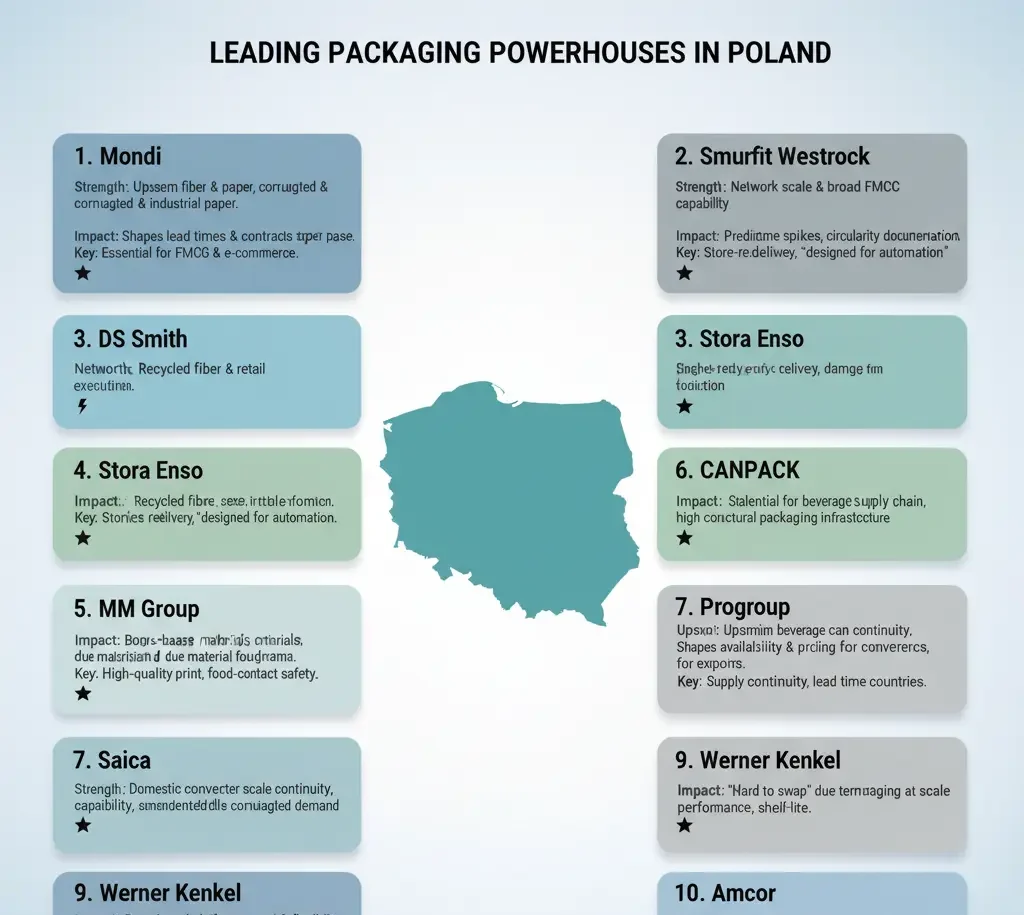
| Rank | Company (Poland operations) | Primary strength | Integration / footprint | Supermarket & FMCG leverage |
|---|---|---|---|---|
| 1 | Mondi (Poland) | Containerboard + kraft + corrugated system power | 5/5 | 5/5 |
| 2 | Smurfit Westrock (Poland) | Corrugated network + FMCG/display capability | 5/5 | 5/5 |
| 3 | DS Smith (Poland) | Recycled corrugated + retail-ready execution | 5/5 | 5/5 |
| 4 | Stora Enso (Poland) | Fibre-based packaging capability and scale | 4/5 | 5/5 |
| 5 | MM Group (Kwidzyn + packaging) | Cartonboard base + folding carton influence | 4/5 | 5/5 |
| 6 | CANPACK (Poland) | Beverage can scale and continuity | 4/5 | 5/5 |
| 7 | Progroup (Poland) | Containerboard economics feeding corrugated | 4/5 | 4/5 |
| 8 | Werner Kenkel (Poland) | Leading Polish-owned corrugated converter | 4/5 | 4/5 |
| 9 | Saica (Poland) | Corrugated + paper-based industrial packaging platform | 3/5 | 4/5 |
| 10 | Amcor (Poland) | Flexible packaging capability and spec barriers | 3/5 | 5/5 |
Note: This list ranks “market power in Poland,” not the highest Polish-entity revenue.
1) Mondi (Poland)
Founded (group): Long-established international group; Polish entity history varies by site and acquisition background.
Core packaging categories:
- Containerboard and kraft paper supply
- Corrugated packaging and industrial paper-based formats
- Transit packaging feeding FMCG and e-commerce flows
Mondi’s market power comes from upstream fibre and paper strength combined with downstream packaging relevance.
In packaging markets, the companies that influence paper and board supply typically carry structural leverage. Corrugated networks ultimately depend on the stability and economics of their paper base.
In Poland, Mondi’s footprint matters because the country serves both domestic FMCG volumes and export logistics.
When fibre-based packaging tightens, the companies with strong paper positions tend to shape lead times and contract structures across the sector.
Operational relevance is straightforward. Corrugated and paper-based packaging sits under almost every supermarket supply chain movement: inbound to factories, outbound to DCs, and store replenishment.
In high-volume categories, packaging stability is not a procurement detail. It is availability protection.
Strategic outlook
Strategically, the key point is that Mondi does not need to “win every converting job” to stay powerful.
If the company maintains strong material and industrial supply positioning, it remains central to how paper-based packaging markets behave.
2) Smurfit Westrock (Poland)
Founded (group): Long-established corrugated groups; current structure reflects the Smurfit Kappa / WestRock combination.
Core packaging categories:
- Corrugated cases and transit packaging
- Retail displays and shelf-ready formats
- Industrial packaging formats that run across multiple sectors
Smurfit Westrock’s market power in Poland is rooted in network converting scale and broad FMCG capability.
Corrugated is often treated like a commodity, but the real performance differentiator is network depth. That means multiple sites, stable uptime, and the ability to handle peaks without collapsing lead times.
This matters in supermarkets because promotional calendars and seasonal volume spikes are packaging-stress events.
When converters are tight, customers experience it as a supply chain issue. They see late cases, rushed substitutions, or compromised packaging quality.
The other layer is shelf-ready and display capability. Retail-ready formats shift labour and speed inside distribution and store operations.
Converters that can deliver consistent retail-ready performance become embedded into FMCG operating models, not just procurement lists.
Strategic outlook
Strategic direction in Poland is likely to keep moving toward service resilience and packaging “designed for automation”. These are cases that run cleanly through DC systems with fewer exceptions.
3) DS Smith (Poland)
Founded (group): Long-established European packaging group.
Core packaging categories:
- Recycled corrugated packaging
- Retail-ready cases and promotional packaging
- Integrated design-to-delivery corrugated systems
DS Smith’s market power comes from the combination of recycled fibre orientation and retail execution discipline.
In practical terms, large supermarket-linked supply chains prefer corrugated that is predictable. That means stacking strength, print stability, and dimensional control at high volume.
Recycled corrugated is also a structural advantage when customers place more weight on circularity documentation and recycled content narratives.
In procurement conversations, those factors increasingly sit alongside unit price. They do not replace cost pressure, but they change what qualifies.
Operational relevance is high because DS Smith is positioned where packaging meets performance: store-ready delivery, damage reduction, and consistency across frequent repeats.
For high-SKU FMCG businesses, corrugated is a “silent cost” that becomes visible only when it fails.
Strategic outlook
Strategically, DS Smith-type operators tend to gain influence when markets become more compliance-heavy. Their systems and documentation can handle customer audits and multi-market retail specifications.
4) Stora Enso (Poland)
Founded (group): Long-established Nordic fibre group.
Core packaging categories:
- Fibre-based packaging materials
- Packaging board applications and paper-based solutions
- Supply chain linkage to corrugated and board formats
Stora Enso’s market power in Poland is tied to fibre-based packaging capability and the broader European direction of travel. That direction means fewer mixed materials, more recyclability, and tighter packaging reporting expectations.
Even when a fibre company is not the largest corrugated converter, it can still carry heavy influence because it operates close to the material foundation.
Fibre packaging markets are sensitive to energy, pulp, and fibre availability. Players with strong fibre capability tend to shape how customers manage risk and contract continuity.
For supermarkets and FMCG, fibre-based packaging is not limited to “sustainability positioning.” It is structural packaging infrastructure.
It covers secondary packaging, shelf-ready cases, and transport formats that must be reliable across thousands of deliveries.
Strategic outlook
Strategically, fibre groups tend to strengthen influence when regulation and reporting tighten. Compliance becomes a procurement filter and not only a corporate target.
5) MM Group (Kwidzyn + packaging operations in Poland)
Founded (site roots): Polish pulp and paper industrial roots; group structure built through multiple European acquisitions.
Core packaging categories:
- Cartonboard / board supply (Kwidzyn industrial base)
- Folding cartons and printed carton packaging (group-level capability)
- Packaging for food, pharma, and consumer goods
MM’s market power in Poland is a blend. It combines board supply influence through mill economics with packaging conversion relevance via folding carton capability.
Cartonboard sits very close to branded and private label shelf packaging, where print consistency and food-contact safety expectations are higher.
Folding cartons are not just “nice packaging.” They are specification-heavy.
Many customers are unwilling to change carton suppliers quickly. Qualification cycles, print approvals, and migration compliance controls can be costly and time-consuming.
That creates market power. A carton supplier with stable board access and strong conversion discipline can remain embedded in long-term packaging programmes even when price pressure rises.
Strategic outlook
Strategically, this segment is moving toward higher SKU complexity and shorter runs. The converters that keep quality stable under complexity tend to carry long-term influence.
6) CANPACK (Poland)
Founded: 1992 (Poland roots widely referenced).
Core packaging categories:
- Aluminium beverage cans
- Ends/closures associated with beverage can systems
CANPACK’s market power is category-specific and extremely strong: beverage can continuity.
Metal packaging runs on high-volume industrial economics. When capacity is tight, the knock-on impact shows up as brand risk, supply interruptions, and reduced promotional flexibility.
For supermarkets, beverage packaging is a foundational supply chain component. Cans affect shipping efficiency, breakage risk, and storage behaviour.
This is a “high consequence” packaging category. When it fails, customers cannot substitute easily.
Market power here is less about how many product types exist. It is more about how few high-quality, stable-volume suppliers can meet beverage industry requirements at scale.
Strategic outlook
Strategically, the key pressures are material cost pass-through (aluminium), energy intensity, and the constant push for lightweighting without performance loss.
7) Progroup (Poland)
Founded (group): Modern European containerboard/corrugated platform.
Core packaging categories:
- Containerboard feeding corrugated conversion
- Paper supply dynamics that influence corrugated pricing and availability
Progroup’s market power is built around board economics and the leverage that comes from being upstream.
Corrugated conversion can be competitive and fragmented. Containerboard capacity is more concentrated, more capital intensive, and more exposed to energy and fibre inputs.
In Poland’s packaging system, upstream board strength can shape availability and pricing stability for converters. It also affects FMCG customers locked into continuous demand.
Operational relevance is strongest in categories where corrugated volume is high and stable: ambient grocery, beverages, household, and e-commerce. These segments do not pause for supply disruptions.
Strategic outlook
Strategically, upstream players gain influence when energy prices rise or fibre becomes tighter. The market then becomes more sensitive to the economics of paper production.
8) Werner Kenkel (Poland)
Founded (group roots): Commonly referenced as late 1970s origins; Polish-owned growth story.
Core packaging categories:
- Corrugated packaging and cases
- Printed packaging and display-related formats (converter typical scope)
Werner Kenkel’s market power is important for a different reason. It represents domestic converter scale with the ability to service FMCG customers in Poland with speed and flexibility.
In a market dominated by multinational groups, strong Polish-owned converters can hold share by being faster, closer, and operationally pragmatic.
This kind of converter often competes on service behaviour: turnaround times, stable deliveries, and the ability to handle mixed portfolios.
For many FMCG plants, packaging reliability beats marginal unit price savings, especially in peak weeks.
Strategic outlook
Strategically, domestic leaders gain leverage when customers want supply continuity across multiple suppliers. They also gain it when lead time stability becomes a risk-control priority.
9) Saica (Poland)
Founded (group): Long-established paper and packaging group.
Core packaging categories:
- Corrugated and paper-based industrial packaging
- Transit and transport packaging relevant to FMCG and industrial flows
Saica carries market power through paper-based packaging platform capability and multi-market presence.
Even when a company is not always the highest-volume player in every local segment, being part of a wider packaging system can strengthen negotiating power and capacity resilience.
For Poland, the relevance is linked to export-oriented production and industrial packaging flows that connect into FMCG logistics.
The companies that can manage industrial packaging requirements at scale tend to become critical during high-output periods.
Strategic outlook
Strategically, Saica-type groups can gain influence when customers push for consistent packaging specifications across multiple countries and want fewer supplier relationships.
10) Amcor (Poland)
Founded (group): Long-established global flexible packaging group.
Core packaging categories:
- Flexible packaging films and laminates
- Food and FMCG flexible packaging formats with strong specification barriers
Amcor’s market power comes from technical barriers rather than simple tonnage.
Flexible packaging often involves performance-driven requirements. These include barrier properties, seal integrity, shelf-life protection, and compliance documentation for food contact.
That makes flexible packaging “hard to swap” in many programmes. Qualification cycles can be lengthy, and packaging failures can be costly, especially in chilled, fresh, and high-sensitivity categories.
For supermarkets and FMCG, flexible packaging is everywhere. In many cases, it is closer to the product safety and shelf-life envelope than paper-based secondary packaging.
That creates strategic importance even when visibility is low.
Strategic outlook
Strategically, this segment is shaped by regulation, recyclability design constraints, and the need to balance performance with simplified material structures.
What This Ranking Says About Poland’s Packaging Structure
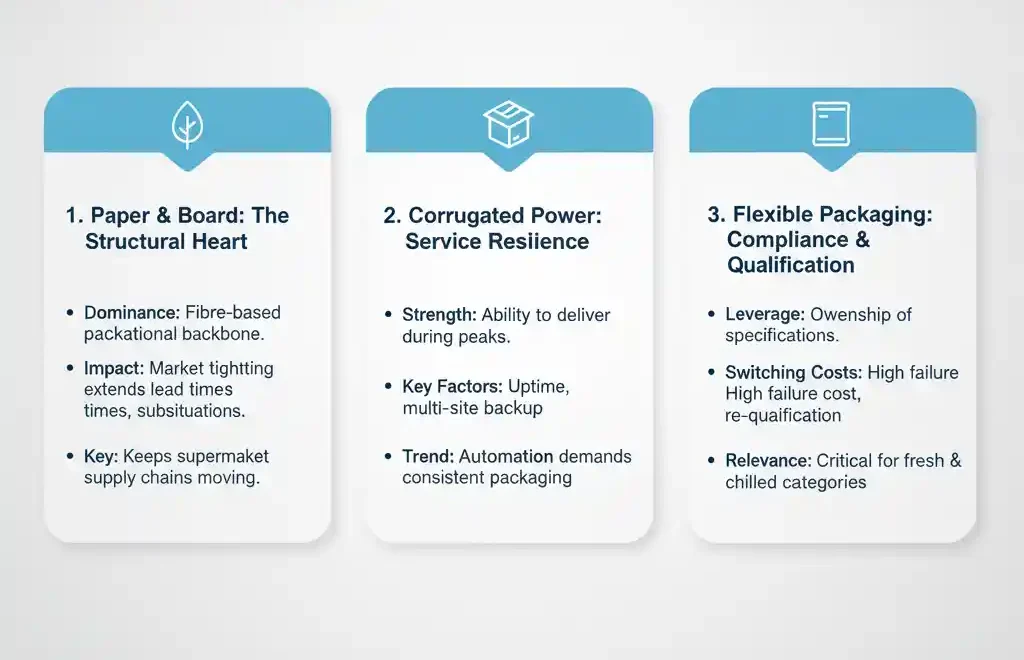
Paper and board remains the structural heart of the system
Even with major metal packaging scale present in Poland, fibre-based packaging dominates the operational backbone.
Corrugated, cartonboard, and containerboard are the packaging system that keeps supermarket supply chains moving.
When fibre packaging markets tighten, the ripple is immediate. Lead times extend, spec substitutions rise, and plants become less flexible on output schedules.
Corrugated market power is about service resilience, not slogans
The corrugated leaders are powerful because they can deliver. Corrugated is exposed to peaks: promotions, seasonal demand, and sudden volume swings from FMCG plants.
Market power comes from uptime, multi-site backup capacity, and consistent quality under stress.
This is also where automation changes the rules. Distribution centres increasingly expect packaging that behaves consistently in handling systems.
Those requirements are pushing converters toward tighter dimensional control and more stable performance across runs.
Flexible packaging power sits in compliance and qualification
Flexible packaging companies hold leverage when they own the specifications: barrier films, complex laminates, and food-safety documentation.
Customers do not switch these suppliers easily because the cost of failure is high and the cost of re-qualification is real.
In Poland, flexible packaging tends to have strong relevance in fresh and chilled categories. There, packaging performance directly affects waste and shelf-life outcomes.
Industry direction in 2026
The direction of travel is not subtle.
Packaging is becoming more controlled, more documented, and more integrated into supply chain performance metrics.
Supermarkets and FMCG producers increasingly treat packaging as part of operational risk management. That covers damage reduction, DC throughput, and compliance readiness.
At the same time, cost pressure does not disappear.
The companies with the strongest market power are the ones that can hold cost competitiveness without giving away stability.
In packaging, stability is often the real product.
Frequently Asked Questions
Which is the top packaging company in Poland?
Mondi ranks first on market power, with 5/5 for both integration and supermarket and FMCG leverage. Smurfit Westrock and DS Smith follow, with the same scores.
Is this a revenue ranking?
No. It is a market power ranking based on operational depth, category presence, and supply chain leverage. No revenue figures were used to determine rank.
Why does fibre-based packaging dominate?
Corrugated, cartonboard, and containerboard form the operational backbone of supermarket supply chains. When fibre markets tighten, lead times extend and plants become less flexible.
Conclusion
The top packaging companies operating in Poland hold market power in different ways. Fibre-based leaders influence the system through control of board supply and converting networks.
Corrugated groups anchor distribution efficiency and peak-volume resilience. Flexible packaging specialists retain leverage through technical compliance and food-contact performance.
Metal packaging producers remain central where beverage continuity supports large-scale retail programmes.
For the Poland supermarket and Poland FMCG landscape, this structure matters. Supermarket growth, private label expansion, and export-oriented food production depend on packaging that performs without interruption.
In practical terms, packaging is embedded in every pallet, every case, and every shelf-ready format moving through Polish retail logistics.
This market power ranking reflects the structural reality of Poland’s packaging economy. Packaging is not simply a supporting input.
It functions as core infrastructure within the Poland supermarket and Poland FMCG supply chain system.
Editor’s Note: This article is a market power ranking, not a revenue ranking. It is based on publicly visible information about company operations, category presence, and packaging segment influence in Poland. No revenue figures were used to determine rank.
Where founded years or entity histories vary by site and acquisition structure, the profile explains that context.