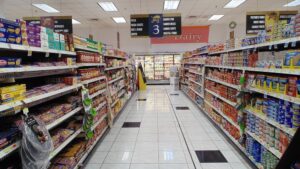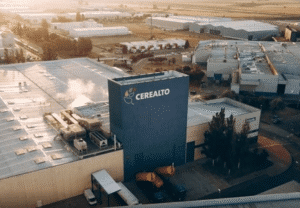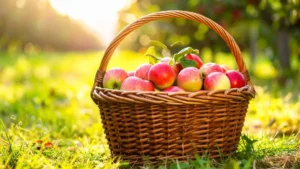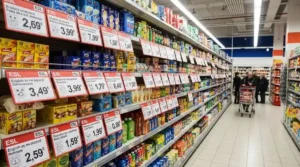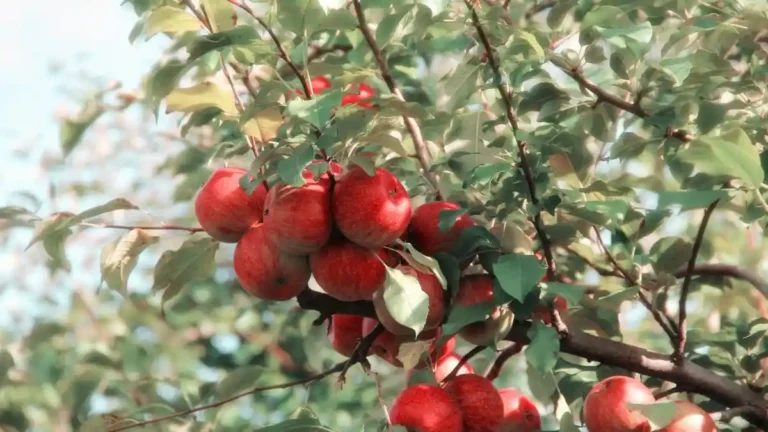

Poland is famous for apples, blueberries, raspberries and mushrooms. It is the largest apple producer in the European Union. It is also one of Europe’s leading exporters of cultivated mushrooms and soft berries.
Several other crops are also produced at large commercial scale:
- carrots
- onions
- cabbage
- greenhouse tomatoes
These supply both domestic supermarkets and cross-border EU retail chains.
Fresh fruit and vegetables are among the most in-demand grocery categories in Poland. Internationally, Polish apples and mushrooms define the country’s agricultural export profile.
Blueberries have become a fast-growing high-value segment over the past decade.
The fresh produce companies in Poland that lead this sector are not defined only by revenue. Market influence is shaped by:
- orchard acreage
- greenhouse capacity
- storage infrastructure
- export reach
- integration with supermarket logistics systems
This ranking uses a hybrid structural model. It assesses Polish-owned fresh produce companies on production depth, export scale and operational relevance within European grocery supply chains.
10 Polish-Owned Fresh Produce Companies
| Rank | Company | Founded | Core Strength | Employees* | Structural Position |
|---|---|---|---|---|---|
| 1 | Appolonia Group | 2001 | Apples & exports | 600+ (seasonal incl.) | Major apple exporter |
| 2 | Rajpol Group | 1996 | Apple production | 500+ | EU retail supply |
| 3 | La-Sad | 2002 | Apple grower cooperative | 400+ | Large orchard base |
| 4 | Polskie Jagody | 2007 | Blueberries | 300+ | Leading berry exporter |
| 5 | Grupaproducentów Owoców Galster | 2003 | Apples | 250+ | Integrated packing |
| 6 | Green Factory | 2010 | Ready-to-eat salads | 700+ | Retail processing integration |
| 7 | Grupa Mularski | 1994 | Mushrooms | 600+ | EU mushroom exporter |
| 8 | Amplus Sp. z o.o. | 1992 | Fruits & vegetables distribution | 800+ | Retail logistics integration |
| 9 | Citronex Fresh | 1998 | Greenhouse tomatoes & bananas | 1,000+ | Controlled greenhouse scale |
| 10 | Grupaproducentów Owoców King Fruit | 2004 | Apples | 200+ | Export-aligned orchard base |
*Employee figures include seasonal labour where applicable. Data based on publicly available disclosures and company materials (FY2024–FY2025 where available).
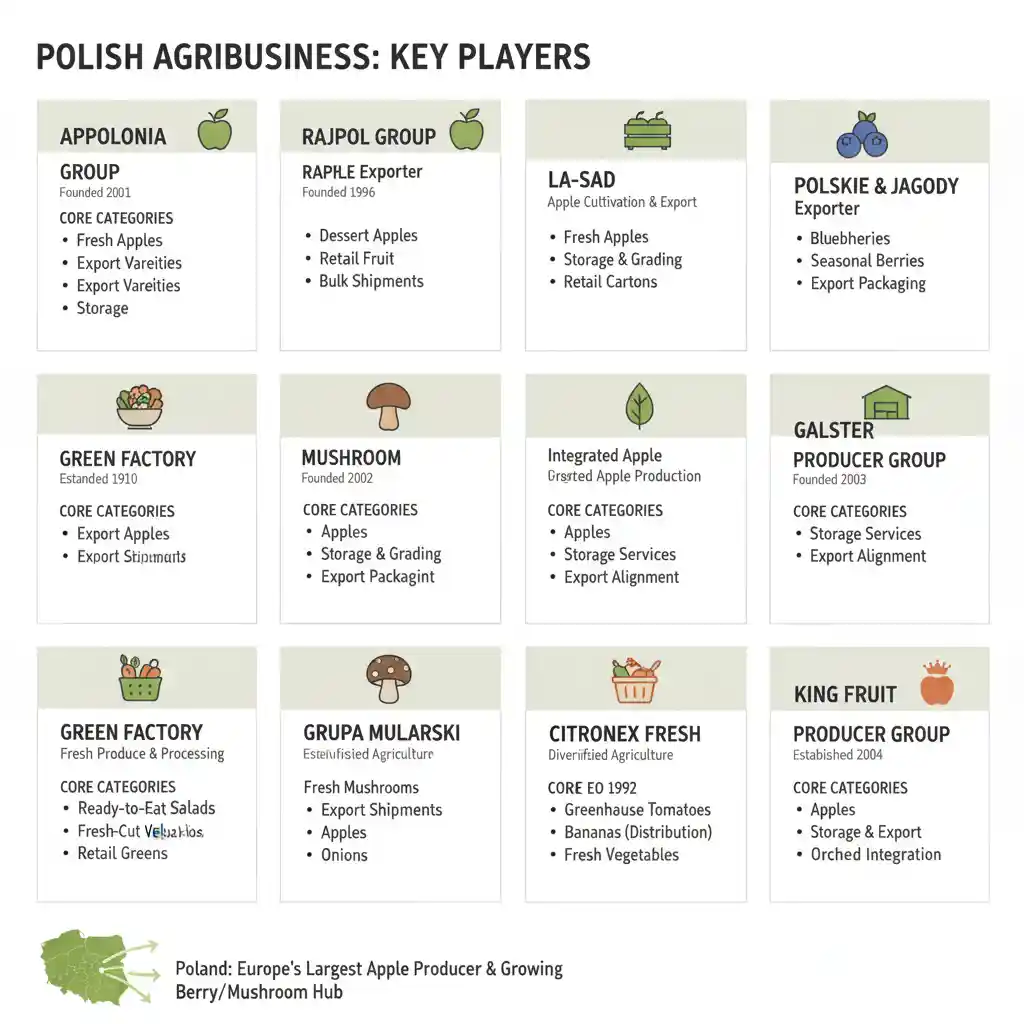
1. Appolonia Group
Founded in 2001, Appolonia Group is one of Poland’s largest apple producer organisations.
Core categories:
- Fresh apples
- Export-grade varieties
- Storage & controlled atmosphere facilities
Poland remains Europe’s largest apple producer. Appolonia plays a central role in export logistics to:
- Germany
- Scandinavia
- the Middle East
- Asia
Operationally, the company links orchard production with advanced storage, grading and packaging systems. This ensures year-round supply to supermarket chains.
Structural power comes from acreage scale and export consistency.
2. Rajpol Group
Established in 1996, Rajpol is a major apple producer and exporter with extensive orchard control.
Core categories:
- Dessert apples
- Retail-packed fruit
- Export bulk shipments
Rajpol supplies EU retailers and operates modern sorting and packing facilities. Its structural relevance comes from consistent volume and quality standards aligned with supermarket sourcing frameworks.
3. La-Sad
La-Sad is a producer group founded in 2002, focused on apple cultivation and export alignment.
Core categories:
- Fresh apples
- Storage & grading
- Retail carton formats
The group manages large orchard acreage and advanced cold storage systems. Its structural importance lies in cooperative governance. This ensures stable supply contracts into EU retail networks.
4. Polskie Jagody
Founded in 2007, Polskie Jagody specialises in blueberries and berry exports.
Core categories:
- Blueberries
- Seasonal berries
- Export packaging
Poland has emerged as one of Europe’s leading blueberry producers. Polskie Jagody supports cross-border supermarket supply during peak European berry season. This reinforces Poland’s expanding high-value fruit segment.
5. Galster Producer Group
Founded in 2003, Galster operates integrated apple production and packing facilities.
Core categories:
- Apples
- Storage services
- Export alignment
Galster’s infrastructure includes controlled-atmosphere warehouses, ensuring extended shelf life for retail distribution. Its structural relevance comes from supply reliability across changing harvest conditions.
6. Green Factory
Established in 2010, Green Factory operates where fresh produce meets processing.
Core categories:
- Ready-to-eat salads
- Fresh-cut vegetables
- Retail packaged greens
Unlike orchard-based exporters, Green Factory runs its own washing, cutting and packaging facilities. This places it within supermarket chilled supply chains. It links agricultural production with FMCG-ready formats.
7. Grupa Mularski
Founded in 1994, Grupa Mularski is a major Polish mushroom producer.
Core categories:
- Fresh mushrooms
- Export shipments
- Retail packaging
Poland is Europe’s leading mushroom exporter. Mularski’s production facilities support steady supply into Western European retailers. This reinforces Poland’s dominance in this niche fresh category.
8. Amplus
Founded in 1992, Amplus operates across fresh fruit and vegetable sourcing and distribution.
Core categories:
- Apples
- Carrots
- Onions
- Export vegetables
Amplus plays a logistical role linking growers to retail chains. Its scale and sorting infrastructure place it within Poland’s supermarket supply ecosystem.
9. Citronex Fresh
Founded in 1998, Citronex is a diversified agricultural group.
Core categories:
- Greenhouse tomatoes
- Bananas (distribution)
- Fresh vegetables
Citronex controls one of Poland’s largest greenhouse tomato operations. It is also active in import distribution. Its domestic production footprint reinforces Poland’s greenhouse expansion trend.
10. King Fruit Producer Group
Established in 2004, King Fruit is another structurally significant apple producer group.
Core categories:
- Apples
- Storage & export packaging
Its relevance lies in export orientation and orchard integration rather than brand recognition. This reflects the cooperative structure common in Polish fresh fruit production.
Structural Analysis: Market Impact
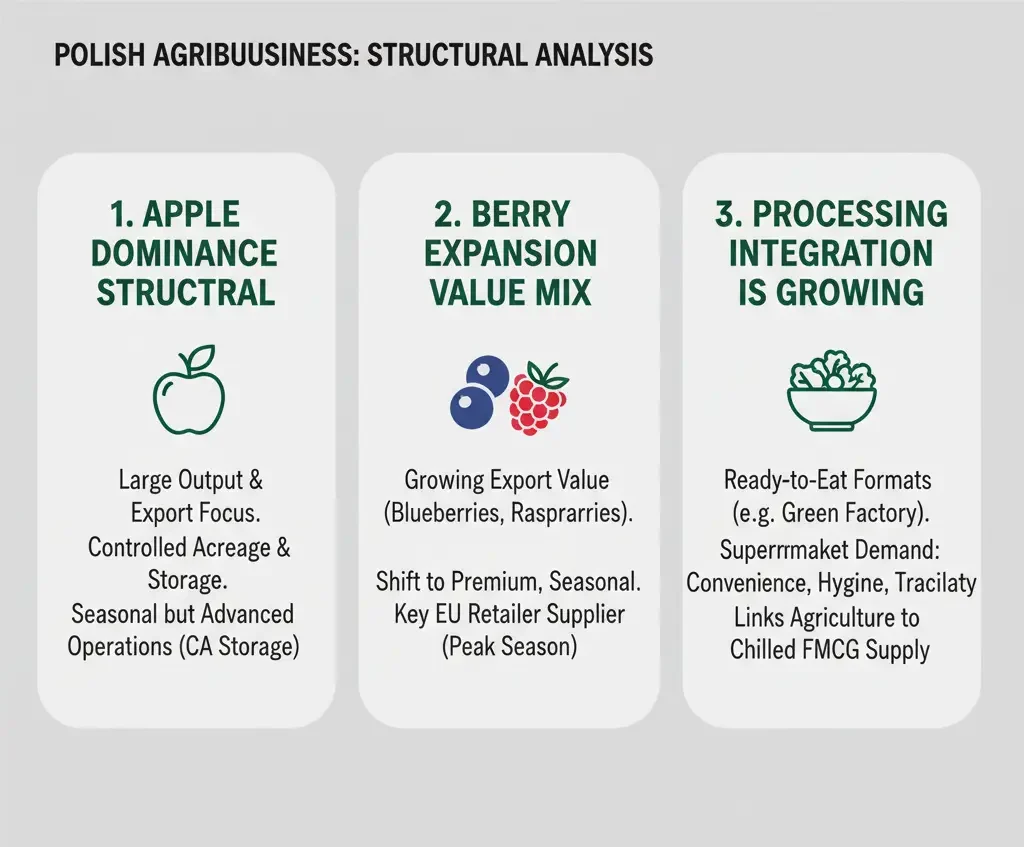
1. Apple Dominance Remains Structural
Apples account for a significant portion of Poland’s fresh fruit output. Producer groups control orchard acreage and storage infrastructure rather than operating as FMCG-style brands.
This concentration means export flows are highly seasonal. But they are operationally advanced, supported by controlled atmosphere storage systems.
2. Berry Expansion Changes Value Mix
Blueberries and raspberries are gaining export value relative to apples.
Higher margin crops shift Poland’s fresh produce profile from volume-driven toward premium seasonal categories. Retailers increasingly rely on Poland during European berry season peaks.
3. Processing Integration Is Growing
Companies such as Green Factory show a structural shift toward ready-to-eat formats.
This reflects supermarket demand for convenience, hygiene certification and traceability. It links agriculture more closely to chilled FMCG supply chains.
Industry Direction (2026 Outlook)
Poland’s fresh produce structure is evolving in three key ways:
- Increased greenhouse expansion to stabilise climate volatility
- Higher certification requirements aligned with EU retail standards
- Greater automation in sorting, grading and packaging
Labour availability and energy costs remain structural pressure points. However, export diversification beyond the EU is gradually expanding.
Market Structure Impact on Supermarkets
Polish fresh produce companies influence supermarket sourcing in Central and Western Europe through:
- Volume reliability
- Competitive pricing
- Flexible packaging formats
- EU-compliant certification systems
Supply chain efficiency, rather than brand recognition, defines competitive advantage.
Frequently Asked Questions
Which fresh produce does Poland lead on in Europe?
Poland is the largest apple producer in the European Union. It is also Europe’s leading mushroom exporter and one of its leading blueberry producers.
Which is the largest Polish fresh produce company by employees in this ranking?
Citronex Fresh lists 1,000+ employees, followed by Amplus with 800+. Employee figures include seasonal labour where applicable.
How is Poland’s fresh produce sector changing in 2026?
It is evolving through greenhouse expansion, higher certification requirements and greater automation in sorting, grading and packaging. Labour availability and energy costs remain pressure points.
Conclusion
Poland’s leading fresh produce companies in 2026 are defined by structural production scale, cooperative integration and export alignment. Brand-driven revenue visibility matters less.
Apples remain dominant. But berries, mushrooms and greenhouse crops are reshaping value distribution across the national supply base.
For Poland supermarket networks, stable volume and year-round storage capacity remain critical sourcing factors. Producer groups that control orchard acreage and cold-chain infrastructure are increasingly central to retail procurement strategies.
Across the wider Poland FMCG ecosystem, fresh categories are becoming more closely linked with packaging standards, traceability systems and logistics automation.
As compliance expectations rise across the EU, operational depth and export diversification will matter most. They will determine which producers retain structural influence within Poland’s fresh produce system.
Editor’s Note: This ranking is based on publicly available company disclosures, producer group information and sector data for FY2024–FY2025 where available. Employment figures may include seasonal workers. No currency conversion was required as revenue data was not uniformly disclosed.