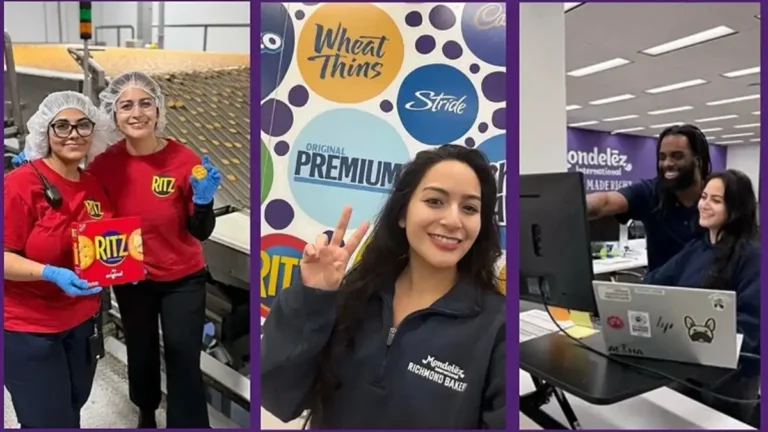

Maddy Hamrick, Productivity Lead at Mondelēz, has outlined how productivity roles inside food manufacturing are increasingly moving beyond day-to-day problem solving toward long-term, cross-functional improvement work across production sites.
Hamrick, who started at Mondelēz four years ago as a Process Engineer on the Ritz production line, said her early experience in manufacturing gave her a strong understanding of plant operations, equipment flow and on-the-ground production challenges.
In her current role, she works across engineering, operations, maintenance and supply chain teams to identify inefficiencies and support broader productivity improvements across US manufacturing sites.
She said productivity is not only measured through cost savings, but also through how effectively teams collaborate to implement change.
“People are at the heart of productivity, and successful initiatives require their engagement and commitment,” she said.
Her progression from process engineering to productivity leadership reflects a wider shift in FMCG manufacturing, where companies are increasingly focusing on standardisation, cross-site learning and long-term efficiency gains rather than isolated plant-level fixes.
Mondelēz’s internal culture also played a key role in her development, with Hamrick describing an environment that encourages collaboration, capability building and continuous improvement across teams.
She added that discomfort often signals progress, highlighting how stepping outside routine work is essential for driving operational change and personal growth in manufacturing roles.
Why This Matters
This shift matters because FMCG manufacturers in the US FMCG sector are under increasing pressure to improve efficiency without large-scale restructuring or cost-driven disruption. Companies like Mondelēz are relying more on internal productivity leadership roles to connect engineering, operations and supply chain decisions into a single improvement system.
It also reflects a broader industry trend where manufacturing performance is no longer driven only by automation or investment, but by how effectively people across functions work together to reduce waste, standardise processes and scale improvements across multiple sites in US FMCG manufacturing environments.
For the wider FMCG sector, this approach signals a gradual move toward people-led productivity models, where workforce capability and collaboration are becoming as important as machinery and production capacity.
Editor’s Note: This article is based on a corporate feature published by Mondelēz on April 17, 2026, highlighting the career journey and insights of Productivity Lead Maddy Hamrick.