
British apple and pear sales to UK supermarkets reached a record 180,506 tonnes in the 2025/26 season, up 10.4% year on year, as growers warned that difficult weather has made the incoming 2026 crop more expensive to produce and harvest.
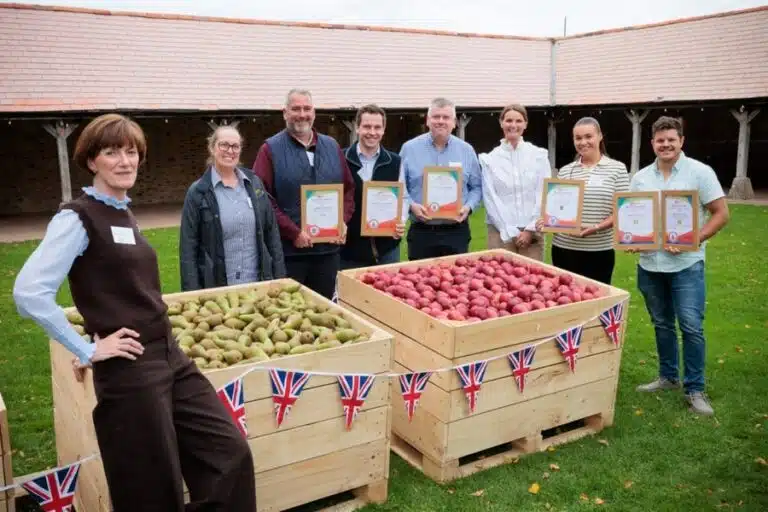
British Apples & Pears Limited (BAPL), which represents UK commercial apple and pear growers, confirmed the figures at its annual orchard event in Kent on 16 September. The organisation published its latest crop update on 17 September.
The record volume gives supermarket buyers a clear signal that shopper demand for British top fruit remains strong. But BAPL said frost, hail, sunscorch and drought have increased pressure on growers during the 2026 season, raising the importance of profitable returns if orchards are to keep investing in future production.
Record Demand Meets 2026 Production Pressures
BAPL members supplied 162,331 tonnes of British apples during 2025/26, an increase of 8.6% from the previous season. Pear sales rose more sharply, increasing 29.3% to 18,175 tonnes, their highest level since 2018/19.
The result is commercially significant because the new 2026 crop is arriving after a difficult growing season. BAPL Executive Chair Ali Capper said frost, hail, sunscorch and drought had made this year’s fruit more costly to grow and harvest.
For supermarket buying teams, that creates a familiar but increasingly important tension. Demand for British-grown fruit is rising, but growers need sufficient returns to justify orchard investment, labour, storage and crop protection costs.
GTN’s analysis of apple brands sold through UK supermarkets has previously highlighted the investment challenge facing domestic orchards. BAPL has argued that continued planting is essential if the sector is to maintain production capacity over the longer term.
Supermarket Battlegrounds: Tesco, Aldi, Sainsbury’s and Lidl
The 2025/26 season also produced one of the closest retailer battles in British apple sales for more than a decade.
| Retailer / Category | Market Leader / Winner | Key Metric / Volume |
|---|---|---|
| Top Apple Sales | Tesco, narrowly ahead of Aldi | 34,436 tonnes versus Aldi’s 34,246 tonnes |
| Top Pear Sales | Sainsbury’s | 6,012 tonnes, up 13.7% |
| Apple Outperformance | Aldi | 21.2% of measured British apple sales versus 10.5% average grocery market share |
| Pear Outperformance | Lidl | 18.9% of measured British pear sales versus 8.3% average grocery market share |
Tesco edges Aldi by just 190 tonnes
Tesco recorded the highest British apple sales at 34,436 tonnes, only 190 tonnes ahead of Aldi at 34,246 tonnes. BAPL said the gap was the smallest between the two retailers in 13 years.
The narrow margin matters because Aldi’s result was also a record for the discounter, underlining how aggressively British apples are now being used across both mainstream and discount grocery retail.
Sainsbury’s leads British pear sales
Sainsbury’s led British pear sales with 6,012 tonnes, an increase of 13.7% on the previous season. It also recorded the strongest early-season pear sales, with 847 tonnes sold during September and October 2025.
Lidl led early-season British apple sales, selling 4,313 tonnes during the same two-month period. Strong early-season availability is commercially important because September and October set the tone for shopper awareness and promotional momentum as the domestic crop reaches stores.
Aldi and Lidl outperform their grocery market share
BAPL’s new Market Outperformance awards compare each retailer’s share of British apple or pear sales with its share of the overall grocery market.
Aldi accounted for 21.2% of British apple sales among retailers included in the analysis against an average grocery market share of 10.5%, producing an outperformance index of 2.02.
For British pears, Lidl accounted for 18.9% of measured sales against an average grocery market share of 8.3%, giving it an outperformance index of 2.28.
The results suggest that British provenance can carry particular commercial weight for discounters when supported by sufficient shelf space, promotional activity and seasonal availability.
What the 2026/27 Season Means for Grocery Buyers
The wider UK fresh produce supply chain is already under pressure to improve resilience while controlling labour, energy, logistics and sustainability costs.
BAPL used the Kent event to stress collaboration across growers, packers and retailers. The organisation said profitable returns are important if growers are to continue investing in orchards, technology and more sustainable production.
The event, hosted by Mansfields, part of the greosn group, at The Night Yard near Canterbury, also included an orchard tour showing the 2026 harvest and technology being used in British apple production.
For supermarket buyers, the immediate task is to turn the record demand achieved in 2025/26 into another strong British season without weakening the grower economics behind future supply.
That will make autumn and winter ranging decisions particularly important. Retailers that secure adequate British volumes early, support visible seasonal launches and maintain commercially sustainable supplier margins may be better placed to avoid tighter availability or supply bottlenecks later in the season.
Strong sales alone will not determine the long-term direction of the category. The returns growers receive from the 2026/27 season will influence whether they have the confidence to reinvest in orchards, storage, technology and future British supply.
Source: British Apples & Pears Limited, 16-17 September 2026.