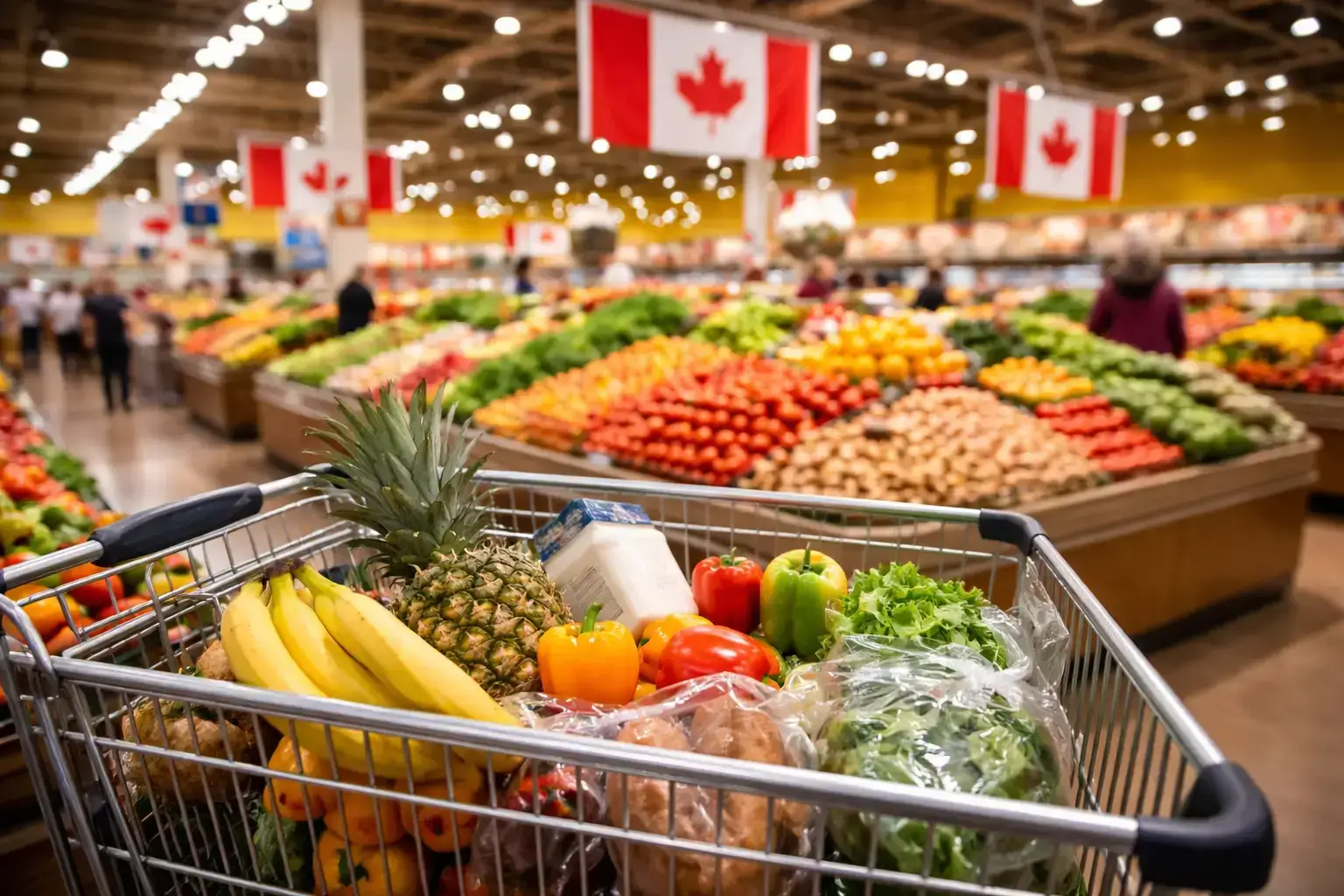

Food prices remain sensitive in Canada.
Consumers still feel pressure at checkout.
At the same time, grocery retailers continue reporting billions in annual sales.
So how much profit do Canadian grocery stores actually make in 2026?
The answer is smaller — and more complex — than headlines suggest.
How much profit do grocery stores in Canada make?
Most Canadian grocery retailers earn between 2% and 4% net profit margin on total sales. That means for every CAD 100 in groceries sold, only CAD 2 to CAD 4 remains as net income after paying suppliers, wages, rent, logistics, and taxes.
Margins are thin. Volume drives sustainability.
Canada’s grocery industry generates more than CAD 115 billion annually.
The sector is dominated by five major groups that shape pricing, supply chains and competition across the country. A detailed breakdown of Canada’s largest operators can be found in our analysis of the top grocery stores in Canada.
But grocery is a low-margin business built on scale and efficiency.
Profit stability depends on:
-
Private label growth
-
Supply chain control
-
Shrink management
-
Labour productivity
-
Buying power
In 2026, regulatory oversight now plays a role too.
What “Profit” Actually Means in Grocery
Many public debates confuse financial terms.
There are three key measures.
1. Gross Margin
Revenue minus cost of goods sold.
2. Operating Margin
Profit after store wages, rent, logistics and overhead.
3. Net Margin
Final earnings after interest and tax.
Most supermarket chains operate with 2–4% net margin.
That is structurally normal for food retail.
Snapshot: Profit by Retail Model (2026)
| Model | Typical Net Margin | Main Driver |
|---|---|---|
| Traditional Supermarket | 2–4% | Private label + scale |
| Discount Banner | 1.5–3% | High volume |
| Big-Box Hybrid | 3–5% blended | Cross-category sales |
| Warehouse Club | 2–3% retail + membership | Fee income |
Different models produce different profit patterns.
Why Grocery Margins Stay Thin
Food retail faces constant cost pressure.
-
Perishable goods create waste risk
-
Price comparison is instant
-
Promotions are frequent
-
Labour is rising
-
Theft remains elevated
-
Canada’s geography increases logistics cost
Retailers cannot raise prices freely without losing traffic.
Competition keeps margins contained.
Is grocery retail highly profitable in Canada?
No. Grocery retail is considered a low-margin industry. Net profit margins typically range between 2% and 4%, significantly lower than banking, technology, or luxury retail. Grocery companies rely on volume, operational efficiency, and repeat purchases rather than high markups.
Where Grocery Profit Comes From
Traditional supermarket groups stabilise earnings through:
-
Private-label brands
-
Pharmacy integration
-
Loyalty ecosystems
-
Financial partnerships
-
Automation in distribution
Private label plays a central role.
Store brands carry higher margin than national brands.
Automation lowers long-term cost per case handled.
But capital investment is heavy.
Distribution centres now require robotics, forecasting software, and energy-efficient systems.
Short-term pressure. Long-term resilience.
Discount Retail: Volume Over Margin
Discount formats win traffic in inflation cycles.
They operate with:
-
Limited SKUs
-
Lean staffing
-
Faster turnover
Margins are thinner than full-service supermarkets.
Profit depends on traffic density.
Price wars compress returns across the sector.
Big-Box Hybrid Retailers
Big-box operators combine food with general merchandise.
This creates blended margin strength.
Food may deliver thin margins.
Non-food categories can offset volatility.
Diversification smooths earnings.
However, fresh food management increases operational complexity.
Warehouse Membership Model
Warehouse retailers operate differently.
Retail margins are very low.
Membership income stabilises profit.
| Revenue Source | Stability Level |
|---|---|
| Retail Sales | Moderate |
| Membership Fees | High |
| Limited SKU Turnover | High |
High renewal rates protect predictable income streams.
This reduces exposure to price volatility.
The Grocery Code of Conduct: A 2026 Turning Point
In 2026, profit discussions changed.
Canada formally implemented the Grocery Code of Conduct.
This framework aims to rebalance relationships between large retailers and suppliers.
It does not cap retail profit.
It regulates commercial fairness.
The Code focuses on:
-
Transparent fees
-
Clear payment timelines
-
Limits on unilateral contract changes
-
Formal dispute resolution
The 2026 implementation of the Grocery Code of Conduct aims to balance these margins between retailers and suppliers.
This matters because margin pressure often flows upstream.
If supplier recovery improves, retailer operating flexibility tightens.
What is Canada’s Grocery Code of Conduct?
Canada’s Grocery Code of Conduct is a 2026 regulatory framework designed to ensure fair trading practices between grocery retailers and suppliers. It improves transparency, limits unexpected fees, and establishes dispute resolution mechanisms without directly controlling retail pricing.
How the Code Affects Profit
Short term:
-
Procurement systems adjust
-
Supplier negotiations become more structured
-
Margin flexibility may narrow
Long term:
-
Supply disputes decline
-
Payment predictability improves
-
Commercial risk stabilises
Profit becomes more governed.
Not necessarily smaller. But more structured.
Public Perception vs Financial Reality
Consumers see:
Higher food bills.
Financial statements show:
Stable margin percentages.
Revenue can grow during inflation even if margin remains constant.
This creates the perception of excess profit.
Percentage margin is the true measure.
Profit Compared to Other Industries
| Industry | Average Net Margin |
|---|---|
| Grocery Retail | 2–4% |
| Banking | 20%+ |
| Technology | 15–25% |
| Luxury Retail | 10–20% |
Grocery is structurally lower-margin than most sectors.
It compensates with volume.
E-Commerce and Margin Pressure
Online grocery remains under 10% of total sales.
Delivery reduces margin due to:
-
Picking labour
-
Transport cost
-
Substitution loss
Click-and-collect performs better than home delivery.
Automation in fulfilment centres improves long-term efficiency.
But last-mile delivery remains expensive in Canada.
Where Profit Is Most Vulnerable in 2026
Three pressure points dominate.
Labour
Wage increases directly affect store-level margins.
Shrink
Retail theft and waste compress operating income.
Discount Expansion
Aggressive price competition reduces sector-wide margin.
What Protects Profit in 2026
Margin stability comes from:
-
Private label growth
-
Distribution automation
-
Energy efficiency upgrades
-
Data-driven pricing
-
Pharmacy integration
Productivity replaces pricing as the main driver.
Why are grocery prices high if margins are low?
Grocery prices can rise even when profit margins remain stable because food inflation increases supplier costs and total revenue. Retailers may generate higher total sales during inflation, but their percentage profit margin often stays within the typical 2–4% range.
Outlook: Profit in a Slower Growth Environment
Canada’s grocery market is stabilising.
Inflation is moderating.
Revenue growth is slowing.
Regulatory oversight has increased.
Canada’s grocery market remains highly concentrated, with five major operators accounting for most national food sales. Those five companies — Loblaw, Sobeys, Metro, Walmart and Costco — define the structure of Canadian food retail. Their scale and strategy are examined in our overview of Canada’s biggest grocery chains.
The profit story in 2026 is no longer about expansion through price.
It is about operational precision.
Retailers that:
-
Control shrink
-
Invest in automation
-
Expand private label
-
Optimise digital fulfilment
-
Adapt to the Grocery Code framework
will protect margin.
Those relying purely on price leverage will struggle.
Grocery profit in Canada remains thin.
But it remains durable.
Low margin.
High volume.
Governed by efficiency.
And in 2026, increasingly shaped by regulation.
Editorial Note
This analysis is based on publicly available financial filings, annual reports, investor presentations and earnings releases from major Canadian grocery retailers, alongside regulatory documentation related to the 2026 implementation of the Grocery Code of Conduct. Revenue and margin ranges reflect the most recent fiscal reporting available at the time of publication.