
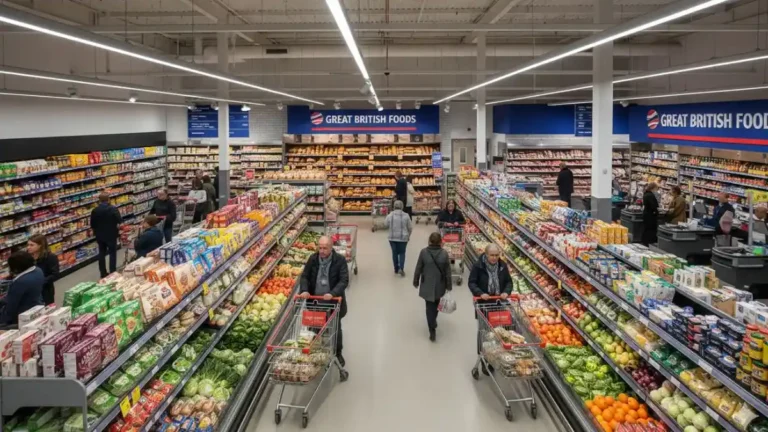

The United Kingdom grocery market remains one of Europe’s largest and most structurally concentrated retail systems.
Total food and grocery sales exceed £230 billion a year. The top operators control most spending across supermarkets, convenience, online fulfilment and wholesale-linked formats.
Inflation pressures eased through 2024, but cost structures remain high. Labour costs increased after changes to National Insurance contributions from April 2025.
Several other forces continue to shape competitive positions:
- energy volatility
- private label expansion
- aggressive promotional activity
In this environment, revenue scale remains the clearest indicator of structural power.
This ranking of UK supermarkets by revenue is based on the most recent full-year financial disclosures (FY2024–FY2025 where available). Figures reflect reported turnover and follow each company’s fiscal calendar.
Revenue Ranking Overview
| Rank | Company | Latest Reported Revenue | Fiscal Year | Employees | Core Strength |
|---|---|---|---|---|---|
| 1 | Tesco | £61.47bn | FY2024 | ~330,000 UK | Full-line supermarket leader |
| 2 | Sainsbury’s | £32.7bn | FY2024 | ~148,000 | Supermarket + convenience |
| 3 | Asda | £21.7bn | FY2024 | ~145,000 | Value-led full-line retail |
| 4 | Aldi UK | £17.9bn | FY2023* | ~43,000 | Discount supermarket |
| 5 | Morrisons | £15.28bn | FY2024 | ~110,000 | Vertically integrated grocer |
| 6 | Lidl GB | £11.0bn | FY2024 | ~32,000 | Hard discount format |
| 7 | Co-op Food | £11.3bn (Group Food) | FY2024 | ~60,000 | Convenience retail |
| 8 | Waitrose | £8.0bn | FY2024 | ~45,000 | Premium supermarket |
| 9 | M&S Food | ~£7bn (Food division) | FY2024 | ~65,000 group | Food-led retailer |
| 10 | Iceland Foods | £4.1bn | FY2025 | ~30,000 | Frozen food specialist |
*Aldi UK’s latest published turnover reflects FY2023 at time of writing.
1. Tesco
Founded: 1919
Headquarters: Welwyn Garden City
Scale and position
Tesco remains the largest supermarket operator in the UK by revenue and market share. Turnover exceeded £61 billion in its FY2024 financial year, giving it significant dominance across grocery retail.
Tesco is also using frozen innovation to widen customer choice. Its addition of four Impossible Foods products to selected UK freezers gives the plant-based brand a new supermarket route to market.
Core categories:
- Fresh food
- Ambient grocery
- Private label (including Finest and Everyday Value tiers)
- Online grocery
- Wholesale (Booker integration)
Operations and strategy
Tesco operates thousands of UK stores across Extra, Superstore, Express and One Stop formats.
The integration of Booker continues to strengthen wholesale and convenience reach. It also tightens supply chain control across independent retailers.
Tesco’s scale influences packaging procurement, supplier negotiation leverage and private label development across categories. The retailer has one of the largest private label portfolios in Europe.
Strategically, Tesco has prioritised:
- price investment
- loyalty-led personalisation through Clubcard
- continued automation in distribution centres
2. Sainsbury’s
Founded: 1869
Headquarters: London
Sainsbury’s reported £32.7 billion in turnover in FY2024. This makes it the UK’s second-largest supermarket by revenue.
Core categories:
- Full-line supermarket retail
- Convenience (Local format)
- Online grocery
- General merchandise (Argos integration)
The acquisition of Argos continues to shape multi-channel strategy. Grocery remains the main revenue driver.
Sainsbury’s keeps a balanced estate of supermarkets and convenience stores, which strengthens urban coverage.
The business is investing in cost savings programmes. It is balancing price competitiveness with brand positioning.
3. Asda
Founded: 1949
Ownership: Issa brothers and TDR Capital
Asda generated about £21.7 billion in revenue in FY2024.
Core categories:
- Large-format supermarket
- Value private label
- George clothing
- Pharmacy and health
Asda’s large hypermarket-style formats provide broad general merchandise exposure alongside grocery.
Recent refinancing activity and debt restructuring reflect the company’s focus on its capital structure. It continues to reposition in price-led segments as discounters expand market share.
4. Aldi UK
Founded in UK: 1990
Parent: Aldi Süd
Aldi UK recorded revenue of £17.9 billion in FY2023. The retailer continues rapid estate expansion, with nearly 30 stores due to open or relocate before Christmas 2026.
Core categories:
- Limited assortment grocery
- Private label dominant model
- Fresh produce focus
Aldi’s operating model is built on SKU simplification, lean logistics and strong own-brand penetration.
The retailer plans significant expansion towards 1,500 UK stores in the long term.
Discount-led formats continue to put structural pressure on mid-market operators.
5. Morrisons
Founded: 1899
Ownership: Clayton, Dubilier & Rice (CD&R)
Morrisons reported £15.28 billion turnover in FY2024.
Core categories:
- Fresh food manufacturing
- Supermarket retail
- Convenience (Morrisons Daily)
Unlike most competitors, Morrisons keeps vertical integration in fresh manufacturing. It runs food production sites that supply its own stores.
This integration gives supply chain resilience but needs heavy capital investment.
Strategic focus includes convenience expansion and wholesale supply agreements.
6. Lidl GB
Entered UK: 1994
Parent: Schwarz Group
Lidl GB reported £13 billion in turnover for the year ended 28 February 2026. Its latest UK results show operating profit reaching £345 million as shopper visits and product volumes increased.
Core categories:
- Discount grocery
- High private label penetration
- Seasonal promotional cycles
Lidl continues aggressive estate growth and capital investment in distribution.
The Schwarz Group’s broader European scale supports sourcing leverage.
7. Co-op Food
Founded: 19th century cooperative movement
The Co-operative Group reported £11.3 billion in food retail revenue in FY2024.
Core categories:
- Convenience grocery
- Community retail
- Own-label products
The Co-op’s estate is heavily weighted towards smaller urban and neighbourhood formats.
The model puts accessibility ahead of hypermarket scale.
Co-op’s appointment of Alex Dower to lead food retail on 2 October 2026 places its store estate and quick-commerce operation under a new managing director.
Convenience density gives Co-op last-mile presence in areas underserved by large-format chains.
For a more recent trading update, Co-op’s first-half 2026 results show how investment in member pricing and quick commerce is affecting its food retail business.
8. Waitrose
Founded: 1904
Ownership: John Lewis Partnership
Waitrose reported £8.0 billion revenue in FY2024.
Core categories:
- Premium grocery
- Fresh and prepared foods
- Branded and speciality products
Waitrose keeps premium positioning and strong brand equity.
Its strategy stresses quality differentiation rather than price-led competition.
9. M&S Food
Founded: 1884 (Food division modern expansion)
Marks & Spencer’s Food division generated about £7 billion in FY2024.
Core categories:
- Prepared meals
- Fresh food
- Premium convenience
M&S has reshaped its estate through partnerships with Ocado in online grocery.
Food now represents a structural growth engine within the group.
10. Iceland Foods
Founded: 1970
Iceland reported turnover of £4.1 billion in FY2025.
Core categories:
- Frozen food
- Private label
- Value grocery
Iceland operates under both Iceland and The Food Warehouse formats.
The company keeps a distinct frozen-focused retail identity within the UK grocery system.
Market Structure Impact
The top ten supermarket operators account for most UK grocery sales.
The “Big Four” historically dominated the market:
- Tesco
- Sainsbury’s
- Asda
- Morrisons
However, discounters Aldi and Lidl continue to expand their share.
Convenience density through Co-op and symbol groups supports neighbourhood access. Premium positioning via Waitrose and M&S Food sustains category diversity.
Category Dominance Trends
Private label penetration remains structurally high.
Discounters operate almost entirely on own-brand models. Full-line supermarkets increasingly expand tiered private label ranges to defend margins.
Fresh produce, ready meals and value lines continue to shape category competition.
Online grocery penetration remains significant but has stabilised after pandemic-driven peaks.
Structural Outlook
Estate expansion continues among discounters.
Cost pressures linked to wage legislation and supply chain restructuring may influence pricing strategy. GTN’s latest UK food inflation update for August 2026 tracks the current price environment facing retailers and suppliers.
Investment in automation, distribution efficiency and data analytics will shape long-term profitability.
The UK supermarket landscape remains highly concentrated, but format diversification continues.
Frequently Asked Questions
What is the biggest UK supermarket by revenue?
Tesco is the largest UK supermarket by revenue and market share. It reported £61.47bn in FY2024.
Who are the “Big Four” UK supermarkets?
The Big Four are Tesco, Sainsbury’s, Asda and Morrisons. They historically dominated the market, but discounters Aldi and Lidl continue to expand share.
How big is the UK grocery market?
Total UK food and grocery sales exceed £230 billion a year. The top ten operators account for most of this spending.
Conclusion
The ranking of UK supermarkets by revenue reflects a mature but competitive retail system. Scale, logistics control and private label strength decide structural leadership.
Tesco remains dominant in revenue terms, while discounters continue reshaping market share. Convenience and premium operators keep distinct positions within the wider market.
This concentration of revenue reaches beyond store estates. It influences supplier negotiations, private label development and procurement standards across the wider UK FMCG manufacturing base.
Supermarket scale also directly affects demand planning, sustainability targets and compliance requirements. This applies across uk private label development and sourcing within the UK grocery supply chain.
The UK grocery sector enters 2026 with margin discipline, expansion momentum and structural competition across formats.
Editor’s Note: All financial information in this article is based on publicly available company annual reports and disclosures for FY2023–FY2025 where available. Revenue figures reflect reported turnover aligned to each company’s fiscal calendar. Where division-level estimates are referenced, they are derived from published segment reporting.








