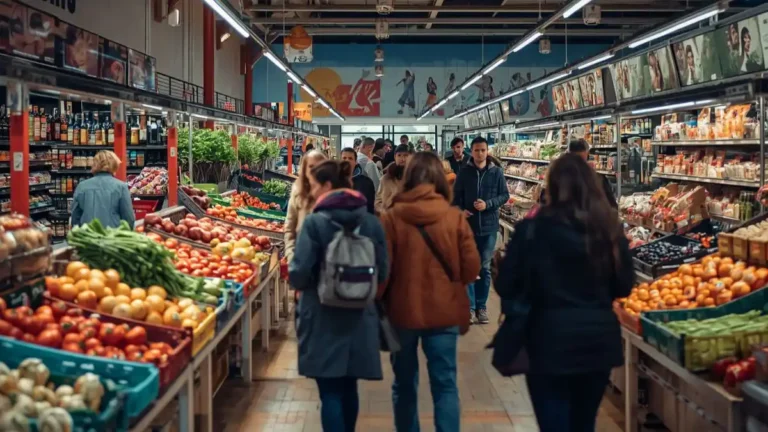

Lithuania’s supermarket sector has become one of the Baltic region’s most competitive grocery markets.
Discounters continue expanding, and private label penetration is rising. Retailers are under growing pressure to balance:
- pricing
- logistics costs
- energy expenses
- changing shopper behaviour
The market is now heavily concentrated around a handful of powerful operators led by Maxima, Lidl, IKI and Norfa. Meanwhile, regional chains continue defending local strongholds through convenience formats and community-level retail networks.
At the same time, Lithuania’s position inside wider Baltic and European FMCG supply chains is strengthening.
Heading into 2027, retailers are investing more heavily in private label sourcing, store modernisation, urban convenience formats and regional distribution efficiency.
At a Glance
| Rank | Company | FY Revenue | Strategic Role |
|---|---|---|---|
| 1 | Maxima | ~€2.18B | Market leader |
| 2 | Lidl Lietuva | ~€889M | Discount expansion |
| 3 | IKI | ~€860–890M | Urban convenience |
| 4 | Norfa | ~€750–820M | Price-first retail |
| 5 | Rimi Lietuva | ~€450–480M | Premium supermarket |
| 6 | Aibė | ~€450M | Cooperative network |
| 7 | Šilas | ~€75–85M | Kaunas regional chain |
| 8 | Čia Market | ~€48–55M | Western Lithuania retail |
| 9 | Express Market | ~€40–50M | Small urban format |
| 10 | Grūstė | ~€25–35M | Northern Lithuania chain |
1. Maxima
Founded in 1992, Maxima remains the dominant force inside the Lithuania supermarket sector.
The retailer operates roughly 250 stores. These range from compact neighbourhood outlets to large hypermarket-style formats.
Ownership and scale
The business is owned by Vilniaus Prekyba, one of the largest corporate groups in the Baltic region.
Its scale gives the company major pricing power across supplier negotiations, logistics operations and private label procurement.
Competitive advantage
Maxima’s biggest competitive advantage is footprint density. Few retailers in Lithuania can match its ability to operate at once in urban centres, secondary towns and smaller regional communities.
As competition from discount chains intensifies, the retailer continues strengthening digital loyalty systems, fresh food categories and localised assortment strategies.
2. Lidl
Lidl entered Lithuania comparatively late, in 2016. But its expansion has been extremely aggressive.
Backed by Germany’s Schwarz Group, Lidl Lietuva has rapidly grown into one of the country’s most important grocery retailers. Its estimated revenue is approaching €889 million.
What drives its growth
Its growth has been heavily driven by:
- discount positioning
- simplified store operations
- high private label penetration
Lidl’s operational model fits current inflation-sensitive shopper behaviour extremely well.
Lithuanian consumers remain highly price conscious. This is especially true in food categories, where energy and logistics inflation keep pressuring household spending.
The retailer has also pushed competitors to improve pricing visibility, promotional cycles and efficiency across supply chains.
3. IKI
IKI’s new Vilnius store in a €6 million development adds a large-format location at Tunelio Street, with Tewox confirming the property investment and long-term lease on 8 October 2026.
IKI was originally founded by the Belgian Ortiz brothers in 1992. It later became part of Germany’s REWE Group through Palink.
The chain now operates around 240 stores and remains one of Lithuania’s strongest urban supermarket operators.
Market positioning
IKI does not follow Lidl’s heavy discount model. Instead, it focuses more aggressively on:
- convenience
- fresh food
- prepared meals
- bakery categories
- inner-city retail density
That positioning matters more and more in larger Lithuanian cities. Fast shopping trips and compact convenience formats continue gaining share there.
IKI has also stayed active in modernising store layouts. It is strengthening customer retention through digital loyalty ecosystems and assortment localisation.
The wider Lithuania FMCG market is seeing stronger competition around convenience retail. Urban shoppers increasingly prioritise speed, proximity and fresh ready-to-eat categories.
4. Norfa
Norfa has become one of Lithuania’s strongest locally controlled supermarket groups.
It was founded in 1997 and is owned by businessman Dainius Dundulis. The retailer operates a vertically integrated structure tied closely to Rivona, its logistics and manufacturing arm.
Why vertical integration matters
That vertical integration gives Norfa stronger control than many competitors over procurement, processing, transportation and inventory management.
The company remains especially strong in regional towns and rural retail markets, where price sensitivity is extremely important.
Norfa’s model also reflects broader pressure inside the Lithuania private label sector. Retailers increasingly seek tighter supply-chain control to protect margins against energy and sourcing volatility.
5. Rimi
Rimi Lietuva continues operating as one of the country’s most recognisable supermarket brands.
The company traces its Lithuanian roots back to 1996. It went through a major ownership change in 2025, when Denmark’s Salling Group acquired it from ICA Gruppen.
Market positioning
Rimi positions itself differently from hard discounters. The retailer focuses more heavily on premium grocery presentation, customer experience, e-commerce development and urban supermarket operations.
This premium positioning gives it a more differentiated role inside Lithuania’s grocery market, especially among higher-income urban consumers.
Rimi also continues investing in digital retail systems and omnichannel grocery operations as Baltic online grocery competition slowly expands.
6. Aibė
Aibė operates differently from most major supermarket chains in Lithuania.
It does not function as a single centralised retailer. Instead, Aibė works as a cooperative alliance connecting hundreds of independent stores across the country.
National footprint
Its network exceeds 800 locations, giving it the largest physical retail footprint nationwide.
Many of these stores are small-format village and neighbourhood outlets. They serve local communities that larger supermarket groups may find hard to operate efficiently.
Aibė remains operationally important because it acts as a regional grocery logistics backbone. This covers smaller municipalities and rural Lithuania supermarket networks.
7. Šilas
Šilas remains one of Lithuania’s strongest regional supermarket specialists.
The company focuses heavily on the Kaunas metropolitan area and operates about 30 stores.
Šilas has not attempted nationwide expansion. Instead, it has concentrated on defending local convenience territory through neighbourhood-level retail density and strong regional familiarity.
That localised operating structure has allowed smaller Lithuanian supermarket businesses to survive. They have done so despite consolidation pressure from multinational grocery operators.
8. Čia Market
Čia Market traces its origins back to 1996. It later rebranded from Žemaitijos Prekyba in 2011.
The retailer keeps a strong presence across Western Lithuania and smaller municipalities.
Its operating model avoids direct large-scale competition with hypermarket operators. Instead, the business focuses on compact grocery formats positioned close to residential communities.
This type of regional retail specialisation continues to play an important role across the wider Lithuania supermarket ecosystem.
9. Express Market
Express Market focuses heavily on fast urban shopping missions.
The retailer operates smaller-footprint stores. These are optimised for quick convenience purchases, grab-and-go traffic and high-density city shopping patterns.
This convenience-first strategy reflects broader changes in Baltic grocery retail. Shoppers increasingly prioritise speed and accessibility over large weekly basket trips.
Urban convenience retail is expected to remain one of the fastest-changing areas of the Lithuania retail technology and supermarket sector over the next few years.
10. Grūstė
Grūstė operates mainly across Northern Lithuania, with a concentration around Mažeikiai and surrounding municipalities.
Founded in 1992, the company combines supermarket operations with wholesale and catering activities.
Its diversified operating structure gives the retailer more flexibility than many smaller independent supermarket businesses.
Regional operators like Grūstė continue to play an important role in maintaining grocery access across less densely populated areas.
Industry Outlook
Lithuania’s grocery market is expected to remain highly competitive through 2026 and 2027.
Three structural pressures are shaping the sector most heavily:
- discount retail expansion,
- private label growth,
- and supply-chain cost management.
Retailers are increasingly investing in:
- logistics efficiency
- refrigeration upgrades
- automation systems
- digital loyalty tools
- localised assortment strategies
The wider Lithuania FMCG ecosystem is also becoming more integrated with Baltic regional distribution systems and European sourcing networks.
That trend is likely to increase consolidation pressure on smaller independent operators over time.
At the same time, regional grocery specialists still keep advantages in local convenience retail, community relationships and flexible neighbourhood operations.
Frequently Asked Questions
Which is the largest supermarket chain in Lithuania?
Maxima is the market leader, with FY revenue of about €2.18B. Founded in 1992, it operates roughly 250 stores and is owned by Vilniaus Prekyba.
Which supermarket network has the most stores in Lithuania?
Aibė has the largest physical retail footprint, with more than 800 locations. It works as a cooperative alliance of independent stores rather than a single centralised retailer.
Who owns Rimi Lietuva?
Denmark’s Salling Group acquired Rimi Lietuva from ICA Gruppen in 2025. Rimi traces its Lithuanian roots back to 1996.
What Happens Next
Lithuania’s supermarket sector will probably become even more concentrated over the next few years.
Large operators such as Maxima, Lidl, IKI and Norfa are likely to keep strengthening their control over national grocery turnover. They will do this through pricing scale, private label sourcing and logistics investment.
Private label manufacturing is also expected to expand further. Retailers are searching for stronger margin protection and more flexible sourcing systems.
The wider Lithuania private label and Lithuania FMCG sectors are becoming increasingly interconnected with Baltic regional distribution hubs and European supplier networks.
At the same time, smaller regional chains may face growing pressure from automation costs, energy expenses and modernisation requirements.
The supermarket groups most likely to strengthen their positions by 2027 will probably be those that can balance:
- pricing discipline
- convenience retail expansion
- logistics efficiency
- localised customer loyalty
Editor’s Note: This article was prepared using verified retailer disclosures, Baltic grocery market reporting, regional business records, and publicly available corporate information covering Lithuania’s supermarket sector during 2024–2026. Revenue figures represent estimated operational ranges based on available filings and market reporting.