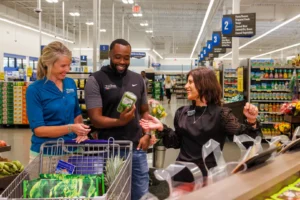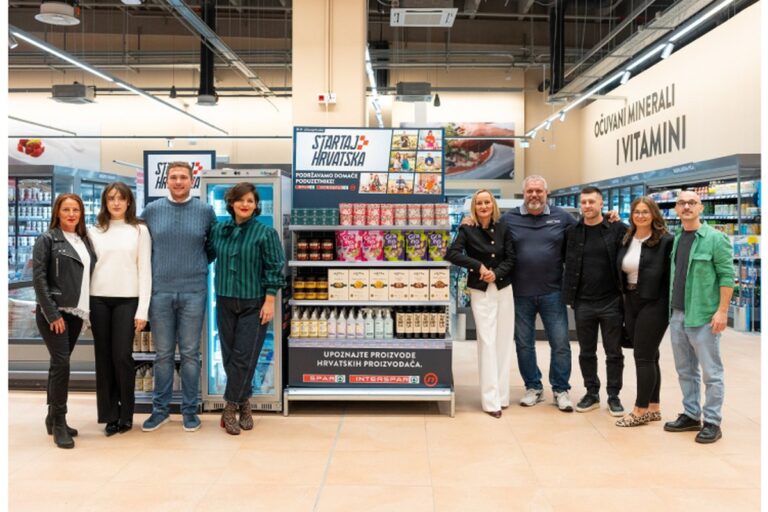

Participants at the seventh-season Startaj Hrvatska launch at INTERSPAR King Cross in Zagreb. Photo: SPAR Croatia.
SPAR Croatia has put 15 products from seven local producers onto supermarket shelves through the seventh season of Startaj Hrvatska, its business development programme with Nova TV and Ascanius Media.
The range is available in INTERSPAR hypermarkets and selected SPAR supermarkets across Croatia. Dedicated blue displays bring the participating brands together in stores. The launch was presented at the INTERSPAR hypermarket in Zagreb’s King Cross.
SPAR International published its update on 2 November 2026. Croatian reporting had already covered the launch on 28 October, ahead of the television series beginning on 8 November. The products are on sale before the broadcasts start.
Five of the seven participating brands supply food. TURINELA offers extra virgin olive oil. LOM makes vegan desserts. BUJA BUJON supplies slow-cooked stocks, while IRENKA produces pasta from grain grown by its founder. CRUNCH YOU makes granola sweetened with barley malt.
The remaining two brands are KMT, which supplies household cleaners, and SAMO ONA, whose Blue Balm is a skincare product. The 15-product total therefore spans food and non-food categories. It should not be read as 15 new food lines.
For the selected businesses, the commercial opportunity combines access to supermarket shelves with television exposure. These are two different forms of support. A product can attract interest through a broadcast, but continued retail sales depend on availability, repeat purchases and how it performs alongside established alternatives.
The programme also gives supermarket chains in Croatia a practical example of how local sourcing can be presented as a distinct part of the assortment. Bringing small brands together on one display makes them easier to find. It also gives each product a shared promotional setting, rather than leaving a new supplier to build recognition from an individual shelf position.
That approach does not make every participant a direct competitor. Olive oil, stock, pasta, granola and desserts serve different shopping needs. Category managers will need to judge each product against the appropriate range, price point and rate of sale. A shared launch cannot establish whether all five food brands will attract the same customers or deliver similar sales.
Store coverage is another important distinction. The announcement names INTERSPAR hypermarkets and selected SPAR supermarkets. It does not say that every SPAR branch carries every product. Nor does it give an exact participating-store count, wholesale prices, supplier margins or minimum order quantities.
For manufacturers, a supermarket listing also brings operational responsibilities beyond the launch itself. Production planning, replenishment, traceability and product information need to support the retail offer. The relevant food safety and supplier approval requirements depend on the product, production site and retailer’s technical specifications.
SPAR says 48 participants introduced more than 100 products during the first six seasons. That shows the programme’s cumulative reach. It does not establish how many earlier products remain listed, or provide a retention rate for participating suppliers.
The new television season will follow the entrepreneurs’ progress across eight episodes. A HIT product is due to be announced in December. The next commercial test will be how the new lines sell through the campaign and whether their suppliers can turn launch visibility into sustained demand.
Editor’s Note: Based on SPAR International’s update of 2 November 2026 and Croatian reporting published on 28–29 October. Croatian material has been translated into English. GTN distinguishes confirmed listings and programme dates from commercial terms and long-term supplier outcomes that have not been disclosed.