
A federal food safety alert involving Kroger’s premium own-brand chicken range is drawing attention to allergen controls and label verification procedures across supermarket private-label supply chains.
The U.S. Department of Agriculture’s Food Safety and Inspection Service (FSIS) has issued a public health alert for a raw chicken product sold at Kroger and Fred Meyer stores after discovering that the packaging failed to declare the presence of egg, a known allergen.
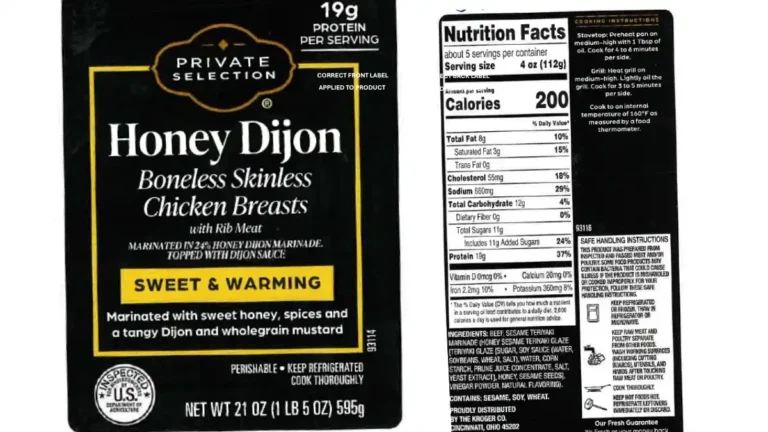
The alert covers 21-ounce vacuum-packed packages of Private Selection Honey Dijon Boneless Skinless Chicken Breasts with Rib Meat produced on 2 June 2026.
The affected products carry a “Best If Used By” date of 28 June 2026, lot code 15326A, and establishment number P-45288B.
The chicken was distributed to stores in Alabama, Alaska, Idaho, Illinois, Indiana, Kentucky, Oregon, Tennessee and Washington.
According to FSIS, the issue was identified after a retailer discovered that the correct front label had been applied to the product, but an incorrect back label containing the ingredient statement had been attached to the package.
The retailer reported the issue to the producing establishment, which subsequently notified federal food safety officials.
A formal recall was not requested because the product is no longer available for purchase. However, FSIS said some packages may still be stored in consumers’ refrigerators or freezers.
No illnesses or adverse reactions linked to the product have been reported.
Consumers who purchased the chicken are advised not to consume it and should either discard the product or return it to the place of purchase.
The product was manufactured by FW Farms LLC of Fort Worth, Texas.
The incident highlights the importance of allergen management and packaging verification procedures across private-label supply chains. As supermarket own-brand products continue to gain market share, retailers and suppliers face increasing pressure to ensure label accuracy and maintain consumer trust.
FSIS said it remains concerned that some of the affected products could still be in consumers’ homes despite no longer being available for sale.
Editor’s Note: This article is based on an official public health alert issued by the U.S. Department of Agriculture’s Food Safety and Inspection Service (FSIS) on 25 June 2026. Information includes product details, distribution states and consumer guidance provided by FSIS and FW Farms LLC.