
Belgian supermarket retailer Colruyt Group has partnered with intralogistics specialist KION Group to accelerate the development and commercial rollout of next-generation warehouse robotics, expanding the use of autonomous vehicles in grocery supply chains across Europe.
Under the agreement announced on 14 July, Colruyt Group has sold a 70% stake in its research and development activities for self-driving pallet trucks to KION while retaining a 30% share in the business. The companies will establish a dedicated research and development centre in Belgium to advance autonomous supply chain technologies and prepare them for wider deployment across Europe, the Middle East and Africa (EMEA).
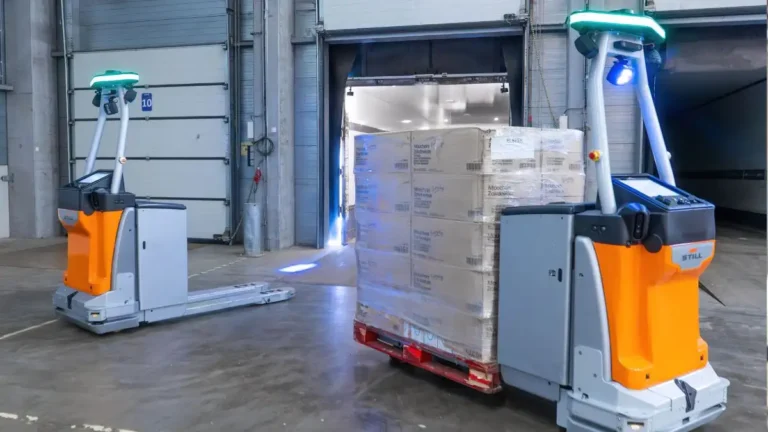
The partnership builds on several years of collaboration between Colruyt Group’s Smart Innovation team and KION brand STILL. Their jointly developed autonomous pallet trucks have already been operating in two Colruyt distribution centres since 2023, where they transport pallets alongside warehouse employees using artificial intelligence, computer vision and advanced navigation systems.
What is warehouse robotics?
Warehouse robotics refers to automated machines that assist with logistics tasks such as transporting pallets, moving goods and supporting order fulfilment. Increasingly powered by artificial intelligence and computer vision, these systems are designed to improve warehouse productivity, reduce repetitive manual work and enhance operational safety while working alongside employees.
At a glance
- Colruyt Group and KION have formed a strategic robotics partnership.
- Colruyt sold a 70% stake in its self-driving pallet truck R&D activities.
- Colruyt retains a 30% ownership interest.
- Autonomous pallet trucks have already been operating in two Colruyt distribution centres.
- The new Belgian R&D centre will develop next-generation supply chain robotics.
- KION plans to industrialise and scale the technology across EMEA markets.
- The transaction is expected to generate approximately €20 million for Colruyt Group during the 2026/27 financial year.
Why are Colruyt and KION expanding their robotics partnership?
The companies aim to move beyond pilot projects and commercialise autonomous warehouse technology on a much larger scale. While Colruyt developed the software intelligence behind the self-driving vehicles, KION brings global manufacturing capabilities, logistics expertise and an international customer network that can support large-scale deployment.
The new KION Automation Center Antwerp will become the dedicated hub for further research and product development, with engineering teams continuing to develop software that combines artificial intelligence, robotics and computer vision.
How do the autonomous pallet trucks work?
The autonomous self-driving vehicles are designed to transport pallets safely within warehouse environments while operating alongside employees. Using sensors, computer vision and AI-powered software, the vehicles can identify pallets, navigate around obstacles and optimise transport routes without requiring manual driving.
The technology allows warehouse staff to spend less time on repetitive transport tasks and focus on more specialised logistics activities.
Why does this matter for supermarket supply chains?
Supermarket distribution centres are under increasing pressure to improve efficiency while managing labour shortages, rising operating costs and growing order volumes. Automation is becoming a major investment area for grocery retailers seeking to increase warehouse productivity without compromising safety.
Unlike many robotics projects that remain in testing, Colruyt’s autonomous pallet trucks have already been used in live retail distribution centres for two years, demonstrating practical applications in everyday grocery logistics.
The partnership also reflects a wider industry trend in which retailers increasingly collaborate with technology specialists to commercialise internally developed innovations rather than keeping them exclusively for in-house operations.
What does the transaction include?
Colruyt Group transferred the majority of its research and development activities relating to self-driving pallet trucks into the new partnership while maintaining a minority ownership position.
Going forward, Smart Innovation NV will be accounted for as an associate using the equity method. Colruyt expects the transaction to contribute approximately €20 million to its consolidated income statement during the 2026/27 financial year.
Industry context
Warehouse automation continues to attract significant investment across the grocery industry as retailers modernise distribution networks to improve efficiency and resilience. Autonomous mobile robots, AI-driven inventory systems and automated pallet handling are increasingly being adopted to support faster fulfilment, reduce repetitive manual tasks and strengthen supply chain performance.
By combining Colruyt’s software expertise with KION’s manufacturing scale and global reach, the partnership aims to accelerate the commercial adoption of autonomous warehouse technologies beyond Belgium into international retail and logistics markets.
What happens next?
The new KION Automation Center Antwerp will continue developing the next generation of autonomous warehouse vehicles while preparing the technology for commercial rollout across EMEA markets. As supermarkets invest further in AI-powered distribution centres, autonomous pallet handling and warehouse robotics are expected to play an increasingly important role in improving logistics efficiency, workplace safety and supply chain resilience.
Editor’s Note: This article is based on information published by Colruyt Group and supported by details from KION Group regarding their strategic partnership to develop and commercialise next-generation supply chain robotics.