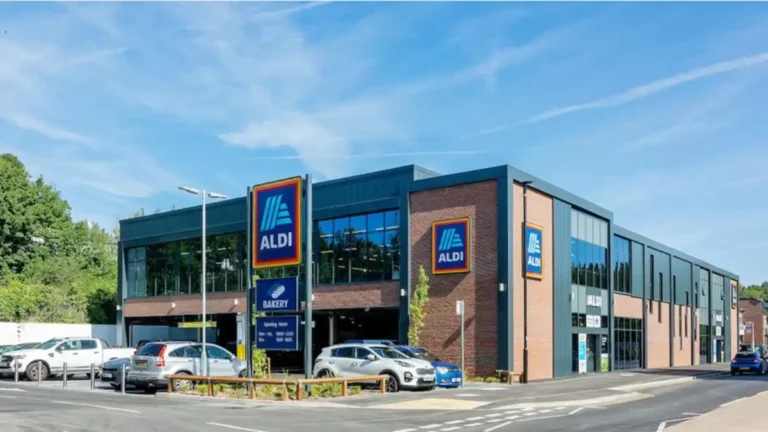

Aldi will launch a grocery delivery trial with Deliveroo at eight stores in England on 6 October, offering around 2,000 products ahead of a planned nationwide rollout in early 2027.
The partnership, announced on 24 September, will cover fresh fruit and vegetables, meat, dairy, bread, household essentials and Specialbuys. Customers will be able to order on demand or select a delivery window.
Deliveroo riders will pick, pack and deliver the orders through its new Shop & Deliver service. The arrangement follows Aldi’s partnerships with Deliveroo’s parent company, DoorDash, in the United States and Australia.
The trial will operate from stores in Ashford, Dover, Norwich, Ipswich, Letchworth Garden City, Margate, Strood and Tamworth.
Giles Hurley, chief executive of Aldi UK, said the partnership would extend access to its products “without changing how our stores operate”.
The operational change is significant. Under Aldi’s earlier Deliveroo trial, supermarket employees picked and packed orders before handing them to riders. The new model transfers the shopping task to the delivery network.
Deliveroo’s guidance says participating riders will select and scan products, pay through a virtual Rider Card and upload the receipt before completing the delivery. Shopping orders typically pay more than standard deliveries because riders undertake both tasks.
For Aldi, this could reduce the need to divert store employees from replenishment and checkout duties. Protecting those routines matters for a discount business built around efficient stores and tight cost control.
The picking cost does not disappear, however. It becomes part of the delivery arrangement, alongside payment for the journey to the customer.
Neither company has disclosed the commission split or contractual terms. Standard restaurant commission rates cannot therefore be assumed to apply to Aldi’s grocery partnership.
The financial challenge can be illustrated without treating an assumed fee as fact. A hypothetical 20% platform charge on a £40 basket would equal £8. Aldi’s reported operating margin for 2024 was 2.4%, equivalent to 96p on £40 of revenue.
These figures measure different things: a company-wide operating margin is not the contribution earned on an individual order, and 20% is not a disclosed Aldi charge. The comparison nevertheless shows why negotiated fees, fulfilment costs and additional sales will determine whether the service is commercially sustainable.
Aldi says its products on Deliveroo will be priced below those of other supermarkets offering rapid delivery. That does not confirm parity with Aldi’s in-store prices or establish that every final basket will be cheaper once delivery and service charges are included.
The retailer ended its previous Deliveroo trial in January 2022, saying it would focus on click and collect. Commission costs alone cannot be presented as the confirmed reason for that decision.
For the UK supermarket sector, the new partnership brings a stronger discount proposition into a channel where proximity, product availability and delivery reliability also influence purchasing decisions.
Co-op benefits from a neighbourhood store network close to customers. Earlier this month, it said almost 90% of the UK population could access its groceries online, while more than 1,200 stores were participating in extended early-morning delivery hours.
Tesco’s Whoosh service takes orders through its own grocery platform, giving it a direct customer relationship. Aldi’s trial will instead reach shoppers through Deliveroo’s app.
Aldi’s price positioning could increase pressure on rivals, including Asda and Morrisons, to demonstrate value on delivered baskets. Any competitive response will depend on the actual prices, charges and service customers encounter when the trial begins.
Rider-led picking also introduces practical challenges. Couriers unfamiliar with a store may take longer to locate products, while unavailable items can trigger substitutions or incomplete orders. Busy aisles and checkout queues could add further delays.
For fresh food, picking accuracy includes selecting the right product, checking its condition and managing the time between collection and delivery. Moving the work outside Aldi’s store team makes consistent execution across those steps particularly important.
These issues are central to the wider use of retail technology in supermarkets. An online assortment must translate into products that customers can receive reliably, rather than simply a larger digital catalogue.
For suppliers and category managers, the trial’s value will depend on availability, repeat purchases and whether delivery creates additional demand. Higher online order numbers would be less compelling if they mainly transferred existing store purchases into a more expensive channel.
The October trial will test whether Aldi can combine discount pricing with dependable delivery while protecting store productivity before the planned national expansion.
Editor’s note: Based on Aldi and Deliveroo announcements, with additional GTN analysis of delivery economics, store operations and supermarket competition.