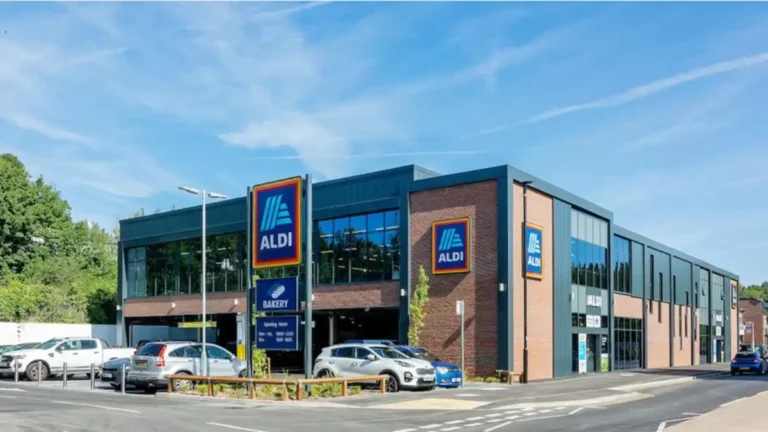

Aldi is preparing its biggest annual UK investment programme to date, committing £900 million to new stores and distribution infrastructure in 2027 as it pushes ahead with expansion across the country.
The discounter plans to open around 40 new supermarkets next year, while continuing to invest in its logistics network and existing estate.
The programme follows another year of sales growth for Aldi UK and Ireland, with turnover reaching a record £19 billion in 2025.
The retailer is also tightening its focus on longer-term supplier relationships as food inflation, production costs and supply-chain disruption continue to shape the grocery market.
Aldi said it wants at least half of the products it sells to be covered by long-term supplier agreements by 2027.
That target could be significant for food producers and manufacturers seeking greater certainty over volumes, pricing discussions and future capacity investment.
The company spent around £14 billion with British suppliers in 2025 and has positioned longer contracts as a way to give producers more confidence to invest in farms, factories and production infrastructure.
The approach adds a supply-chain dimension to what would otherwise be a straightforward store expansion story.
Aldi currently operates more than 1,090 UK stores and has a long-term ambition to reach 1,500 locations.
Before the end of this year, it plans to open around 30 additional stores, including locations in London, Newport, Dumbarton and Willesden.
The 2027 programme represents a substantial increase on earlier expansion commitments. In January, Aldi outlined a £370 million plan linked to new UK openings and store development. GTN previously covered Aldi’s £370 million UK expansion programme as the retailer accelerated its store pipeline.
Distribution capacity is becoming equally important.
Aldi has continued to invest in large-scale logistics infrastructure to support the growing estate, including its major Bardon operation and other regional distribution facilities. GTN has also reported on Aldi’s expansion of its UK warehouse network.
The latest investment comes as competition between the major UK grocery groups remains intense.
Aldi has built its position around a limited-assortment model, heavy private-label penetration and aggressive pricing, but growth increasingly depends on how quickly the business can add stores in areas where its coverage remains weaker.
At the same time, the retailer is competing for supply with Tesco, Sainsbury’s, Asda, Lidl and other chains that are also seeking greater resilience across food manufacturing, fresh produce and distribution.
That makes the supplier-contract target particularly important.
Longer agreements can give producers better visibility over future demand, but they can also deepen the relationship between retailer and supplier by linking investment decisions more closely to expected supermarket volumes.
For Aldi, that could support faster expansion without placing the same pressure on suppliers to respond to growth through short-term production increases.
The company has also continued to invest in price reductions during 2026 as it seeks to maintain its value position.
Operating profit for 2025 was broadly flat at £432.9 million despite higher sales, reflecting continued spending on prices, wages and infrastructure.
That underlines the trade-off facing the business: expansion requires substantial capital at the same time as Aldi remains under pressure to protect its low-price positioning.
The 2027 investment plan suggests the retailer is prepared to keep prioritising scale.
With 40 more stores planned, further distribution spending and a growing emphasis on longer supplier contracts, Aldi’s next phase of UK growth is becoming as much about supply-chain capacity as physical store numbers.
Editor note: Based on Aldi UK’s 28 September 2026 corporate announcement and independently reported company results. GTN added analysis of the implications for supplier contracts, distribution capacity and UK grocery competition.