
Buying fresh produce from Armenia requires a more precise brief than “Armenian fruit and vegetables”. A seasonal orchard programme, a greenhouse tomato contract and a strawberry order have different harvest windows, packing requirements and delivery risks. The supplier’s role also matters: growing, collecting, grading and transporting produce are separate capabilities, even when one group offers several of them.
Spayka and Green Food illustrate two distinct sourcing routes. Spayka documents a broad fruit-and-vegetable business with production and logistics activities. Green Food describes a specialist greenhouse strawberry operation. Both are relevant starting points for commercial enquiries, but neither should receive an order solely on the strength of a company profile.
This guide examines the evidence available for those suppliers and the questions supermarket buyers should resolve before a trial shipment. It complements our coverage of Armenia’s supermarket chains, which addresses retail channels rather than farm and packhouse qualification.
Armenian fresh produce suppliers: the practical comparison
| Supplier | Documented focus | Scale evidence | First procurement question |
|---|---|---|---|
| Spayka / Araratfruit | Fruit and vegetables, greenhouse production, orchards and logistics | Company website describes 105 hectares of greenhouses across two locations; undated operating profile | Which crop, farm, packhouse and weekly allocation will fulfil the order? |
| Green Food | Greenhouse strawberries | Company describes 3 hectares commissioned in 2018 and another 6 hectares in 2019 | Which varieties, harvest weeks and retail pack formats are available now? |
These are selected, documented businesses rather than a complete census or a revenue ranking. The area figures describe company-reported facilities and historical development. They do not establish current saleable output, free capacity or the volume available to a new customer.
Spayka: a broad sourcing and logistics route
Spayka says it began exporting and trading fresh fruit and vegetables in 2007. Its company profile dates the launch of the Araratfruit trademark to 2009. Its activities extend beyond selling produce: the business describes sorting and packing equipment, refrigerated storage, greenhouse growing, orchards and a transport fleet.
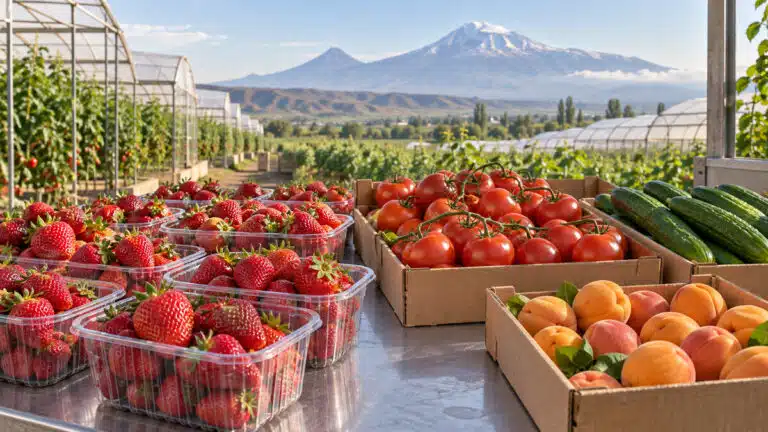
The greenhouse page identifies approximately 55 hectares in the Ararat area and 50 hectares near Yerevan, giving a stated total of 105 hectares. Tomatoes and cucumbers are among the crops described. The page does not provide a clear reporting date for these figures, so they should be treated as the company’s published description rather than a newly audited 2026 capacity statement.
Its orchard page lists apricots, peaches, apples, plums, cherries and pears. The wider seasonal catalogue includes additional vegetables and fruit. That catalogue is useful for an initial enquiry, but a listed product is not proof of continuous availability or of production on a company-owned farm.
Where it fits: buyers seeking several crops, consolidated packing and a coordinated transport discussion have a reason to investigate Spayka. A multi-product programme still needs separate specifications and availability commitments for each line. Combining products commercially does not make their handling requirements identical.
How to interpret Spayka’s scale claims
The company’s website includes a 70% claim relating to Armenian fresh-produce exports. It does not give a sufficiently clear measurement period and independent methodology to use that percentage as a current market-share ranking here. Export share would also be different from a share of Armenian supermarket sales.
There are inconsistencies in the orchard-area figures across the company’s pages. For that reason, this guide does not select one figure and present it as an established current total. Ask for a site list and crop plan if orchard ownership or area is relevant to a supply decision.
Similarly, historical references to jobs created by individual projects should not be added together and labelled today’s workforce. A useful procurement request separates permanent employees, seasonal labour and third-party labour at the farm and packhouse that will handle the order.
Questions for a Spayka enquiry
Identify whether the quotation covers own-grown produce, produce from contracted growers or traded supply. Ask how those sources are distinguished in the traceability system and whether substitutions require approval. A buyer may accept several growing sites, but the sites should be known before delivery rather than reconstructed after a quality complaint.
For a tomato programme, request varieties, size bands, intended harvest stage, packing options and a weekly supply forecast. For orchard fruit, add maturity criteria, expected grading yield and the process for agreeing changes when the crop differs from the pre-season estimate.
Finally, clarify the transport contract. A supplier may arrange carriage without accepting every risk at destination. The quotation should identify the delivery term, receiving location, temperature-record responsibilities and claim procedure. These are commercial details to negotiate, not assumptions to make from a photograph of refrigerated trucks.
Green Food: a specialist strawberry enquiry
Green Food’s own website describes a strawberry greenhouse project at the foot of Mount Aragats, at an elevation of approximately 1,700 metres. It says a 3-hectare greenhouse began operating in 2018 and a further 6 hectares followed in 2019. The business gives an address in Artik, Shirak.
The company identifies French greenhouse supplier Richel in its development story and describes sales under the Green Food brand in Armenia and several export markets. These statements establish the business’s stated specialism and history; they do not establish a guaranteed weekly export allocation for a new supermarket customer.
Where it fits: Green Food is a focused enquiry for buyers building a strawberry programme rather than seeking a general fruit-and-vegetable wholesaler. That narrower scope makes the variety, punnet specification and delivery window especially important.
The public website does not provide a reliable current revenue figure or exact employee total. Those gaps should remain gaps. The greenhouse history offers more useful context than an invented financial estimate, while direct discussions can establish current operational capacity.
A dated document is more useful than a certification logo
Green Food publishes a declaration of conformity for fresh strawberries, registered on 5 November 2025 and stating validity through 4 November 2026. The document identifies the producer and Artik address and refers to the applicable Eurasian Economic Union food-safety and labelling technical regulations.
This is not a GLOBALG.A.P. certificate. Although the company’s website also mentions GLOBALG.A.P., buyers should request the current certificate and check its producer identity, products, sites, scope and validity separately. One document cannot be substituted for the other.
For a programme extending beyond early November 2026, request the replacement documentation before the existing declaration expires. Build that date into supplier approval records so the issue is resolved before a shipment is due. A document that is valid at the first meeting may not cover the entire contract period.
Questions for a Green Food enquiry
Ask which strawberry varieties are available during the proposed delivery weeks and obtain samples from the intended production programme. A sample from a different variety or growing period may be commercially attractive but cannot settle the specification for later deliveries.
Specify the retail unit weight, allowable weight variation, fruit size presentation, label layout and case configuration. Confirm who sources the punnets, who applies the retailer’s label and how late an artwork change can be accepted. These choices affect the lead time before the first order.
For export enquiries, discuss the route and transit plan before finalising harvest and dispatch arrangements. Ask for the supplier’s proposed handling conditions and evidence that the planned route can preserve the agreed quality through the receiving date. Avoid treating a claimed export destination as proof that every delivery model to that market is already established.
Build the programme around saleable arrivals
The most useful comparison is the cost of produce that meets specification when received. A low farm-gate price can become expensive if grading losses, packing, transport or rejected arrivals sit outside the headline quotation.
Define the unit of comparison. Is the price per kilogram harvested, per kilogram packed, per case dispatched or per accepted retail unit? Record packaging and delivery charges in the same worksheet. If two suppliers use different case weights, normalise them before discussing which offer is cheaper.
Agree a crop calendar at the level of variety and supply week. Do not copy a national season chart into a purchase contract. Greenhouse production, orchard location, weather and storage arrangements can produce different availability patterns within the same country.
| Programme element | Evidence to request | Decision it supports |
|---|---|---|
| Crop availability | Variety, growing site and weekly forecast | Whether the supplier can support the listing period |
| Quality | Written specification, representative samples and inspection method | What qualifies as an acceptable delivery |
| Packing | Retail pack, case and pallet details | Whether the shipment fits receiving and replenishment |
| Assurance | Current documents for the named producer and sites | Whether approval covers the proposed supply |
| Logistics | Route, handovers, handling plan and records | Who controls the product at each stage |
| Commercial terms | Price basis, delivery term, claims and substitution rules | Which costs and responsibilities each party accepts |
Make the first shipment a measured trial
A trial should answer a defined question: can the supplier deliver the agreed product through the intended route and receiving process? Use the same specification, packaging and documentation planned for routine orders. A specially prepared sample box is useful for tasting but does not test the commercial operation.
Record dispatch details, arrival condition, pack weights and defects against an agreed inspection method. Where temperature monitoring is part of the programme, agree the equipment, placement and interpretation beforehand. A record that neither party knows how to evaluate rarely resolves a disagreement.
Set a deadline for claims and identify the information that must accompany them. Photographs, lot numbers, quantities and inspection findings should refer to the same delivery. Separate a cosmetic grading issue from a shortage or a food-safety concern so the response is proportionate and the records remain useful.
After the trial, agree changes in writing. If the buyer accepts a different size band for a promotional line, that concession should not silently become the standard for every future delivery. Likewise, a one-off alternative variety should have a clear approval trail.
Keep backup supply and growth claims realistic
Ask what happens when the expected crop falls short. A supplier may offer an alternative growing site, another variety or a later delivery. Decide in advance which changes are acceptable and which require the buyer’s approval. An emergency substitution is easier to evaluate when the basic rules are already documented.
Do not interpret farm area as a promise of expansion for your account. Harvested volume, grading yield, existing commitments and packing availability all affect what can be sold. Ask for an allocation in the relevant unit and week, with a process for updating forecasts as the harvest approaches.
Packaging and logistics also connect fresh produce to the broader Armenian grocery supply chain. A successful listing depends on coordinated replenishment, not simply on finding an attractive product at origin.
Editorial note: This guide uses company information and the dated Green Food declaration reviewed in September 2026. Undated capacity statements are identified, conflicting orchard totals are excluded, and historical certification references are not treated as proof of current certification. The shortlist is selective and is not an audited ranking by market share, revenue or workforce.