
UPM Specialty Materials has launched an 80gsm grease-resistant paper for food-label applications, extending barrier technology previously used in its packaging range.
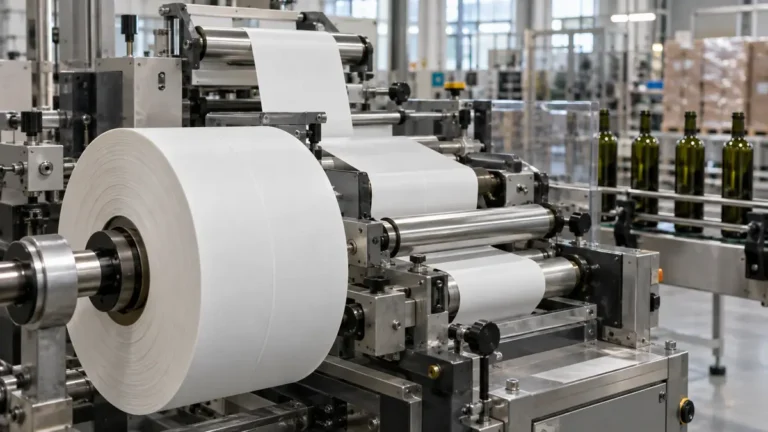
The company announced UPM Asendo 80 on 15 September 2026. It is designed for grease-sensitive uses such as labels on olive-oil bottles and is produced without intentionally added per- and polyfluoroalkyl substances.
The timing is commercially relevant for European grocery suppliers. From 12 August 2026, the EU Packaging and Packaging Waste Regulation restricts food-contact packaging containing PFAS at or above specified limits.
UPM said it does not add PFAS to its papers at any stage of production. The company also said each grade is tested by independent laboratories and that supporting documentation is available for converters and their customers.
For supermarket buyers, that documentation matters more than a general PFAS-free claim. Procurement teams need evidence covering the finished label construction, including the face paper, adhesive, inks, varnishes and any other coatings, because compliance cannot be established from the paper substrate alone.
UPM Asendo 80 is compatible with several adhesive types and is intended for UV flexographic and UV inkjet printing. UPM said the grade meets US Food and Drug Administration and German Federal Institute for Risk Assessment requirements for food-contact applications, and can be supplied with FSC or PEFC certification.
The 80gsm basis weight is commonly used in labels, which may make trials easier for converters already working with comparable paper specifications. However, a matching basis weight does not guarantee equivalent performance on an existing line.
Suppliers should test print quality, die cutting, dispensing speed, adhesive anchorage and resistance to oil migration under the conditions expected in stores and distribution. For chilled or refrigerated products, condensation and label adhesion would require separate validation.
That testing is particularly important for olive oil and other fatty products, where staining can affect barcode readability, regulatory information and shelf presentation. A paper that performs well on the bottle at filling may behave differently after transport, handling or prolonged retail display.
UPM appears in GTN’s review of packaging companies in Finland. The new grade gives the company a more specialised offer for converters serving food and beverage brands rather than replacing its wider packaging-paper portfolio.
The launch also sits alongside broader work on fibre-based and mono-material food packaging. Labels are a smaller component than the main pack, but incompatible materials, adhesives or coatings can still affect sorting and recycling outcomes.
UPM has not disclosed the price, minimum order volume, available widths or commercial lead times for Asendo 80. It has also not published comparative data showing how the grade performs against conventional grease-resistant label papers in specific grocery applications.
Those omissions leave buyers and converters with practical questions to resolve during sampling. They should request migration and food-contact documentation, PFAS test methods and detection limits, print-trial results and evidence that the complete label works with the intended container and recycling route.
UPM is offering technical guidance and samples for application testing. The next indication of the grade’s commercial relevance will come from converter trials and named food or beverage applications using Asendo 80 at production scale.