
Marks & Spencer reported a 13.9% increase in food sales to £5.16 billion for the 26 weeks ended 26 September 2026, as more families used its stores for their regular grocery shopping.
The UK retailer announced the figures on Wednesday, 4 November. Like-for-like food sales rose 11.7%, while food volumes increased 11.9%, showing that growth was not driven by prices alone. Adjusted operating profit in the food division reached £288.6 million, compared with £89.1 million in the same period last year.
Its adjusted food operating margin rose to 5.6% from 2.0%. The comparison follows a difficult previous year affected by the retailer’s cyber incident, so the size of the rebound should be read alongside the recovery in operations.
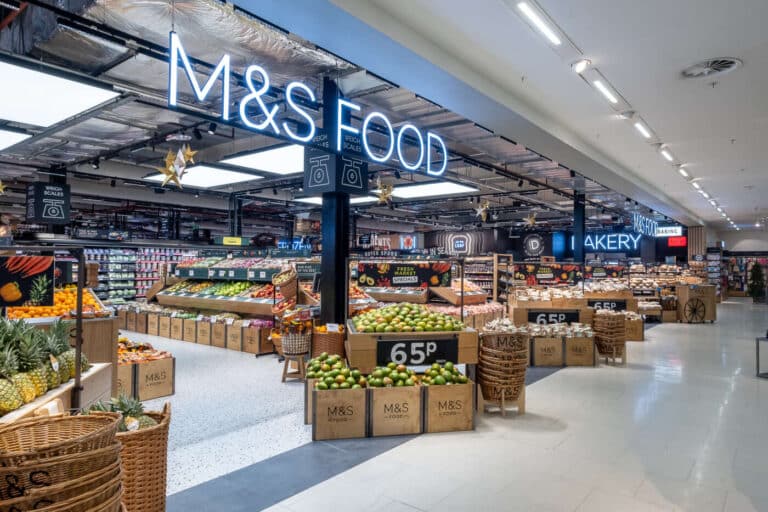
M&S said approximately 1.5 million more customers are shopping with the group. Its strategy has shifted towards larger Foodhalls, everyday value products and broader grocery ranges that allow families to complete more of a weekly shop in one visit.
The results show an intensifying contest for shopping baskets among the UK’s leading supermarket chains. Rather than competing only on special meals and premium ranges, M&S is strengthening its everyday grocery offer in categories such as frozen food, bakery and household essentials.
During the first half, M&S opened, renewed or expanded food space in 17 stores. The company said larger locations converted from former Homebase units have performed especially strongly. One example of its new format is the large Foodhall in Godalming, designed around a wider family grocery shop.
The retailer invested more than £50 million on an annualised basis in food value during the period. This includes efforts to make everyday lines more competitive while retaining a focus on quality and innovation.
The stronger food performance was not limited to physical stores. M&S Food sales through Ocado Retail increased 22.8%, and M&S products now account for 30.9% of the average Ocado basket. That highlights the role of online distribution in the brand’s attempt to win a bigger share of regular grocery spending.
Supply chain investment is central to the expansion. M&S said its new Avonmouth distribution centre is expected to support volumes through the Christmas peak. Combined with its Daventry development, the projects are intended to add more than 30% capacity and lower the cost of handling each case.
For food manufacturers, the move towards more full-range stores could mean larger and more consistent orders across grocery, chilled, fresh and private-label lines. Suppliers will also face tighter expectations on stock availability, distribution efficiency and value as M&S scales the business.
The broader group reported sales of £9.26 billion, up 16.2%, and adjusted profit before tax of £403.2 million, compared with £184.1 million the previous year. The group said its £750 million investment programme across stores, technology and supply chain remains on track.
Chief executive Stuart Machin said the food business was attracting more family shoppers and had delivered double-digit volume growth in a broadly flat market. He said investment in stores, technology and distribution was helping support the next stage of expansion.
M&S expects food margins for the full year to be above the level recorded in 2024/25. Its longer-term objective remains to double the size of the food business, although success will depend on keeping prices attractive while improving distribution and controlling costs.
Editor’s Note: Volume growth and new distribution capacity make this result significant for UK grocery suppliers. The sharp profit rebound also reflects recovery from last year’s disruption, so the comparison needs context. Source: M&S interim results, 4 November 2026.